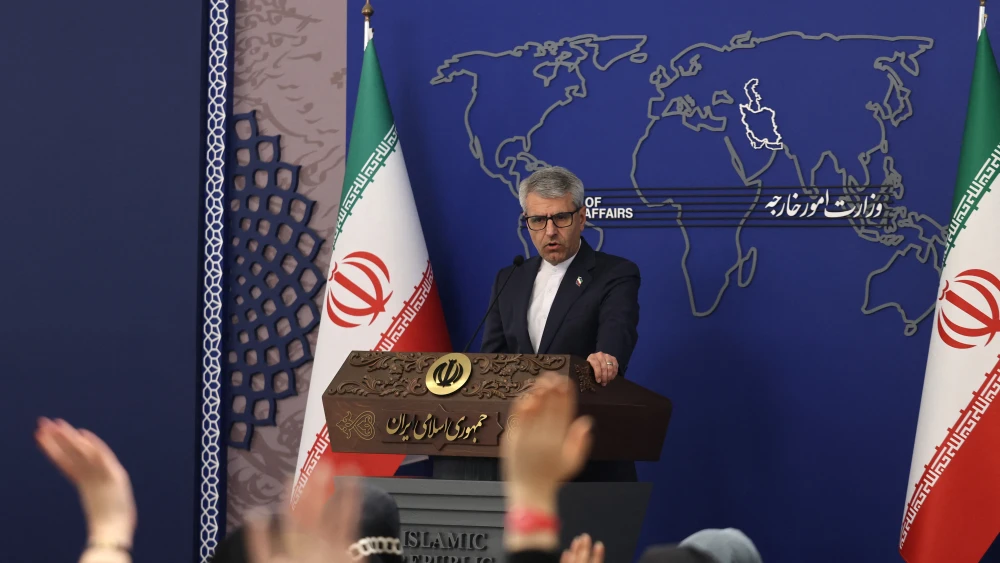
Iranian Foreign Ministry spokesman Esmaeil Baghaei said on Monday that Tehran had no plans to take part in a second round of talks with the United States.
Speaking with reporters in Tehran, the spokesman accused Washington of violating the ceasefire by imposing a naval blockade and committing “aggressive acts” against Iran.
He reiterated that the Islamic Republic would not negotiate about its missiles, calling the issue non-negotiable. “We did not start this war, and all our actions have been in legitimate self-defense to protect our sovereignty,” Baghaei said of Tehran’s ballistic missile attacks that targeted Israel and numerous regional countries.
U.S. negotiators will be going to talk with Tehran despite the IRGC Navy’s violations of the ceasefire, President Donald Trump said on Sunday, while threatening to target Iranian civilian infrastructure if talks fail.
“I hope they take it,” Trump wrote on Sunday on Truth Social, referencing the U.S. offer for a deal, which he said was “very fair and reasonable.” If the Iranian regime does not take the deal, “the United States is going to knock out every single power plant, and every single bridge, in Iran,” the president wrote.
“Iran decided to fire bullets yesterday in the Strait of Hormuz—a total violation of our ceasefire agreement! Many of them were aimed at a French ship, and a freighter from the United Kingdom. That wasn’t nice, was it?” Trump wrote in the beginning of his post.
“My representatives are going to Islamabad, Pakistan—they will be there tomorrow evening, for negotiations,” he wrote. He suggested the Iranian decision to close the strait was inconsequential since the U.S. is imposing its own blockade, meant to prevent the Islamic Republic from receiving vital goods and products.
Iran’s government said on Saturday that it had reimposed “strict control” over the Strait of Hormuz as gunboats of the Islamic Revolutionary Guard Corps fired on three commercial vessels, according to maritime security reports. This ended a brief period of calm in the maritime route following the declaration on April 8 of a two-weak ceasefire in the hostilities between Tehran and Washington.
Traffic through the strait, a bottleneck along a major shipping route, is a key element of the ceasefire and any future deal.
There is no officially published exact hour for the truce’s expiry. In practice, analysts treat it as expiring at end of day April 22 local time, roughly late afternoon/early evening Eastern Time.