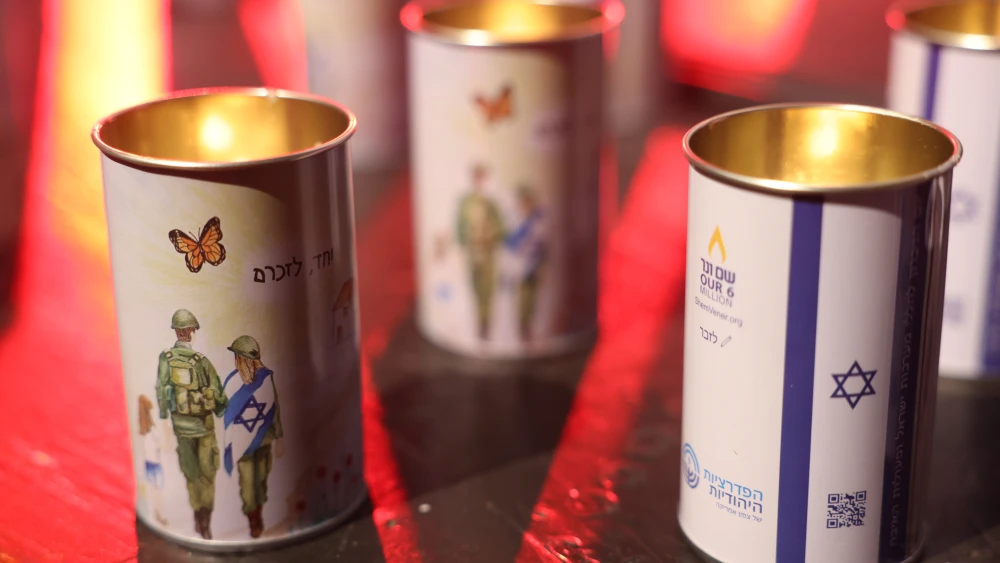

Yom Hazikaron is not just a date on the calendar. It is the most sacred, most painful and most defining day of the year for Israelis.
Living in America has not changed that. If anything, it has made it more complicated.
I grew up in Israel, where Yom Hazikaron is not a ceremony you attend but something that surrounds you. The country comes to a halt. The siren sounds. Cars stop in the middle of the highway. People stand in silence. Grief is not private. It is shared.
When I first moved to the United States, I struggled to find that same sense of grounding. I would go to community memorial ceremonies searching for a way to feel connected, to mark the moment in a meaningful way. Without those spaces, the day felt untethered, almost as if it could pass unnoticed by the world around me.
As a child, Yom Hazikaron was something I learned about in school. As I grew older, it became something I lived. At first, it was stories. Then it became names. A neighbor, a classmate, a friend. When I was 18, during my own army service, my friend was killed.
Today, it is our friends who have tragically lost children. It is constant and personal. This is what it means to be Israeli. Everyone knows someone; the loss is never abstract.
And now, I experience this day not only as an Israeli but as the mother of two lone soldiers. I raised them in the United States as Zionists. My older daughter enlisted first, and I supported her without hesitation. When my younger daughter insisted on enlisting after the Hamas-led terrorist attacks in southern Israel on Oct. 7, 2023, it was different. As an Israeli and a Zionist, I understood. But as her mother, I was afraid.
She told me that now, more than ever, this was her time to give back and her time to stand with her people. Her time to turn everything she had been raised to believe into action.
Through them, Yom Hazikaron has taken on a deeper meaning. The first time my daughter attended a military funeral, she was the same age I was when I lost my friend. Now she carries that same weight, made heavier after Oct. 7, when five of her relatives were murdered and a friend was taken hostage. And I am not there to stand beside her. There is a quiet heartbreak in that distance.
Since 1948, Israeli parents have told themselves that by the time their children turn 18, there will be peace. That they will not have to send them into war. And yet, here we are again, watching our children lose friends. And not seeing the end.
One of the most powerful moments of my life was standing at my daughter’s officer ceremony. When “Hatikvah” (“The Hope”) was played, she saluted—a gesture reserved for officers. I stood there remembering my own uniform and my own ceremonies, realizing that this story was now continuing through her.
There is a quiet heartbreak in that distance. I hold onto the fact that she is not alone, that she is surrounded by a community that has become her family, and that she is about to move into a new home in Tel Aviv through the Lone Soldier Center in Memory of Michael Levin, where she will live alongside 25 others like her.
Today, both of my daughters stand in uniform at military cemeteries. They stand at attention. There are no words for what that feels like as a mother.
From America, Yom Hazikaron feels disorienting. The first siren sounds in Israel while it is still nighttime here, and the second comes in the morning. The hours do not align. The world around you continues as normal, while internally everything stands still.
And yet, emotionally, you are there. You sit in front of the television. You follow the ceremonies and cry your heart out. You reach out to others who understand.
In recent years, I have found another layer of meaning through a group I now help lead, a network of parents of lone soldiers. Many of us live outside of Israel while our children serve. We carry the same fears, the same pride, the same distance. We hold each other up.
Some of us have already experienced unimaginable loss, including in our own families. The weight is collective. Living abroad has made something else clear to me. What happens in Israel does not stay in Israel. When Israel struggles, we feel it here. When Israel is divided, the impact reaches us. And when Israel mourns, that mourning belongs to the entire Jewish people.
Yom Hazikaron is not only a day of remembrance. It is a reminder of our shared responsibility. The soldiers we honor did not only defend a country; they defended a people. And that calls on us—wherever we live—to respond. Without those who were willing to stand in harm’s way, we would not have the privilege of standing at all.
We owe it to the ones who sacrifice their lives to always be united, strong, and full of hope and solidarity.
On Yom Hazikaron, I am a mother. I am an Israeli. I am a Jew living in America. And I am reminded that these are not separate identities. They are bound together by memory, sacrifice and an unbreakable responsibility to one another.
Am Yisrael Chai!