
The mother of Israeli hostage Yonatan Samerano wants to show the judges of the International Court of Justice, in person, the video of a worker from the U.N. Relief and Works Agency for Palestine Refugees (UNRWA) kidnapping her son’s body to Gaza during Hamas’s Oct. 7 massacre.
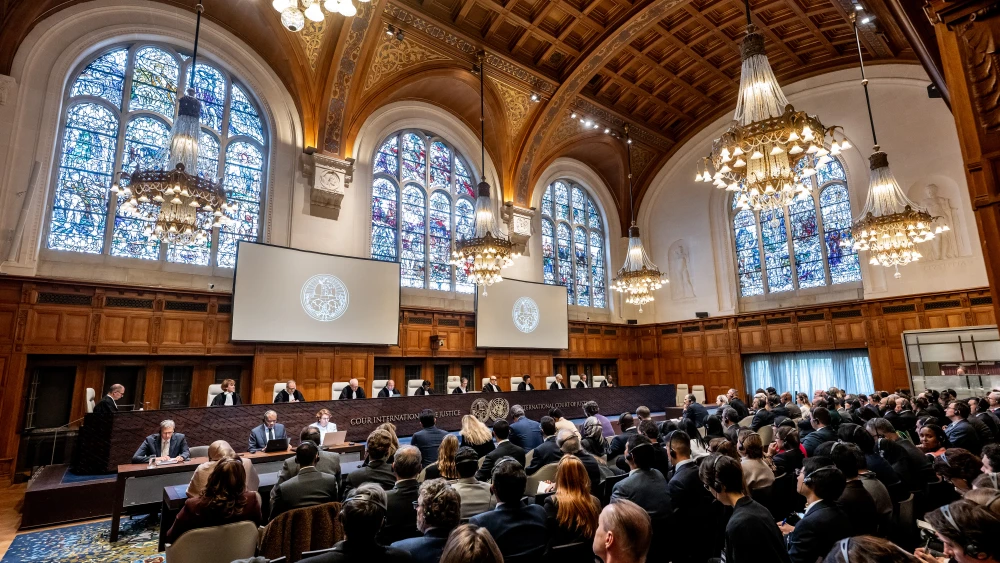
This horror, however, would not likely influence the ICJ. Late last month, the ICJ issued a blatantly politicized advisory opinion that unfairly bashes Israel and seeks to force the Jewish state to work with UNRWA in Gaza, while neglecting the U.N. agency’s established complicity in Hamas’s terrorist enterprise.
Not only is the ICJ functioning as a criminal accomplice of Hamas, but so are the media that reported the ICJ action uncritically. It’s all part of a concerted effort to support the resurrection of Hamas and discredit Israel’s efforts to protect its citizens.
The ICJ and mainstream media regurgitated disproven accusations Hamas has used to smear and vilify Israel for the last two years. These accusations contributed to skyrocketing antisemitism worldwide and damaged Israel’s (and Israelis’) standing globally.
Fortunately, the ICJ has no power to make Israel do anything, much less force it to cooperate with an organization seeking its destruction. The ICJ is not a proper court of law, but rather a “partisan political tool,” as the U.S. State Department has described it.
Most egregiously, the ICJ ignored stark evidence of UNRWA’s inseparable connection to Hamas, which contradicts the United Nations’ lofty moral and legal principles, which the ICJ is supposedly chartered to uphold.
In short, the ICJ’s advisory opinion is a travesty of international justice that gives aid and comfort to irredeemable terrorists, and gives Israel and its allies every reason to ignore it.
The ICJ’s opinion ignored irrefutable evidence of UNRWA’s collaboration with Hamas. The court denied, for instance, that Israel had “substantiated its allegations that a significant part of UNRWA employees ‘are members of Hamas ... or other terrorist factions.’ ” In fact, Israel issued detailed documentation last April substantiating that approximately12% of UNRWA employees were members of Hamas or other terrorist groups. Even back in 2004, then UNRWA commissioner general Peter Hansen admitted that Hamas members were likely on the organization’s payroll, but cavalierly said, “I don’t see that’s a crime.”
The ICJ also claimed there was no evidence of UNRWA’s lack of impartiality as required by Article 59 of the Fourth Geneva Convention. Yet UN Watch documented UNRWA teachers in a 3,000-member chat group celebrating Oct. 7 on social media. In addition, Hamas terror chiefs such as Suhail al-Hindi and Fathi Sharif led UNRWA’s unions.
Hamas’s regular use of UNRWA facilities as staging areas for rocket attacks, as well as underground operational headquarters and computer banks, has also been publicly documented.
Bottom line: Evidence against UNRWA was profuse, but the ICJ chose to ignore it.
ICJ also regurgitated Hamas-inspired, obviously false accusations against Israel. It called on Israel to “respect the prohibition on the use of starvation of civilians as a method of warfare,” implying that Israel was intentionally starving Gazans, despite Israel’s facilitation of millions of tons of food aid. It also accused Israel of “massive forcible transfer and displacement of the local population” because Israel warned Gazans to evacuate in the face of impending attacks on Hamas terrorists in their midst.
Furthermore, the ICJ insists that Israel must cooperate with tainted UNRWA, calling the agency “an indispensable provider of humanitarian relief in the Gaza Strip.” This blithely ignores dozens of other aid groups working there, in favor of the only one proven to be controlled by terrorists.
The media parroted the ICJ’s baseless claims without any critical pushback. Several media, including The Guardian, CNN and Reuters, repeated ICJ’s outrageous claim of insufficient evidence tying UNRWA to Hamas but refuse to reference any research proving that UNRWA and Hamas are indistinguishable. Obviously, criticizing ICJ allegations would undermine the pro-Hamas narrative adopted by much of mainstream media, which paints Israel as the ruthless aggressor and Hamas as defenders of oppressed victims.
The ICJ is not a court of law, nor does it have jurisdiction over Israel. The ICJ is the principal judicial organ of the United Nations, designed to settle legal disputes between states and give advisory opinions on legal questions referred by the world body. Its rulings interpret international law, treaties and the U.N. Charter.
But the ICJ is anything but just. Its judges are neither independent nor impartial. They are elected by U.N. member states in the General Assembly and Security Council, which are dominated by countries hostile to Israel (and often the United States). No wonder ICJ judges vote based on political alliances rather than legal reasoning. For example, in a 2004 advisory opinion on Israel’s anti-terrorist security barrier, judges from Muslim-majority and developing countries voted in favor of an advisory opinion that Israel’s barrier violated international law. The vote was 14-1, with the lone dissenting opinion coming from the U.S. judge.
Furthermore, the ICJ has no enforcement mechanism. It can’t force Israel or any other country to do anything. In addition, countries must formally consent to abide by ICJ rulings, but the United States and Israel have long refused this consent. In fact, due to the biased, politicized nature of the ICJ, Israel simply boycotted the court’s recent proceedings.
ICJ’s opinion on UNRWA mocks the United Nations’ own principles. The U.N. Charter requires the United Nations and its affiliates to support and promote the goals of “friendly relations among nations” and strengthen “universal peace.” UNRWA violates these goals blatantly by collaborating in Hamas’s terrorist enterprise and functioning as the group’s subsidiary. Even if Israel assented to ICJ authority, which it doesn’t, it can refuse because UNRWA’s activities violate the charter.
The ICJ opinion is a miscarriage of justice. This so-called court has, in the words of the watchdog NGO UN Watch, “turned a blind eye to the truth and made a mockery of its own mandate.”
By overlooking evidence that UNRWA operates as a subsidiary of Hamas, the ICJ proved it is not a court, but rather the agent of a terrorist group. For this reason, the best thing that Israel, its allies and advocates of true justice can do is ignore it.
Originally published by Facts and Logic About the Middle East (FLAME).