
More than a month after Israel and Hamas agreed to a ceasefire in Gaza, many questions remain about how long-term peace can be secured in the region. Some hostage families have yet to receive the remains of their loved ones, violating the initial phase of the ceasefire agreement.
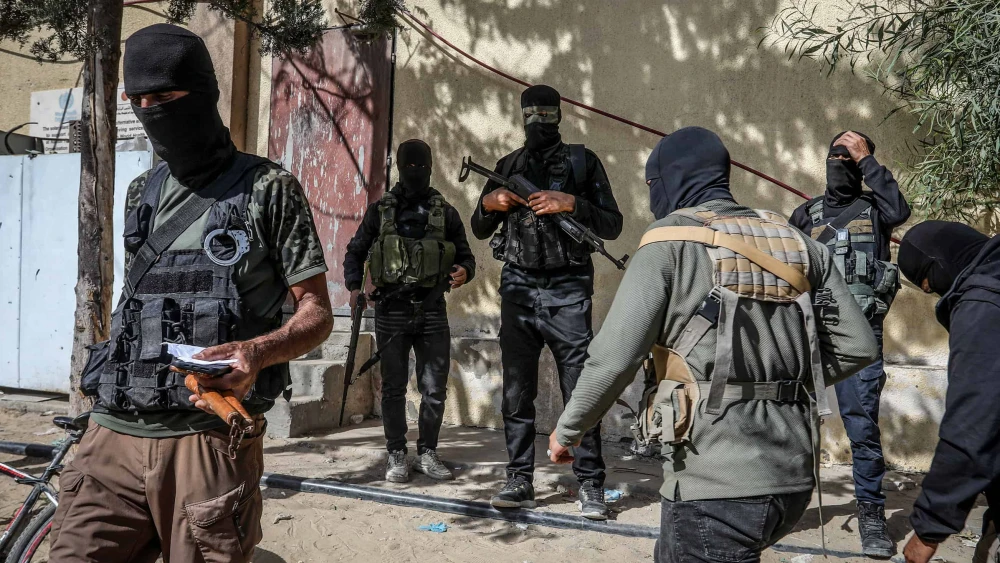
At the same time, the terrorists insist that they will not disarm, even using their weapons to eliminate rivals in a series of ghastly public executions. There is every chance that Hamas could reassert its control of the enclave in the most ruthless fashion.
For Israel to translate its many tactical victories into an overarching strategic success, and for the West to avoid another war, it is essential to put into operation three core principles to achieve peace in Gaza: disarmament, deradicalization and democratic legitimacy.
First and foremost, Hamas must be disarmed. This will involve the destruction of the tunnels under international supervision by a means that will prevent tunnels from being rebuilt, the decommissioning of the terrorists’ rocket arsenal and a constant screening of dual-use items.
To achieve these measures, the 20-point plan envisages that a new technocratic committee will be formed to replace Hamas’s governing capability, aided by the International Stabilization Force (ISF) to deal with internal security.
Already, King Abdullah II of Jordan has decried the notion that his forces should be “running around Gaza on patrol with weapons,” preferring a less confrontational model of peacekeeping. Yet without such force, Hamas will remain an armed menace in the background, capable of challenging any new government. The Board of Peace must have teeth to succeed.
The second principle is deradicalization. Hamas is not just a fighting force with residual military capacity. It has laid down institutional roots throughout Palestinian society in Gaza, including in schools, hospitals, mosques, the media and various branches of civil administration. In the long term, the Board of Peace must ensure that these institutions are free from Islamist influence.
Hamas administrators in schools and hospitals must be sacked, and preachers who incite hatred in mosques must be similarly removed. Moreover, it is especially important to deradicalize the next generation of young Palestinians by replacing the hate-filled school curriculum imposed by Hamas in favor of one that welcomes coexistence, religious pluralism and secular values.
One model for Gaza would be the educational curriculum of the United Arab Emirates. According to a report from IMPACT-se, the Emirati curriculum teaches that “prosperity and national pride are closely associated with peace and tolerance.” Textbooks offer a “realistic approach to peace and security” by teaching patriotism, anti-radicalism and cooperation with allies.
The Islamic education program emphasizes “tolerance, coexistence and friendly relations with all non-Muslims and ethnicities,” as well as “women’s participation in all walks of life.” Positive relations with the West are viewed as friendly and positive, and the Abraham Accords are emphasized. There is no evidence of antisemitism or incitement in these materials. Taken together, these are crucial principles for changing mindsets in the long term.
The third principle is democratic legitimacy. The Palestinian Authority right now is an endemically corrupt, highly authoritarian body that redirects international aid to greedy ministers and officials. With good reason, the Emirati foreign minister, Sheikh Abdullah bin Zayed, has likened the P.A. to Ali Baba and the 40 Thieves.
The most representative symbol of such domestic authoritarianism is Mahmoud Abbas himself, a president who is now serving his 21st year of a four-year term. Under his rule, dissidents have been arrested, tortured and killed, among them Nizar Banat, an outspoken critic of the P.A., who was dragged to his death in 2021 by regime thugs. Without substantial reform and democratic accountability, the P.A. risks a repeat of 2006 when it was usurped by Hamas.
The three-Ds plan is the only sure path to avoiding a new phase of confrontation in Gaza and providing long-term security for Israelis and Palestinians. Without it, Gaza risks anarchy and a new and even bloodier phase of the war.