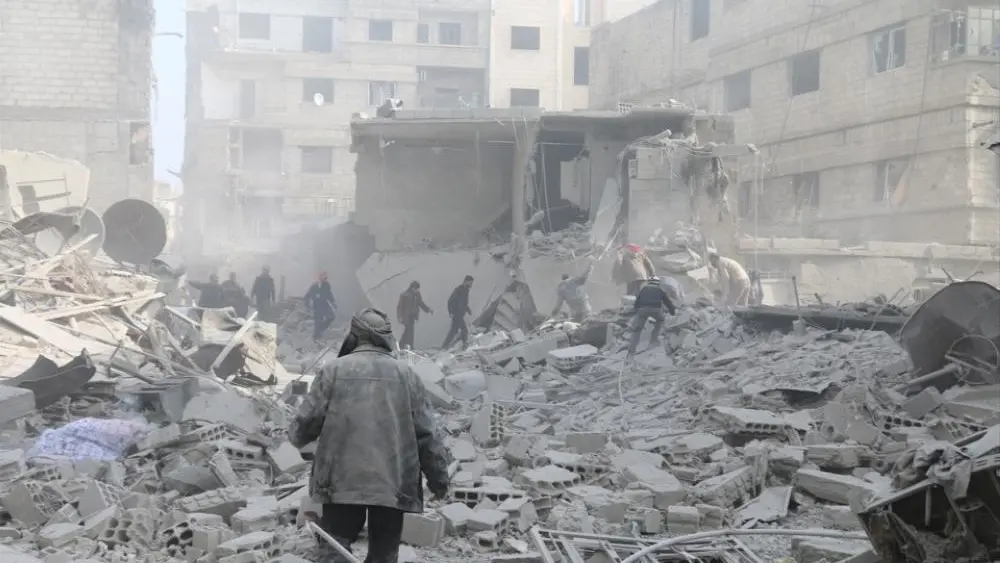
Israel is getting an earful from Russia after allegedly bombing a joint Russian-Iranian base in the Homs province of Syria early on Monday. Iran has publicized that four of its officers were killed, and Syrian President Bashar Assad, quiet as usual, is likely fuming that his expensive Russian air-defense equipment once again failed to defend his allies from Israeli bombs.
After the last major conflagration, where Syria downed an Israeli fighter jet as part of a mission to target Iranian installations on Feb. 10, Syria made it clear that it would use anti-air attack missiles that could fly into Israeli territory. In the most recent incident, because Israeli allegedly flew over Lebanese airspace, that vague threat was embarrassingly irrelevant. The whole world knows that Assad can only bomb his own people.
Someone started the rumor on Twitter that Israel gave Russia advanced notice an hour before hitting the base, and so Russians were able to quietly escape leaving their Iranian counterparts wide open to a known Israeli attack.
Such rumors could be part of a psychological operation aimed at driving a wedge between Russia and Iran. Indeed, last April, after Israel hit near the Damascus airport, a report came out in the Daily Beast that Israel had almost certainly received the green light from Russia to hit inside Syria.
This week, Russia was forced to not only deny helping Israel, but to hit back with harsh words about the Israeli policy towards the Palestinians. Russia condemns Israel’s use of indiscriminate fire in Gaza. Yet a few weeks ago, Russia was heartened by Israel’s low-key reaction to the poisoning of Sergei and Yulia Skripal in the United Kingdom.
In addition to agitating Russia, Israeli Defense Minister Avigdor Lieberman sent a message to U.S. President Donald Trump, saying on Sunday that the administration did not consult with Israel before Trump’s declaration of intent to remove U.S. troops from Syria very soon.
It was clear from the Pentagon’s initial response to the alleged Israeli bombing of Homs that America was caught off-guard. Even if Israel notified the United States in a short span of time before the bombing, it might not have been really asking for permission, but rather informing the Unites States that the stakes are about to be raised.
Joel Parker is a researcher at the Moshe Dayan Center for Middle Eastern and African Studies at Tel Aviv University.