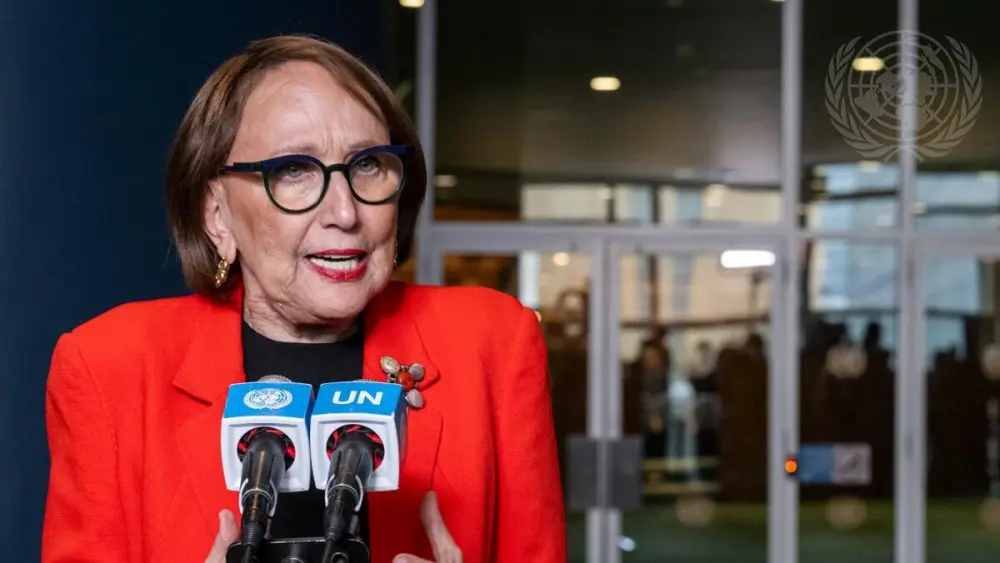
Jewish economist Rebeca Grynspan has retaken the lead in the race for the next United Nations secretary-general, but Friday’s third U.N. Security Council straw poll produced no clear front-runner and could leave the field open to additional candidates.
Grynspan, a former vice president of Costa Rica and secretary-general of the U.N. Conference on Trade and Development, received nine “encourage” votes, five “discourage” votes and one “no opinion” in the 15-member council’s secret ballot. She led the first poll in July before falling behind Guyana’s Carolyn Rodrigues-Birkett in the second round on Aug. 21.
The latest poll did not use color-coded ballots, so it remains unknown whether any of the five permanent Security Council members—China, France, Russia, the United Kingdom or the United States—voted to “discourage” individual candidates. Such a vote from a permanent member could ultimately block a candidate through its veto power.
A candidate must receive at least nine votes from the 15-member council and avoid a veto from any of its five permanent members. The council will eventually recommend a candidate to the 193-member General Assembly, which will make the formal appointment.
Grynspan, the daughter of Holocaust refugees, has family ties to Israel. Her sister moved to the Jewish state as a teenager, and her niece and nephew served in the Israel Defense Forces. Grynspan has served as UNCTAD secretary-general since 2021 and is currently on special leave from the post while pursuing her candidacy.
Rodrigues-Birkett, Guyana’s permanent representative to the United Nations, received eight “encourage” votes, six “discourage” votes and one “no opinion.” She led the Aug. 21 poll with eight “encourage” votes, compared with seven for Grynspan.
The former Guyanese foreign affairs minister was the first woman to hold that post. She also served on the U.N. Security Council during Guyana’s 2024-25 term and previously chaired the G77 coalition of developing countries.
Rafael Grossi, Argentina’s candidate and director-general of the International Atomic Energy Agency, received five “encourage,” eight “discourage” and two “no opinion” votes.
Olara Otunnu, Uganda’s candidate and a former U.N. under-secretary-general, received five “encourage,” seven “discourage” and three “no opinion” votes.
Macky Sall, former president of Senegal, received five “encourage,” nine “discourage” and one “no opinion” vote.
María Fernanda Espinosa, Ecuador’s former foreign affairs minister and former president of the U.N. General Assembly, received three “encourage,” six “discourage” and six “no opinion” votes.
Former Chilean president Michelle Bachelet, a physician and former U.N. high commissioner for human rights, received one “encourage,” 11 “discourage” and three “no opinion” votes. During her tenure as U.N. human rights chief, Bachelet repeatedly criticized Israeli policies and actions, including Israel’s plans to annex parts of the West Bank.
Ivonne A-Baki, an Ecuadorian diplomat and late entrant to the race, received no “encourage” votes for the second consecutive poll, along with 10 “discourage” and five “no opinion” votes. Tonga nominated A-Baki in August. She has served as Ecuador’s ambassador to the United States, France and Qatar and is of Lebanese heritage. She has also publicly described her friendship with U.S. President Donald Trump.
Danny Danon, Israel’s ambassador to the United Nations, criticized the poll over a lack of attention to Jew-hatred within the global body.
“At this advanced stage in the race to select the next U.N. Secretary-General, we have still not seen a single candidate present a detailed plan to combat institutional antisemitism at the United Nations,” he said.
Danon said the “surge in antisemitism” under current Secretary-General António Guterres “must not continue under the next secretary-general.”
“I encourage each candidate to present a detailed plan to address this problem,” he said. “Antisemitism at the U.N. is a deep-rooted issue that must be eradicated.”
The U.S. State Department also weighed in on the selection process on Thursday, stating that the next secretary-general should return the United Nations to “its primary purpose of maintaining peace and security in the world, rather than the absurd, politicized, woke ideology that has undermined the institution’s effectiveness.”