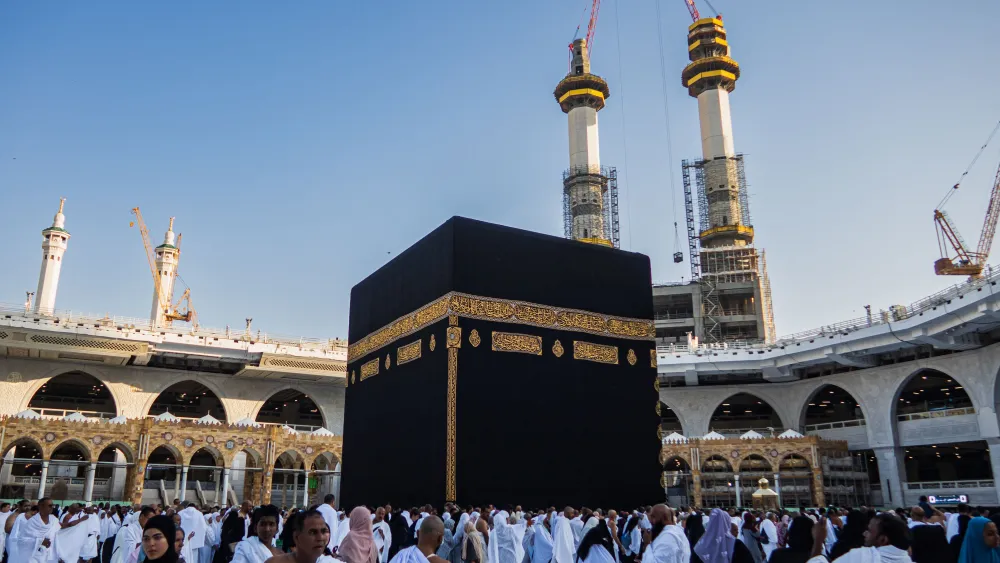

Pakistan, Turkey and Saudi Arabia signed the Mecca Joint Defense Agreement in Mecca on Aug. 7, forming what many are calling a “Muslim NATO.”
U.S. President Donald Trump praised the deal, describing it as a “big, bold and important first step.” He added that he was “very happy” about it and that it showed the Middle East “coming together,” allowing the participants to defend themselves “in a more meaningful way.”
He does not appear to have considered the consequences for America or its ally Israel, nor how Greece and India might react.
Interestingly, in November of last year, Trump signed a Strategic Defense Agreement with Saudi Crown Prince Mohammed bin Salman. The White House affirmed that the United States is Saudi Arabia’s “primary strategic partner” and the plan includes the sale of F-35s and hundreds of American tanks to Riyadh. Trump has also offered to advance a civilian nuclear deal with the Saudis if they join the Abraham Accords, which they refused.
Trump’s praise of the Mecca agreement overlooks long-term geopolitical consequences, which could have negative implications for Israel, India, Greece, and ultimately, the United States. Indeed, the alliance appears designed to reduce and eventually replace U.S. influence in the region. It appears that Saudi Arabia, having faced missile attacks from Iran—allegedly due to hosting U.S. military bases—is now seeking to align more closely with fellow Sunni Muslim allies.
The Saudis also want to appease their restive Wahhabi population by removing the “infidel” American presence from its soil. Even during the Gulf War in the early 1990s, when Saudi Arabia hosted a large contingent of American forces to defend against an expected invasion by Iraq’s dictator Saddam Hussein, the influential Saudi religious establishment was railing against the presence of Americans on holy Islamic land.
The New York Times headlined an Aug. 10, 2026 article, “Trump Wants to Move on From the Middle East. It’s Not Letting Him.” Trump may want to move on, but he seems not to have considered the fact that, should the U.S. withdraw its forces from the region, the Chinese would be only too happy to fill the vacuum.
Moreover, it does not appear that the Mecca agreement would serve Saudi interests. Since Pakistan and Turkey share a border with Iran, the Saudis anticipate that the two allies would intervene if Iran were to attack the kingdom. However, Pakistan refrained from intervening on behalf of the Saudis against Iran while the Saudis faced Iranian missile fire over the past few months, despite an existing defense agreement between the Saudis and Pakistan. This is despite substantial Saudi financial support for the Pakistani government.
As for Turkey, it has served as a financial and logistical conduit for Iran.
These threatening statements clearly indicate that the Mecca alliance is directed at the Jewish state.
Essentially, the Mecca alliance is anti-Western. All three parties resent Western cultural influence on their countries. Israel, because it shares Western values, is also viewed as a major nemesis. Recep Tayyip Erdoğan, Turkey’s dictatorial and antisemitic president, has voiced his desire to eliminate the Jewish state on numerous occasions. The recent escalating tensions between Israel and Turkey over Ankara’s gradual annexation of Syria and its ultimate goal of reaching the Israeli border are clear signs of a potential clash between the two nations. In fact, Erdoğan has urged the Islamic nations to wage war on Israel.
On Sept. 7, 2024, Erdoğan called for the formation of an Islamic alliance to halt what he called “the growing threat of expansionism” from the Jewish state. Falsely claiming that Israeli officials “openly state” their desire to occupy the entire region, Erdoğan maintained that an alliance of Islamic countries is the “only step that will stop Israeli arrogance.”
More recently, Pakistani Defense Minister Khawaja Asif described Israel as “evil and a curse for humanity,” adding that he hopes its founders “burn in hell.”
These threatening statements clearly indicate that the Mecca alliance is directed at the Jewish state, despite the declaration that the agreement’s foundation is solely collective defense. Pakistan’s inclusion is obviously due to its nuclear arsenal, which is perceived as a counterbalance to Israel’s alleged nuclear capabilities. Erdoğan believes that his armed forces can defeat Israel on the ground. Consequently, if Israel, in desperation, were to resort to using its nuclear weapons, Pakistan would counter such an attempt.
The reaction in Greece is likely that if the Mecca agreement were activated, military conflict over Cyprus—the Greek island near the Turkish mainland—maritime passage in the Aegean or Mediterranean Sea, or other issues might become unavoidable. Turkey would then receive support from Pakistan and Saudi Arabia. Thus, the agreement could give Ankara more leverage in the region.
India’s Maj. Gen. (Ret.) Gagan Deep Bakshi said that the emergence of what he called a “Sunni NATO” in the Middle East was “a serious cause for concern.” He is right. For example, the Bab al-Mandeb Strait, a crucial chokepoint for India’s energy imports and trade, could potentially fall under the influence of a bloc that excludes Indian strategic involvement. Additionally, the deployment of advanced Turkish military hardware or personnel in the region would be a significant force multiplier for Pakistan.
Regarding Israel, the Mecca agreement could potentially hinder future Israeli operations in the Gulf and/or against Iranian-linked targets. Additionally, Israel would need to consider the possibility of coordinated aggression from three powerful regional states. On the other hand, the agreement could lead to stronger relations between Israel, the United Arab Emirates, India and Greece.