


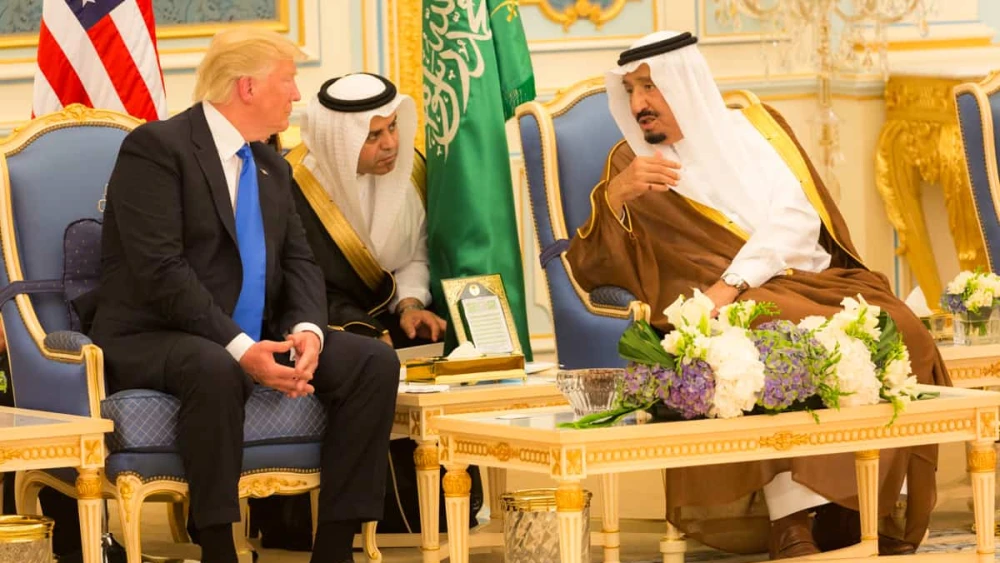

Saudi Arabia signed the Mecca Joint Defense Agreement with Pakistan and Turkey on Aug. 7. The first ministerial-level defense pact between the three parties, a Saudi official called it “comprehensive, all military means”; Pakistan’s foreign minister said it was “purely defensive” and open to any state willing to join; while his Turkish counterpart said the pact is not aimed at any other country.
In April, when a “Sunni NATO” label first got attached to the Riyadh-Ankara-Islamabad grouping, I argued that the framing of the alignment as the formation of a regional axis was mistaken. The Iran war had already proven it.
Indeed, Pakistan’s response when Iran struck Saudi Arabia showed the limits of the pact. Islamabad deployed around 16 jets, nearly 8,000 troops and an air-defense battery to Saudi soil in April under a 2025 bilateral agreement, but these were confined to an advisory role.
Moreover, all three parties are still operating under the American security architecture. One of them is even a member of NATO. They are simply maneuvering to serve their own independent interests.
- For Saudi Arabia, the pact came just weeks after a civil nuclear deal with the United States was stalled because of U.S. President Donald Trump’s precondition of normalizing relations with Israel, which the Saudis declined.
- For Pakistan, the agreement is a play aimed at developing global reach and a global image while trying to contain India’s influence in the Middle East and the international arena. Pakistan’s close relations with China are also a factor.
- For Turkey, the pact serves its aspiration to become the dominant Muslim power in the Middle East by taking advantage of Iran’s weakened position. It must be noted that, in doing so, Turkey presents a growing threat to Israel’s national security.
The pact was tested just hours after the signing when the Houthis struck Saudi-backed positions in Yemen’s Marib province, killing eight. A Saudi Aramco facility in Jazan was hit within two days. There was no sign that Turkey or Pakistan was preparing to enter the Yemen war directly. Although the agreement defines an attack on one as an attack on all, no one has defined what response such an attack would trigger. Clearly, the first attack after the signing didn’t visibly trigger anything.
Behind the optics, the most concerning aspect of the pact is the potential strengthening of military ties between Turkey and Pakistan. The Israeli government should closely monitor developments in this regard and ensure that the issue remains on the security agenda following the upcoming Israeli elections.
Some argue that Israel-India-United Arab Emirates relations were the driving force behind the Mecca agreement; however, those relations were already rooted in place years before anyone in Riyadh, Ankara or Islamabad was thinking about a formal pact. In fact, Riyadh was closer to joining the Abraham Accords than any agreement with Turkey and Pakistan.
Unlike the Mecca pact, which is driven by self-interest, Israel-UAE-India cooperation is natural and has proven resilient in challenging times. During the Iran war, Israel deployed an Iron Dome battery, interceptors and Israel Defense Forces personnel to the UAE, while the Emiratis reportedly joined Israel and the United States in striking Iran. India continued to supply defense shipments to Israel during the Gaza war despite domestic criticism, and Israel assisted India during Operation Sindoor, in which Turkey supported Pakistan.
Furthermore, the artificial and fragile connections between the members of the Mecca pact create an inherent conflict between Turkey and Saudi Arabia over who should lead the Middle East’s Muslims. This conflict is only a matter of time and could eventually bring the Saudis closer to Israel.
One major issue for the Saudis is the ongoing conflict in Gaza. At an Aug. 17 meeting, Israeli Prime Minister Benjamin Netanyahu called progress on the administration’s 15-point Gaza framework “politically problematic” ahead of Israel’s upcoming Oct. 27 election and insisted Hamas make the first move. Hamas, however, is refusing to disarm before any Israeli withdrawal from Gaza. This remains a serious obstacle to any normalization with the Saudis.
On Aug. 18, in a Fox News interview, Kushner stated that “Israeli politics in an election are very complicated. Hopefully, when we get after the Israeli election, there will be some opportunities for expansion.”
This means normalization is still on the table. In response, the Israeli political system should show unity on security matters. It ought to insist on disarming Hamas, preventing a Turkish military buildup in Syria and containing growing Pakistani-Chinese involvement in the Middle East.
With that unity, Israel can keep the possibility of normalization alive. Saudi Arabia is still negotiating its own civil nuclear deal with Washington, and that lever will stay on the table after Israel’s election and the U.S. midterms that follow. Neither Jerusalem nor Riyadh has any incentive to act before then.


