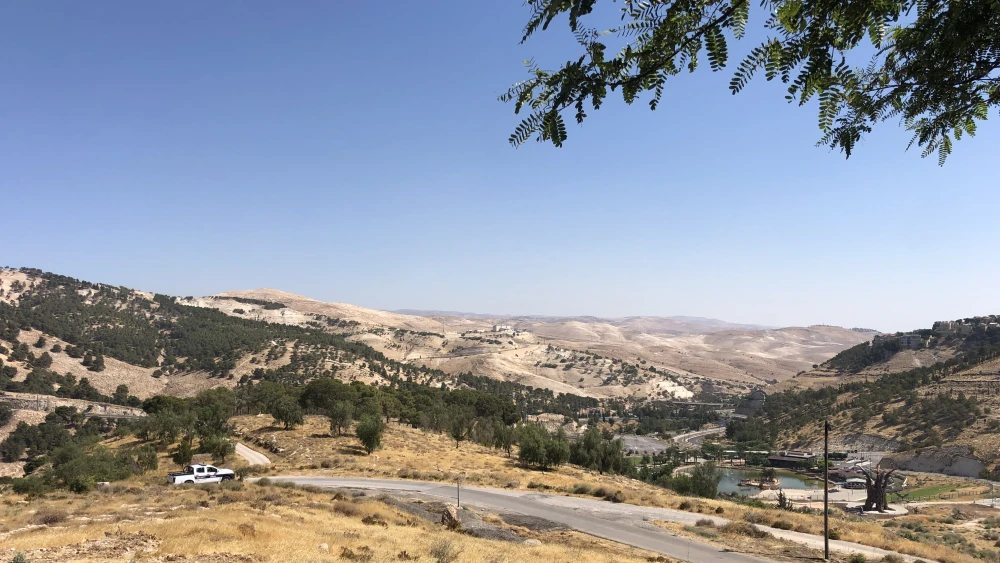

Israel issued tenders last week for 1,234 housing units in E1, the strategically located area between Jerusalem and Ma’ale Adumim. The project is part of a larger plan for roughly 3,400 homes.
Ma’ale Adumim is already a large Israeli city, sitting immediately east of Jerusalem. E1 is the territory between the two cities. Building there would strengthen the physical connection between Ma’ale Adumim and Jerusalem, and turn what has essentially been a gap on the map into a developed urban corridor.
This is not a new idea. The plan for E1 dates back to 1994. It was first put forward under Israeli Prime Minister Yitzhak Rabin, the same leader who signed the Oslo Accords. Every Israeli prime minister since, from across the political spectrum, has kept the plan alive in one form or another, only for it to be repeatedly shelved under international pressure.
In other words, the development of E1 was never a right-wing invention. It has always been treated, even by the architect of Oslo, as a legitimate part of Israel’s strategic geography.
For decades, Israel has avoided establishing its borders. Despite being a sovereign state, it has often behaved as if its final borders would somehow be determined by a peace deal with the Palestinians. After innumerable negotiations, failed summits, terrorism, wars and changing leadership, that moment has still not arrived.
Maybe it’s time to look at the problem differently.
There is nothing inherently aggressive about wanting defined boundaries.
Former Knesset member Einat Wilf has made this issue a central plank of her Oz Party platform, which holds that Israel needs to behave like a sovereign state and define its borders. It should determine its own interests, define its strategic requirements and, ultimately, decide where its borders should be. Israel should not remain in a permanent state of territorial uncertainty simply because the Palestinian leadership has not agreed to a final settlement.
That makes the Israeli government’s decision to move ahead with construction in E1 worth looking at in a much broader context.
Israel has constantly been told not to jeopardize a future peace deal. But after so many failed attempts, how realistic is the possibility of such an agreement? The failure of past negotiations was not simply the result of Israelis refusing to give enough land. Each time, all of Gaza was on the table along with the overwhelming majority of Judea and Samaria. Yet each time, the offer was refused.
Clearly, the issue is not over where to draw the border. Experience suggests that the problem goes much deeper: Most of the Palestinian Arab leadership has never accepted Israel as the nation-state of the Jewish people. Moreover, even if one faction were prepared to do so, the deep divisions within Palestinian society mean that Israel would still have serious security concerns about whether a peace agreement could be enforced and sustained.
A country cannot be expected to negotiate its borders forever with someone who regards that country’s very nature as temporary or illegitimate. This is one reason Wilf’s argument about setting borders is so important. Israel cannot control whether a Palestinian leadership eventually accepts a Jewish state, but it can control its own decisions.
E1 is one of those decisions, because a country does not establish borders only by drawing lines on a map. Borders become meaningful when they are connected to roads, communities, infrastructure, economic activity and defensible geography. A border that exists only on paper is not durable.
If Israel believes that Jerusalem and Ma’ale Adumim are both going to remain part of Israel, it makes sense to connect them. If Israel believes that the eastern approaches to Jerusalem are strategically important, it makes sense to develop them. In short, it makes sense to define borders.
European governments have criticized the E1 construction plans, arguing that they could undermine the territorial continuity of a future Palestinian state. From the Israeli perspective, however, the failure to build in E1 would undermine the territorial continuity of the Jewish state.
The question, then, should not be whether Israel is “allowed” to build in E1, but whether it is finally prepared to decide what its permanent strategic geography should be. If the answer is yes, then construction in E1 is not something that Israel needs to apologize for. It should be seen as part of the larger process of establishing permanent borders.
There is nothing inherently aggressive about wanting defined boundaries. In fact, the opposite can be true. A country with a clearly defined border knows what it is defending, where it is prepared to compromise and what territory it considers essential.
Israel has spent generations waiting for a final agreement that will define its borders. The time has come for Israel to decide for itself.