


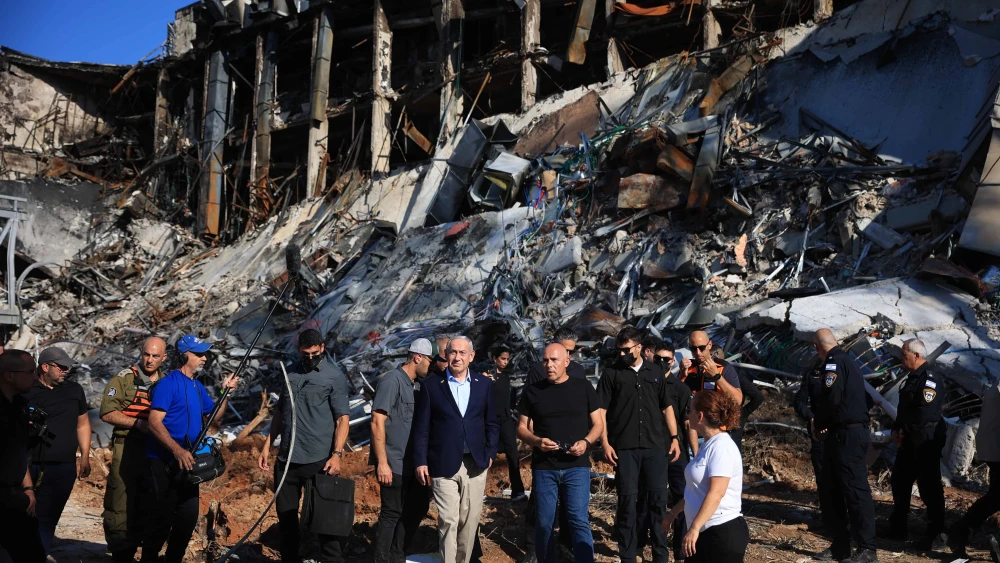

In the dead of night, as families in Rehovot lay sleeping, a missile launched by Iran raced across the sky. It did not strike a weapons depot. It did not aim for a military outpost. Its intended target: the Weizmann Institute of Science.
It honed in on one of the world’s leading centers of scientific innovation, a place dedicated not to war, but to life and healing.
This was more than just a military provocation. It was a moral assault, a deliberate attack on a symbol of progress, of peace, of shared human potential.
Nestled in the heart of Israel, the Weizmann Institute stands on the shoulders of giants and ghosts alike.
Born in a nation risen from the ashes of genocide, the institute embodies a story of renewal. Survivors of the Holocaust, refugees who arrived with nothing, helped build the country, and with it, the institutions that define Israel today.
From the trauma of history, Israel forged a commitment to life. The Weizmann is the epitome of that promise—a hub where scientists work on cancer treatments, climate solutions, neurological breakthroughs. Attacking it is not just a strike against Israel. It is a strike against humanity.
Meanwhile, Iran invests its vast resources not in the progress of its people or the advancement of peace, but in the pursuit of weapons of mass destruction. While Israeli scientists collaborate across borders to find cures for diseases that afflict everyone regardless of nationality, race or creed, Iranian leaders develop tools meant only to sow death and fear. The contrast could not be more stark.
On one side, Israel, a nation under threat, is committed to building, innovating and healing. Iran, a regime obsessed with annihilation, is willing to target a civilian institution simply because of what it represents: a future where life triumphs over destruction.
The Weizmann has no military value; it is not a fortified base and not involved in weapons development. It is located in a quiet, residential area. I know this firsthand since I lived for years just across the street. I walked those sidewalks, passed students deep in thought, saw parents with strollers and heard laughter from the local cafe. The only thing the Weizmann ever “produced” was knowledge, discovery and hope. That’s what Iran tried to destroy.
And there is no outcry from the world.
Time and again, Israel faces international condemnation for taking action against facilities tied to Iran’s nuclear-weapons program—defensive actions aimed at delaying a very real and existential threat. However, when Iran fires a missile at a civilian science campus, the silence is deafening.
This double standard is not just frustrating but dangerous. It sends a message that some aggressions will be tolerated. That certain victims are less worthy of global solidarity, and that a regime that openly threatens genocide can strike at the heart of a civilian city with little consequence.
This story is not only Israel’s. It is a global one.
When a missile is launched at a lab working on cures for cancer, it threatens every family praying for a breakthrough. When a place dedicated to climate innovation is targeted, it affects every child who will live on this planet. When a building that symbolizes peaceful cooperation among scientists from around the world is placed in the crosshairs, it should enrage every citizen who believes in human dignity and progress.
In trying to destroy the Weizmann, Iran revealed not only its nature but the stakes of this conflict. This was not a battle of borders, but of values.
Targeting science is terrorism. Attacking knowledge is tyranny. Attempting to extinguish hope is the hallmark of a regime that fears its own irrelevance in a future shaped not by warlords but by those who dare to heal.
Now it is up to the world to respond—not with silence but clarity. The world must stand with those who build, not those who destroy. Because when science, knowledge, innovation and discovery are under fire, all of humanity is in the blast radius.


