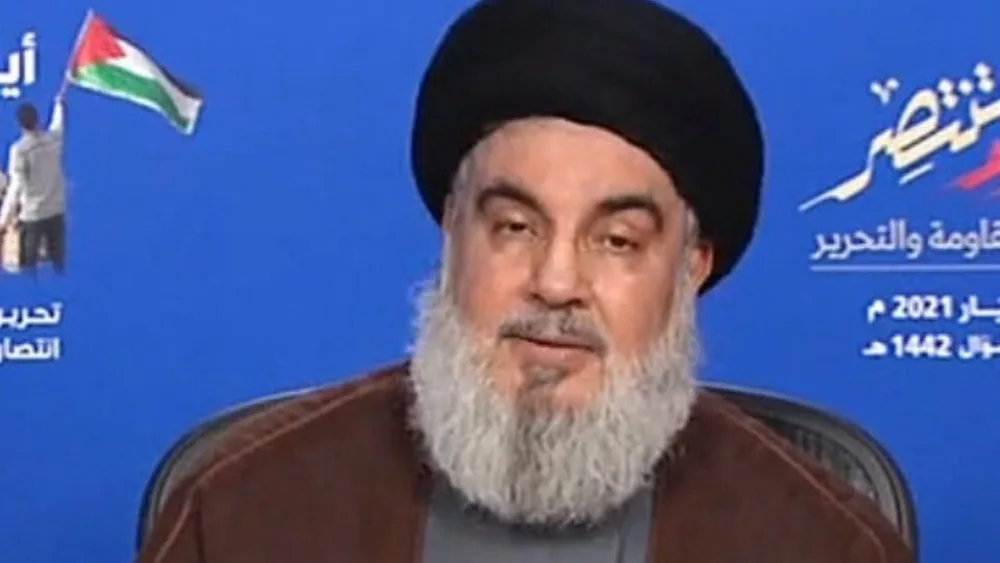
Hezbollah leader Hassan Nasrallah said on Tuesday that any violations of Jerusalem and sites holy to Muslims would spark a regional war.
Speaking publicly for the first time since the ceasefire ending the 11-day war between Hamas and Israel, Nasrallah said Gaza’s terrorist groups had won a great victory and warned that Hezbollah could get involved in the next round.
“When holy sites face serious threats there are no red lines,” said Nasrallah. “The Israelis must understand that breaching the holy city and Al-Aqsa mosque and sanctuaries won’t stop at Gaza resistance,” he added.
Jerusalem, said the Hezbollah leader, “means a regional war. All the resistance movements cannot stand by and watch this happening if the holy city is in real, grave danger.”
During his televised speech marking the 21st anniversary of Israel’s withdrawal from southern Lebanon, the Hezbollah leader spoke slowly and in quieter than usual tones. Looking pale, he coughed repeatedly throughout the address and appeared to struggle to catch his breath several times.
Addressing Lebanon’s dire economic situation, the terrorist leader, whose group holds considerable influence in the country, added that the only way out of the prolonged financial crisis was the formation of a viable cabinet.
Prime minister-designate Saad al-Hariri has been at loggerheads for months with President Michel Aoun, an ally of Hezbollah, over cabinet positions.
“The only realistic thing for the Lebanese today is that the prime minister-designate, in cooperation with the president, forms a government,” said Nasrallah.
Lebanon’s economic meltdown has pushed much of the population into poverty and poses the biggest threat to the country’s stability since the 1975-1990 civil war.
This article first appeared in Israel Hayom.