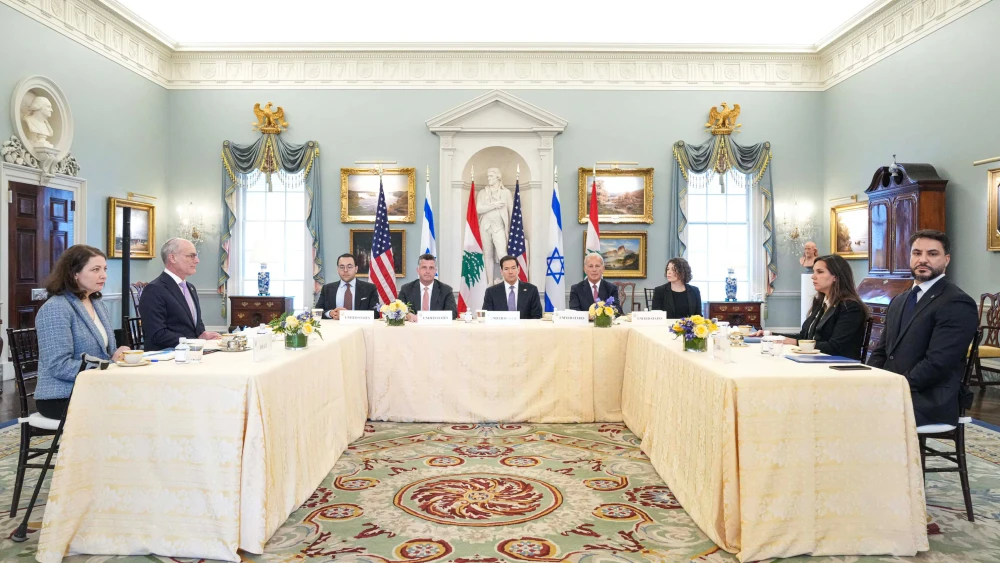
The Israeli and Lebanese ambassadors to the United States agreed on Tuesday that their countries would hold direct negotiations following the first meeting between the two sides since 1993.
After more than two hours of talks that U.S. Secretary of State Marco Rubio hosted in Washington, D.C., the ambassadors emphasized different goals for direct engagement between the two countries that have been in a formal state of war since Israel declared independence in 1948.
According to a readout provided by the State Department, Israel will seek to “resolve all outstanding issues and achieve a durable peace,” while Lebanon said it wanted “a ceasefire and concrete measures to address and alleviate the severe humanitarian crisis that the country continues to endure as a result of the ongoing conflict.”
Unlike the U.S. and Israeli sections, the Lebanese portion of the readout did not refer to a permanent peace agreement.
The conflict in Lebanon resumed in early March after Hezbollah launched attacks on Israel after the start of the U.S.-Israeli war against Iran. Israel in turn has carried out ground operations in southern Lebanon and a massive bombing campaign directed against Hezbollah targets throughout much of the country.
Israeli ground troops have also begun to hold extensive territory in southern Lebanon between the Blue Line and the Litani River.
Israeli Ambassador to the United States Yechiel Leiter said that the most important outcome of Tuesday’s talks was that Israel and Lebanon are “on the same side of the equation.”
“We are both united in liberating Lebanon from an occupation power dominated by Iran called Hezbollah,” Leiter said. “Lebanon is under their occupation, and we are suffering from their constant barrages of missiles and terror attacks trying to cross our border.”
“We talked about a number of things, most importantly the long-term vision where there will be a clearly delineated border between our countries and where the only reason we’ll need to cross each other’s territory will be in business suits to conduct business or in bathing suits to go on vacation,” Leiter said.
Israel and Lebanon have a long-standing border dispute over the Shebaa Farms area that Israel claims was occupied from Syria as part of the Golan Heights in 1967 and that Lebanon claims as its own.
The more immediate issue to resolve for both sides will likely be Israel’s desire to disarm Hezbollah, which the Lebanese government has long been unwilling or unable to do, and the Iranian government’s efforts to add Lebanon to U.S. ceasefire with Iran.
The U.S. and Israeli sides insisted that there was no link between the talks with Lebanon and the talks with Iran, despite the Iranian government’s insistence that any ceasefire with it should also include Lebanon.
“Iran dragged the Lebanese people into a war so it cannot pretend to be Lebanon’s protector,” a State Department official said. “Iran will not be allowed to dictate the future of Lebanon any more. These talks are part of that effort.”
Leiter said that it was “imperative” that there be a “complete de-linkage between Lebanon and Iran.”
Lebanese President Joseph Aoun stated after the meeting that he hoped the talks mark “the beginning of the end of the suffering of the Lebanese people.”
“The only solution lies in the Lebanese army re-deploying up to the internationally recognized border, and so being solely responsible for the security of the area and the safety of its residents, without the partnership of any other party,” Aoun said.