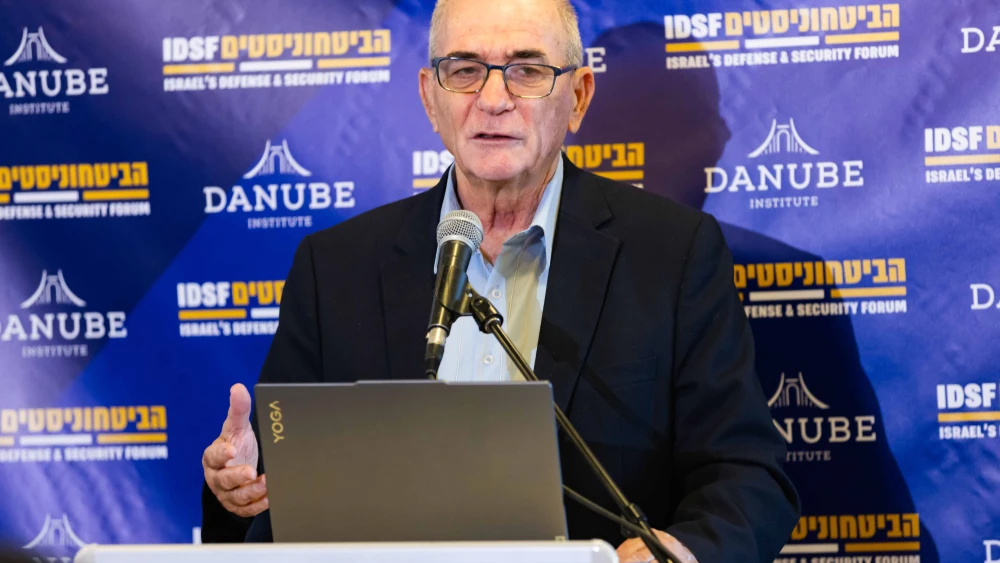
Israel is primed to renew military action against Hamas in Gaza “within weeks,” and any eleventh-hour agreement between the sides due to pressure over an imminent attack would only delay a return to combat, a veteran Israeli intelligence and security expert said on Wednesday.
The remarks by Brig. Gen. (res.) Yossi Kuperwasser, the newly installed head of the Jerusalem Institute for Strategy and Security (JISS), mirror similar assessments by other former Israeli generals about the expected resumption of the 15-month war against Hamas, which was paused on Jan. 19 with a ceasefire and a phased hostages-for-terrorists exchange agreement.
“The most likely scenario is that we will resume fighting against Hamas in the coming weeks,” Kuperwasser, a former head of the research division in the IDF Intelligence Directorate, told JNS in an interview at his office in the Israeli capital.
“There is a small chance that Israeli and Egyptian pressure will cause Hamas to change their position …, but this will only temporarily push the military campaign off,” he continued.
Fifty-nine hostages remain held in Gaza, including two dozen who are believed to be alive.
Kuperwasser said that if an agreement to free some of the remaining hostages is to be reached with the help of international mediators led by the U.S., it would only come about if Hamas is convinced that Israeli military action is imminent, and even so it would be a temporary move since the terrorist group is refusing to disarm and leave Gaza, something Israel will not accept after the Oct. 7, 2023 massacre.
“The more they believe that Israel is ready to carry out a military campaign, the greater the chances of an agreement,” he said. “But this is only pushing off the end, not avoiding it.”
Last week, Hamas refused to extend of the first stage of the ceasefire deal and what was billed as a U.S. proposal to release half the hostages now with a seven-week extension of the truce through Ramadan and Passover while a longer ceasefire is worked out. That proposal came as an alternative to the more difficult to reach second stage of the Jan. 19 deal and reconciling Israel’s goal of dismantling Hamas’s governing and military capabilities and the terrorist group’s refusal to disarm.
Hamas views the hostages as critical to maintain its grip on Gaza, and is demanding an end to the war and a full Israeli pullout from the Strip with international guarantees for their release.
U.S. President Donald Trump’s Middle East envoy Steve Witkoff is set to again visit the region in the coming days in an effort to extend the truce.
Kuperwasser said Israel has the military capability to destroy Hamas and its 20,000 remaining fighters, something that, he said, would take weeks, but did not do so until now primarily because of opposition by the Israeli security establishment and pressure from the former US administration over Palestinian civilian casualties as well as the safety of the hostages.
“It has to be made clear to the Arab world—with Hamas losing its rule over Gaza—that October 7 was a total failure,” he said.
Such a dramatic shift in the balance of power in the Middle East would ease the way to a peace agreement with Saudi Arabia and additional Arab countries, Kuperwasser said.