Most U.S. states are making some progress combating Jew-hatred, but more has to be done at the state level, according to a tool that the Anti-Defamation League launched on Friday.
The ADL’s Jewish Policy Index is a “first-of-its-kind,” interactive tool to assess the efforts of each U.S. state in addressing antisemitism, with a specific focus on “legislation, education and public policy.”
“States have a lot of power even if Congress is gridlocked,” Shira Goodman, vice president of advocacy at the ADL, told JNS. “There are things that every state can do that make a difference for their populations.”
“We have a crisis right now, and we need to pull every lever on the state level and the federal level,” she said. “We think there is a lot of progress to be made, and we’ve set out a path.”
According to the report, nine states—including California, Florida and New York—are taking defined steps to combat Jew-hatred, such as requiring Holocaust education, providing funding for security at Jewish institutions and passing legislation against anti-Israel boycotts.
Then there are 12 states—including Delaware, South Carolina and Wyoming—that have done little to address Jew-hatred, according to the ADL tool.
In between are 29 states—including Connecticut, Pennsylvania and Michigan—that are making progress but aren’t there yet.
The tool is designed for policymakers, educators, advocates and community leaders, the ADL stated, to encourage states to take decisive action against rising antisemitism, which spiked in the United States after Oct. 7.
For example, California, New York and Virginia are the only three states that have state strategies to fight antisemitism. All but four states have enacted hate crime laws, and 17 states have moved to address campus antisemitism.
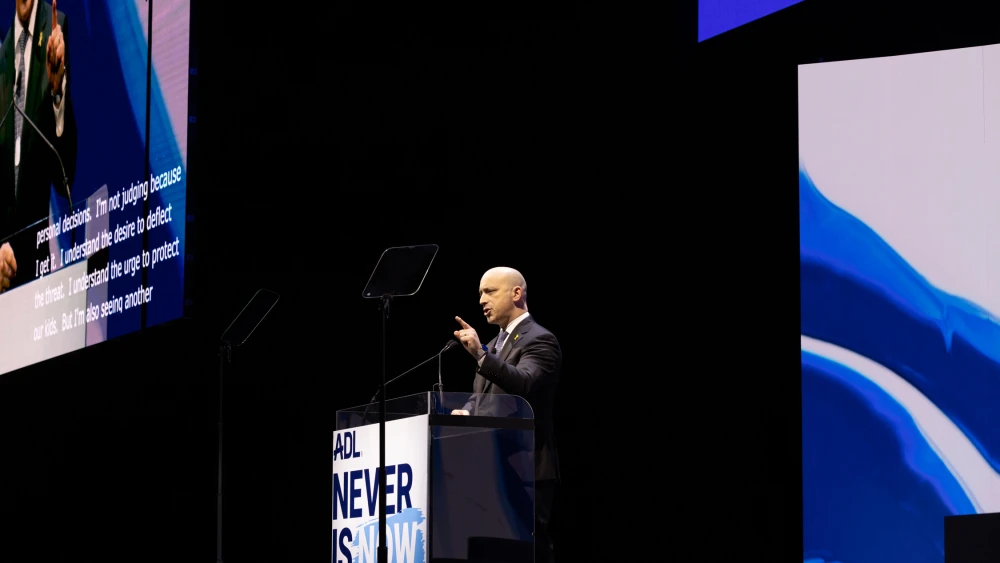
“With antisemitic incidents at record highs nationwide, we need more than rhetoric. We need real, measurable policy action,” stated Jonathan Greenblatt, national director and CEO of the ADL. “This tool offers us a comprehensive picture of where states are and what steps they can take to do better.”
“We urge state lawmakers to take swift and decisive action to enact strong policies and laws that protect their Jewish communities,” he said.
Goodman told JNS that the report showed that fighting antisemitism was a bipartisan issue. Of the nine top states, five supported Kamala Harris and four backed Donald Trump in the 2024 election.
“It does not look like an electoral map,” she said. “It’s very balanced. That shows that red, blue and purple states are finding ways to get things done. They are leaning into things that might be easier to pass in their states.”
In compiling the index, the ADL evaluated each state based on 22 criteria, grouped into three categories: prioritizing the fight against antisemitism, educating about the Jewish experience and protecting Jewish communities.
“You won’t see a state saying, ‘We can’t do any of those,’” Goodman told JNS. “We’re hearing from legislators and governors who want to use this tool already. That’s exactly what we are hoping for.’’
The categories of ADL’s Jewish Policy Index are states that are leading, progressing and limited.
California, Virginia, Florida, New York, Texas, Tennessee, Arizona, Colorado and Illinois—a list that includes six of the 10 states with the largest number of antisemitic incidents last year, per ADL’s annual audit—are identified as leaders.
Oklahoma, Connecticut, Kentucky, Iowa, Ohio, Massachusetts, Michigan, North Carolina, Missouri, Alabama, Arkansas, Maryland, Minnesota, New Jersey, Louisiana, Washington, Kansas, Georgia, Nevada, Pennsylvania, West Virginia, Rhode Island, Indiana, New Hampshire, Wisconsin, Nebraska, Alaska, Maine and Oregon are “progressing.” (The list includes the other four states on ADL’s top 10 list.)
The limited action states are Delaware, Idaho, South Dakota, North Dakota, South Carolina, Utah, Mississippi, Vermont, Hawaii, New Mexico, Montana and Wyoming. None of that list had more than 44 reported incidents last year.
“Too many states are still falling short when it comes to protecting their Jewish communities,” stated Danny Barefoot, senior director of ADL’s Ratings and Assessments Institute.
“This isn’t just a ranking. It’s a tool for change,” he said. “We built the index to push policy forward, equip advocates with data and hold lawmakers accountable. Fighting antisemitism requires more than outrage. It demands action, and that;s exactly what this Index is designed to drive.”