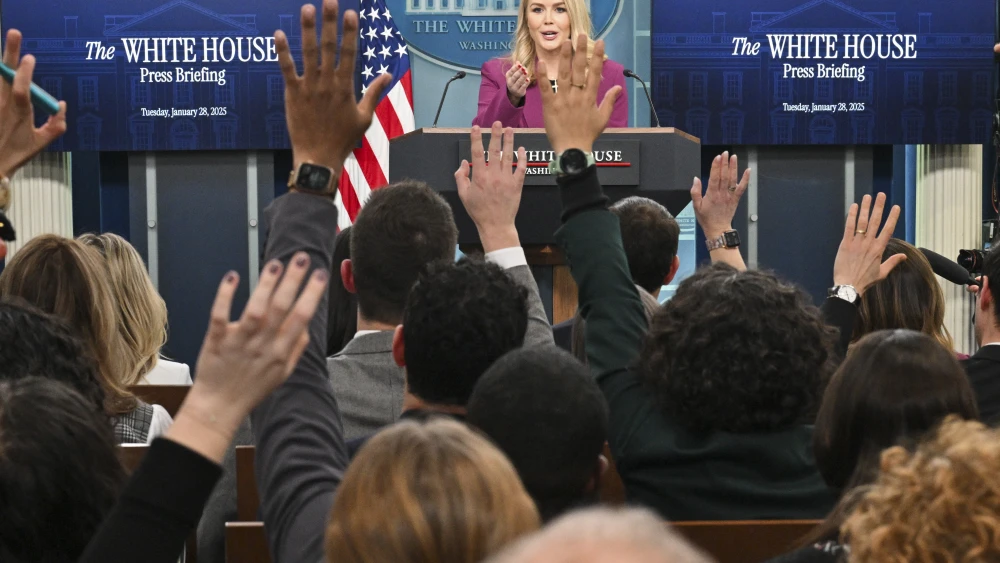
White House Press Secretary Karoline Leavitt announced on Tuesday that the Trump administration froze a $50 million federal disbursement for “condoms in Gaza.”
The Office of Management and Budget and the newly-formed Department of Government Efficiency “found that there was about to be $50 million taxpayer dollars that went out the door to fund condoms in Gaza,” Leavitt told reporters.
“That is a preposterous waste of taxpayer money,” she said. “That’s what this pause is focused on: being good stewards of tax dollars.”
U.S. President Donald Trump has ordered a widespread freeze on foreign aid and domestic grant programs in what the White House has said is an effort to align federal spending with the administration’s agenda under the DOGE and Office of Management and Budget. (JNS sought comment from the White House with more details about the money and under what program or agency it was to be spent.)
The U.S. Agency for International Development runs a family planning and reproductive health program in 41 countries but does not list Gaza or Israel as a recipient of that aid.
The U.S. Department of Health and Human Services recommends that travelers to “Israel, including the West Bank and Gaza” bring “latex condoms” with them “to prevent illness or injury.” (The HHS webpage was last updated on Aug. 5, 2024.)
In 2020, Hamas used condoms inflated with helium to send firebombs into Israel.
On Jan. 29, Trump talked to reporters about the funds in the White House East Room during a ceremony in which he signed the Laken Riley Act.
“We identified and stopped $50 million being sent to Gaza to buy condoms for Hamas, $50 million,” Trump said, drawing some laughter from attendees. “And you know what’s happened to them? They’ve used them as a method of making bombs. How about that?”
Speaking at the first White House press briefing of the new administration, Leavitt said that Trump intends to stand by his decision to remove the security details of former officials under threat from Iran after Sen. Tom Cotton (R-Ark.) asked the president to “revisit” that decision on Monday.
“He does not believe American taxpayers should fund security details for individuals who have served in the government for the rest of their lives,” Leavitt said. “There’s nothing stopping these individuals that you mentioned from obtaining private security.”
Asked if the Trump administration intended to investigate Biden administration officials, who provided funding to the U.N.’s Palestinian aid agency UNRWA and to remove Yemen’s Houthi rebels from the State Department’s list of designated Foreign Terrorist Organizations, Leavitt said that was not under discussion.
“It wouldn’t be a bad idea, considering that the Houthis certainly are terrorists,” she said.