Newsletter
Newsletter Support JNS

Volunteers saved $50m in Israeli produce during war, study finds

Hundreds of thousands of volunteers from Israel and around the world have helped rescue over 35,000 tons of produce, according to Israeli charity Leket Israel.

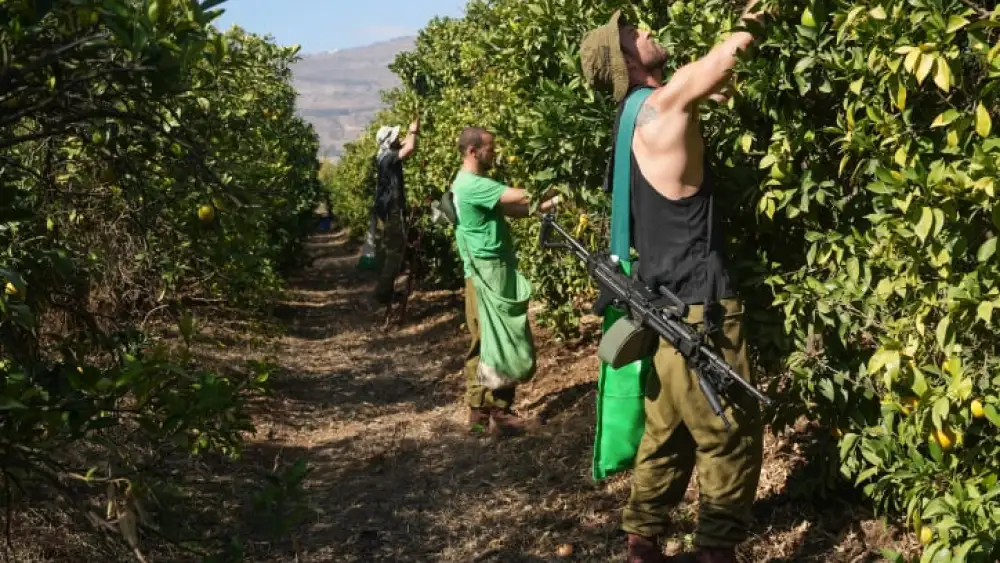
Israeli reserve soldiers help farmers pick oranges in Moshav Beit Hillel, not far from the Israeli border with Lebanon, Nov. 10, 2023. Photo by Ayal Margolin/Flash90.

Volunteers in Israel have saved agricultural produce valued at $50 million since the start of the war against Hamas in Gaza, even amid major damage to the country’s agricultural sector, according to a study released this week.

Hundreds of thousands of volunteers from Israel and around the world have helped rescue over 35,000 tons of produce, according to Leket Israel, The National Food Bank, a registered Israel-based charity.

Nearly one in two Israelis volunteered in the first months of the war, earlier surveys have shown, while both Jewish and Christian volunteers from around the globe came to Israel to help hard-hit farmers harvest their crops.

The price of fresh produce in Israel still increased by as much as 18% during the first six months of the war, the report found, while fruit prices rose by as much as 12%.

Nearly a third of Israel’s agricultural land lies in frontline areas, with about 22% in the Gaza border area and 10% on the northern border with Lebanon.

The study found that increased food waste as a result of the war cost the economy approximately $275 million, including $185 million worth of wasted food.

More than 20% of produce was wasted as a result of the war, the study found, compared to less than 10% before the war broke out.

“The war has caused severe damage to Israeli agriculture and its consequences will be felt for many years to come,” said Gidi Kroch, CEO of Leket Israel. “Strengthening local agriculture is not only an essential economic need but a necessary condition to ensure food security and strengthen national resilience for Israel’s citizens.”

Etgar Lefkovits, an award-winning international journalist, is an Israel correspondent and a feature news writer for JNS. A native of Chicago, he has two decades of experience in journalism, having served as Jerusalem correspondent in one of the world’s most demanding positions. He is currently based in Tel Aviv.
Addressing Tehran, the secretary said that it has “no defense industry, no ability to replenish your offensive or defensive capabilities.”
With Israeli elections set for this fall, “we don’t want to act politically” in halting the agreement governing the EU-Israel relationship, Dubravka Šuica tells JNS.
Nicole Gelinas, of Manhattan Institute, told JNS that the move from Albany and City Hall is a “gimmicky tax-the-rich idea” that’s a “marketing ploy” amid a stalled state budget.
From Moroccan heritage preservation and Holocaust survivor testimony to contemporary concerns over antisemitism in North America, participants at the March of the Living reflect on legacy, loss and the fight against hatred.
Russian President Vladimir Putin’s deputy on the Russian Security Council, Dmitry Medvedev, warned on X that the threat must be taken “literally.”
The U.S. and Iran have reached an “in principle agreement” to extend their ceasefire.
