A Jerusalem Center for Security and Foreign Affairs (JCFA) survey of 322 randomly selected Americans conducted after the recent ceasefire in the Israel–Gaza war reveals nuanced and complex attitudes toward the conflict and its aftermath.
While sympathy for Israel remains stronger than for Hamas, there is a growing empathy for Palestinians as distinct from Hamas. Most respondents believe no side truly “won” the war, though those who did choose a winner overwhelmingly named Israel.
A majority still favors the two-state solution, but support drops by 10 percentage points when conditions such as recognizing Israel as a Jewish state and Palestinians’ renouncing the right of return are introduced.
Nearly half of respondents assign shared responsibility to both Israeli and Palestinian citizens for their leaders’ actions, and most expected Hamas to violate the ceasefire first.
The results suggest that American perceptions are guided by notions of fairness, and highlight an opportunity for Israeli public diplomacy to influence views on Palestinian independence and post-war stability.
The Jerusalem Center for Security and Foreign Affairs launched a survey on Oct. 13, 2025, among 322 random Americans (margin of error ±5 percentage points) to assess reactions related to the Israeli–Palestinian conflict, the Israel–Gaza war, and several related issues. The survey was conducted after U.S. President Donald Trump left Israel following his speech at the Knesset marking the end of the war.
After a short introduction, respondents were asked seven questions. The introduction text was as follows:
“Mediated by the United States, the Israel–Gaza war ended this week.
“A ceasefire took effect, Israeli hostages held by Hamas were to be released, and Israel would free Palestinian prisoners. A regional peace conference was also convened to discuss future possibilities. Under the agreement, Hamas would have no role in Gaza’s future administration and would be disarmed. Israel would withdraw to agreed-upon lines.
“An international force would supervise the process. Now that the war has officially ended, we are interested in your opinions on several related issues. Please answer the following questions regarding the Israeli–Palestinian conflict and the future of regional dynamics.”
Empathy question
The first question—“Where does your empathy lie?”—has been a recurring one in the Jerusalem Center’s surveys over the past two years.
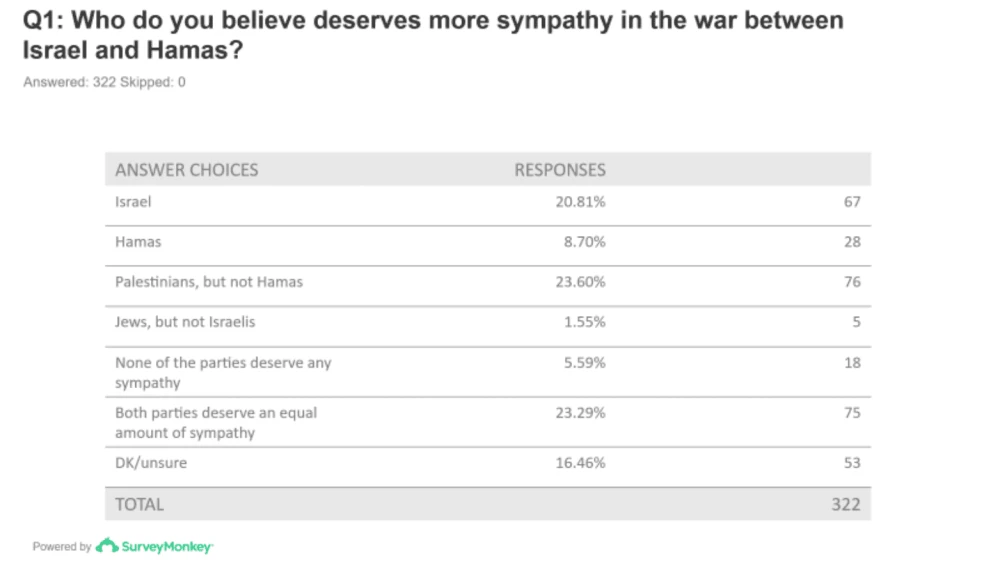
The result of this question aligns with the trend observed during the war—sympathy for Israel remains much higher than sympathy for Hamas, but is lower than the combined sympathy for “Palestinians (not Hamas)” and “Hamas.”
Perceived “winner” of the war
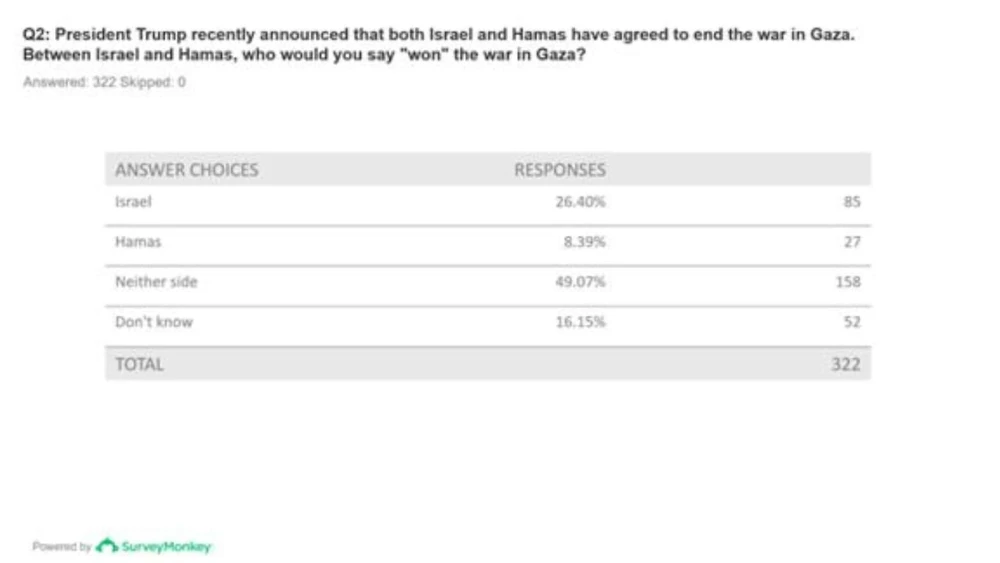
Regarding who “won” the war, the general feeling was that “neither side” truly won. However, among those who did choose a side (about a third of our sample), Israel was favored by more than a 3-to-1 margin.
Responsibility for actions
In light of protests and reports of antisemitic and anti-Israel behavior around the world, we compared our sample’s views on how much “ordinary citizens”—Palestinians and Israelis alike—are responsible for the actions of Hamas and the Israeli government. The comparison shows nearly identical results: between 41% (Palestinians) and 38% (Israelis) of respondents felt that citizens bear “at least some” responsibility.
Breaking the ceasefire
More respondents (27%) believed Hamas would be the first to violate the ceasefire agreement, compared to about 20% who thought Israel would. About a quarter believed both sides were equally likely to break it, and only 5% believed there would be no violations at all.

Preferred solutions
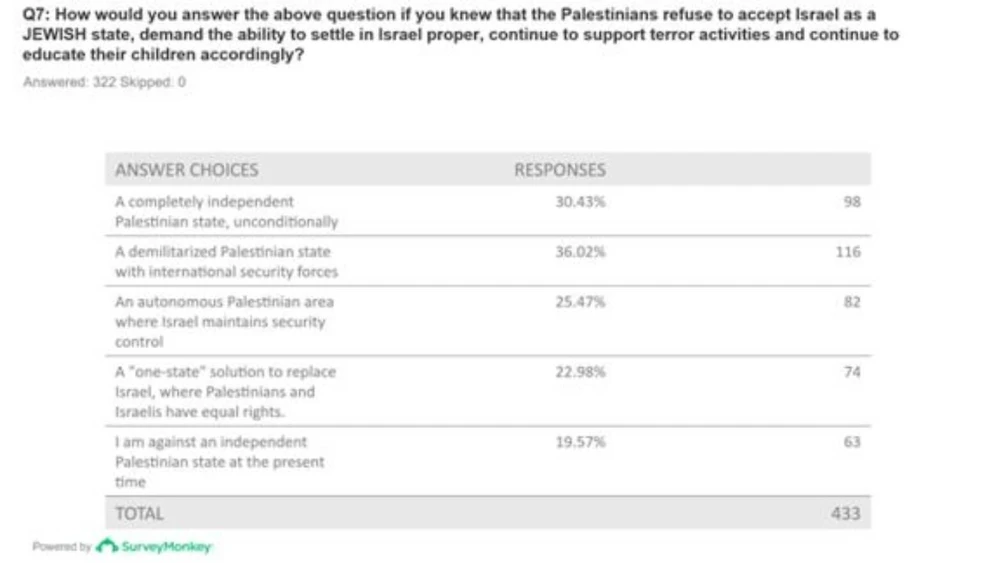
The “two-state solution” remains the most popular idea among the respondents, though about 32% were open to a demilitarized Palestinian state with international security forces. About 20% supported an autonomous Palestinian state under Israeli security control, and about a quarter supported a “one-state” solution with equal rights for both peoples. A small minority opposed any form of independent Palestinian statehood.
Conditions for Palestinian statehood
There are several conditions that Israelis generally believe must be met before considering an independent Palestinian state. The most basic include:
- Palestinian recognition of Israel as a “Jewish state,”
- No demand for resettlement within Israel proper, and
- The need for changes in Palestinian education and terrorism-related activities.
When these conditions were added as requirements, support for an independent Palestinian state dropped by about 10 percentage points, while support slightly increased (about 5 percentage points) for a demilitarized state with international security control or for an autonomous Palestinian region under Israeli security oversight. A similar increase occurred among those opposed to any Palestinian statehood.
Conclusions
- Overall sympathy toward Israel compared to the Palestinians remained unchanged with the war’s end—though there is slightly more empathy toward Palestinians.
- The general feeling is that “neither side” truly won, though among those who did choose a winner, Israel was preferred.
- About 8 percentage points more respondents believed Hamas would be the first to violate the ceasefire, though about a quarter felt both sides were equally likely to do so.
- There is a balanced sense of shared responsibility among both Israelis and Palestinians for the actions of their leadership.
- The two-state solution remains the majority preference, but support drops by 10 percentage points when conditions for Palestinian statehood (recognition, renunciation of “right of return,” and education reform) are introduced.
In summary, consistent sympathy for Israel remains low, and there is a prevailing perception of moral equivalence between both sides—matching previous surveys and reflecting a typical American notion of “fairness.” While support for the “two-state solution” remains solid, it weakens when tied to conditions requiring recognition of Israel as a Jewish state, the abandonment of the right of return, and reforms to Palestinian education and anti-terror attitudes.
These findings offer an opportunity for Israeli public diplomacy to further shape these attitudes—both by refining support for Palestinian independence and by presenting realistic and viable alternatives to the traditional “two-state solution.”
Originally published by the Jerusalem Center for Security and Foreign Affairs.