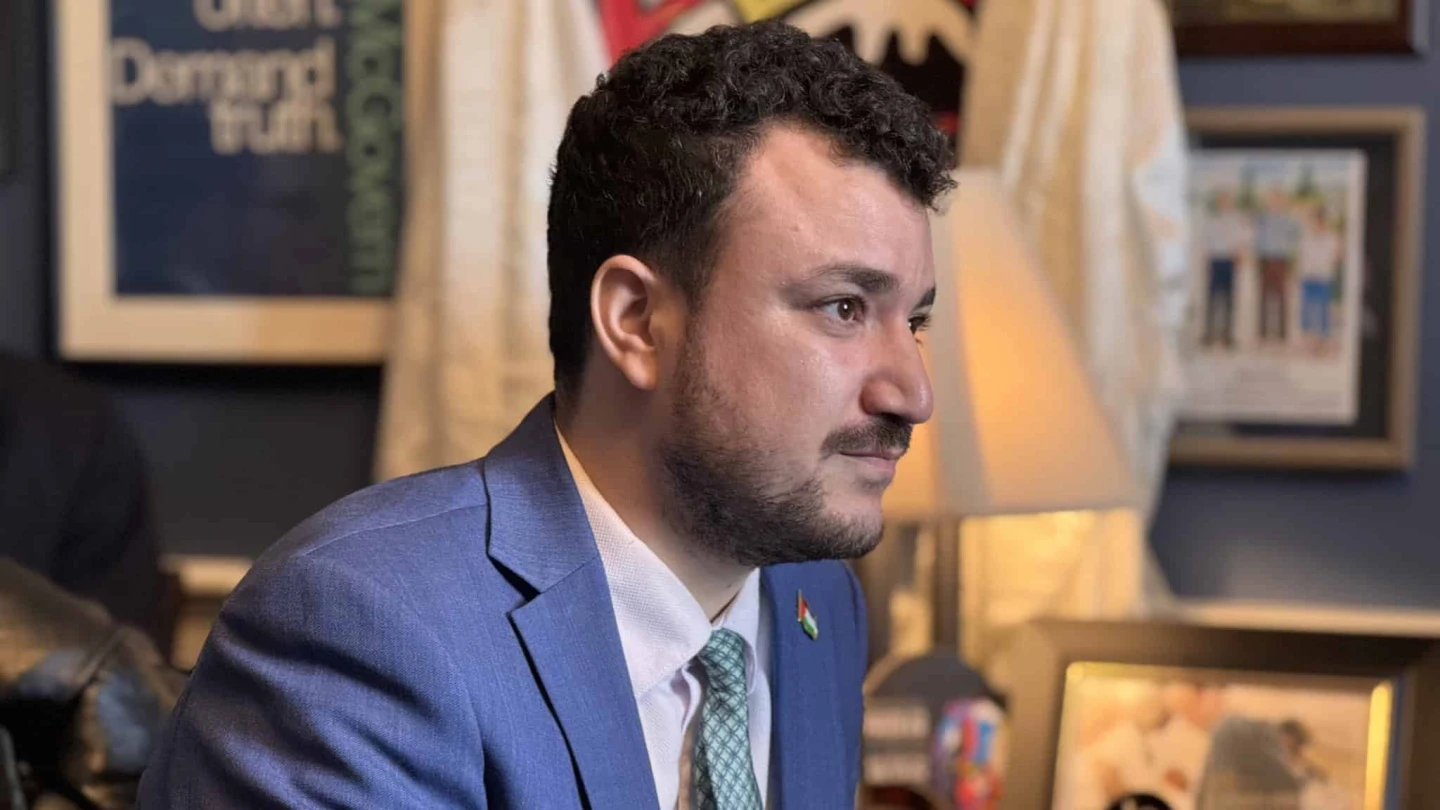
The photograph of Rabbi Daniel Walker in a bloodstained white robe has become the defining image of last month’s Heaton Park knife attack, in which a Syrian man killed two Jews outside an English synagogue.
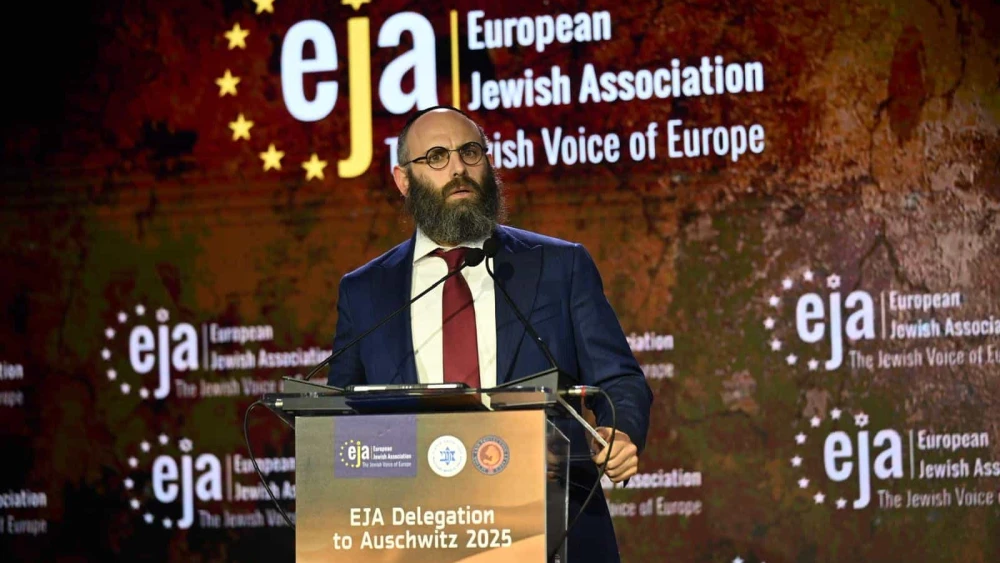
On Monday, Walker reflected on the Oct. 2 attack—the latest deadly assault on Jews in Europe—at a major conference on antisemitism in Krakow, Poland. His remarks captured a growing sense of alarm among Jewish leaders who say Europe’s Jews face mounting, even existential, threat.
“I’m a very optimistic person. So, to be honest, I didn’t really think something like this could happen,” Walker told the annual gathering of the European Jewish Association (EJA).
Seated alongside former British Prime Minister Boris Johnson and EJA chairman Rabbi Menachem Margolin, Walker nonetheless noted that precautions had been taken. “Many lives were saved because of the security infrastructure and the procedures in place,” said Walker, who helped block the attacker from entering the synagogue.
Outside, the assailant murdered Adrian Daulby and Melvin Cravitz, whose memory was honored at the conference with a Kaddish prayer led by Walker.
“When our attacker was still on the steps and I was looking at him through the window, he shouted: ‘These are killing our kids,’” Walker said. “That accusation is really on every Jew in the world—that we are somehow collectively killing children. It’s the language of genocide, the language of condemnation.”
That sentiment echoed the conference’s central theme: the fusion of anti-Israel hostility with antisemitism, a trend Jewish leaders say has intensified since Hamas’s Oct. 7, 2023, invasion of Israel and the ensuing war.
Walker said the Manchester attack has altered his sense of safety. “I received a death threat a few months ago—someone left a message telling me to get out of Manchester because I ‘support genocide,’” he said. “At the time, I laughed it off. I’m not laughing anymore.”
The two-day event’s logo—an Israeli flag whose Star of David is emblazoned with the word Jude, German for “Jew”—evoked the yellow badges Jews were forced to wear during the Holocaust. Margolin opened the gathering by revealing that the EJA has begun training rabbis in Krav Maga, Israel’s self-defense discipline.
“Eighty years since the Holocaust, the vast majority of Jews are again thinking about self-defense,” Margolin said. “Because today, governments have not been doing the job.” He urged European authorities to “make Jews a protected population,” similar to the Sami minority in Scandinavia. “Many thousands have already left, and hundreds of thousands more will follow,” he warned, calling the crisis “existential—not only for Jews, but for Europe as we know it.”
The 35-year-old suspect in the Manchester attack, Jihad al-Shamie, a British citizen of Syrian descent, was free on police bail for alleged rape when he rammed a car into pedestrians and began stabbing worshippers on Yom Kippur.
“Every day we are approached, insulted and threatened,” said Margolin. “Many Jews put their heads down. It’s degrading. It’s humiliation. No citizen in Europe should live this way.”
Walker shared that his young daughter is slowly recovering from the trauma of the attack. “She just wants things to go back to being normal,” he said. “But the ‘normal’ she knows isn’t good enough. I don’t want my daughter going to school behind big gates with guards outside. She might be used to it, but I refuse to get used to it,” said Walker.
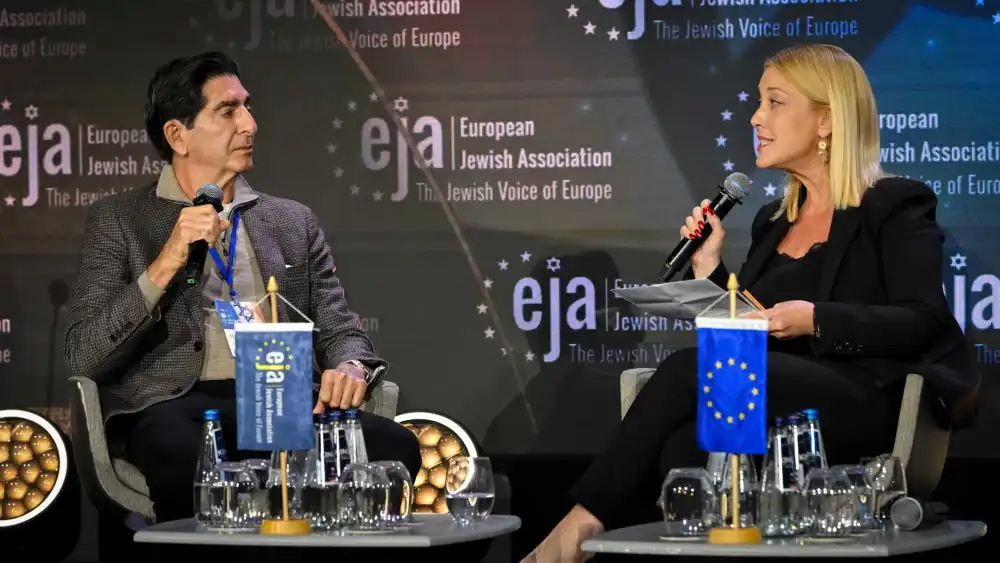
Johnson, a Conservative and former London mayor, blamed U.K. Prime Minister Keir Starmer’s Labour government for emboldening antisemites through its “false equivalence” between Hamas and Israel.
“The U.K. began by saying we stood shoulder to shoulder with Israel,” he said, “but then imposed a partial arms ban and prematurely recognized Palestine. It doesn’t deliver anything—for Israel or for Palestinians.”
Ruth Daskalopoulou-Isaac, the EJA’s director of E.U. relations, underlined a passage from Johnson’s speech noting that “we had plenty of warnings before 1945.” The same applies today, she said. " our generation has today. “We cannot act surprised when horrific antisemitic attacks are taking place if we choose to ignore the very dangerous rhetoric and systematic demonization of Jewish people online and, often, by many mainstream media.” Daskalopoulou, who is the coordinator of the Annual EJA Delegation to Auschwitz that brings together politicians from around Europe, spoke of the need to “combat the modern blood libel and conspiracy theories that place Jewish people worldwide at risk.”
American Jewish activist Harley Lippman, a member of the U.S. Commission for the Preservation of America’s Heritage Abroad, went further, accusing Europe of “sacrificing its Jewish minorities.” He said: “Europe had appeasers in the 1930s, and largely they’re appeasers now, including in the recognition of ‘Palestine.’”
Co-sponsored by the Maccabi World Union and the Action and Protection Foundation, the conference drew some 200 community leaders, politicians and activists from across Europe, timed ahead of the Nov. 8–9 anniversary of Kristallnacht. That pogrom in Germany and Austria marked the beginning of the Nazis’ genocidal violence.
Participants were set to visit Auschwitz for a commemoration—the first such visit for Johnson.
Two Holocaust survivors, including Baroness Regina Sluszny of Belgium, addressed the attendees, telling them of their survival and determination to speak at schools about it. Since Oct. 7, 2023, Sluszny has had her offers to give talks declined at some schools, she revealed.
Sessions also highlighted threats to Jewish religious life, including bans on shechitah (kosher slaughter) and moves to prohibit milah (ritual circumcision). Activists opposed to Jewish and Muslim presence in Europe have pushed such bans, often joined by advocates for the perceived rights of animals and children, respectively. In Belgium, shechitah is already banned in two of the country’s three regions.
Belgian Prime Minister Bart De Wever, in a recorded message, condemned antisemitism but did not address those bans. His party colleague Michael Freilich, a Jewish lawmaker, later praised De Wever for denouncing a Belgian town’s decision to block an Israeli musician’s performance.
Hungary’s EU affairs minister János Bóka directly tackled the issue of religious freedoms: “If Jewish communities are not allowed to perform circumcision or kosher slaughter, then how serious are we about fostering Jewish life?” he asked.
Across two days of speeches, prayers and defiance, the message from Krakow was stark: for Europe’s Jews, life is becoming increasingly untenable—and patience with governments’ promises is wearing thin.