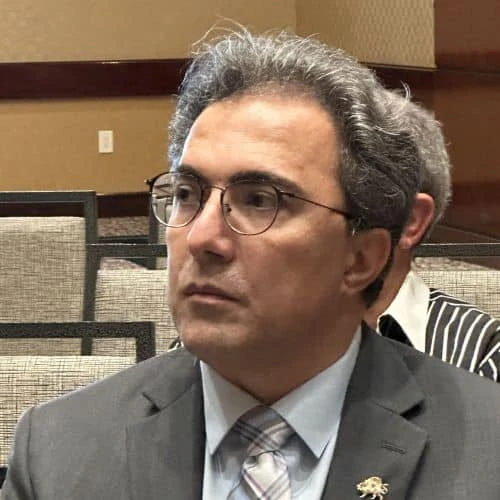
Swedish authorities extradited a man, who is accused of fleeing the United States with evidence that could have implicated his brother in antisemitic arson attacks in Massachusetts, to Boston on Friday.
Alexander Giannakakis, 37, was arrested in a suburb of Stockholm and served a prison term for illegal possession of weapons, including a gun.
Towards the end of his sentence, the Swedish Supreme Court ruled to honor the U.S. request for the former resident of Quincy, Mass., to be extradited. The Swedish government granted the request on Dec. 21, according to the U.S. Attorney’s Office for the District of Massachusetts.
Giannakakis, who arrived in Boston on Feb. 2, is scheduled to appear in federal court in Boston on Monday afternoon, in connection with May 2019 arson attacks on Jewish institutions in Arlington, Needham and Chelsea, Mass.
A federal grand jury indicted him in Boston in 2019 for, among other things, lying in a domestic terrorism investigation, concealing records in a federal investigation and tampering with documents, per the U.S. attorney’s office.
Giannakakis took electronic devices and papers that belonged to his younger brother, who became the main suspect in the arson attacks around February 2020, to Sweden, where he was living, per the indictment.
The U.S. attorney’s office alleged in 2022 that Giannakakis told investigators about one storage unit that his parents owned, but denied that his brother stored property anywhere else. The previous night, it alleges, he removed his brother’s belongings from a different storage unit, including “t-shirts with a swastika depicted on the front, a box with his brother’s name on it, his brother’s passport, a notebook with his brother’s name on it and a swastika drawn inside and a black backpack containing a bottle of cyanide.”
Around February 2020, when Giannakakis’s brother became the prime suspect in the case, the latter was in a coma in the hospital. He died later that year.
He was suspected of setting fires at a Chabad center in Arlington (on May 11 and May 16, 2019), at a Chabad center in Needham and at a Jewish business in Chelsea (May 26, 2019).
Investigators questioned Giannakakis in March 2020 when he returned stateside and “made false and misleading statements,” according to court documents. “Giannakakis allegedly removed and concealed physical evidence being sought by investigators which implicated his brother,” the U.S. attorney’s office stated.
Giannakakis returned to Sweden, where he remained until he was arrested in February 2022.
He faces up to 76 years in prison, 15 years of supervised release and $1.25 million in fines for the five offenses.