In recent weeks, former Fox News host and current podcast Tucker Carlson has been asking a series of questions about the joint U.S.-Israeli war against Iran. Why did America strike? Who pushed the United States into the conflict? Could the war somehow be tied to Israel’s religious aspirations regarding the Temple Mount in Jerusalem?
Carlson insists that he is merely asking questions. His defenders argue that criticism of foreign policy—specifically, American involvement in Middle Eastern wars—is entirely legitimate. On that point, they are correct. Americans have always debated foreign policy, and vigorous disagreement is healthy in a democracy.
But there is something about Carlson’s line of questioning that should sound familiar to students of American history.
The pattern is not new.
In the early 1920s, industrialist Henry Ford used his newspaper, The Dearborn Independent, to publish a series of articles later compiled as “The International Jew.” The publication presented itself as investigative journalism. Week after week, it raised some “questions” about Jewish influence in banking, politics and world affairs. The articles suggested that Jews manipulated governments and pushed nations into wars that served their interests.
Ford didn’t always make direct accusations. Instead, he initiated suspicions. He hinted and prodded. He invited readers to draw their own conclusions.
The result was one of the most influential antisemitic propaganda campaigns in American history.
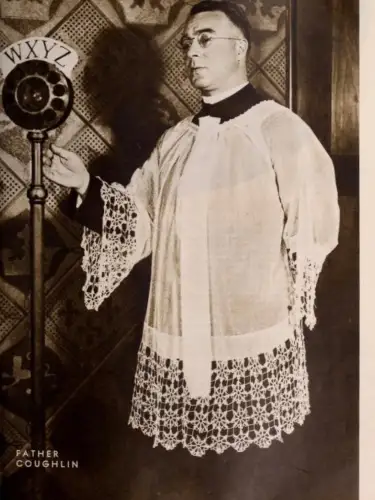
A decade later, the Catholic priest Charles E. Coughlin reached tens of millions of Americans through his radio broadcasts. Like Ford before him, Coughlin framed his attacks on Jews and “international bankers” as populist criticism of elites and foreign entanglements. He claimed that he was defending ordinary Americans against hidden forces manipulating the country’s policies.
Coughlin also insisted he was simply raising questions.
Today, the technology has changed, but the rhetorical strategy remains remarkably similar.
Carlson’s podcast and streaming programs reach millions of listeners. His influence rivals that of major television networks. When he repeatedly asks why Israel supposedly benefits from American military action or suggests that hidden actors are pushing the United States into war with Iran, the implication is clear, even if it is never stated outright.
The technique is simple and effective: raise provocative questions while avoiding direct claims.
“Could this be about rebuilding the Third Temple?” Carlson recently asked.
No evidence is offered. None is required. The power of the insinuation lies precisely in its vagueness. Once such ideas are planted, they circulate widely across social media, detached from the context in which they were first raised.
None of this means that criticism of Israeli policy is antisemitic. It is not. Israelis themselves engage in vigorous debate about their government’s decisions every day.
Nor is isolationism inherently antisemitic. Americans have long debated whether the United States should intervene abroad or focus primarily on domestic concerns.
However, there is a clear line between legitimate debate and the revival of a familiar historical trope: the suggestion that Jews—or the Jewish state—are manipulating great powers into wars for their own purposes.
That accusation has a long and ugly history.
It was used against Jews in Europe for centuries. It surfaced in America during debates over World War I and World War II. It animated the propaganda of figures like Ford and Coughlin. And it helped fuel antisemitic movements on both sides of the Atlantic.
History shows that once this narrative gains traction, it rarely stops with criticism of Israel. It inevitably expands into suspicion toward Jews more broadly.

For those of us who have experienced Iran’s terrorism firsthand, the current debate has an additional dimension.
My daughter Alisa was murdered in a 1995 terrorist bombing in Israel carried out by terrorists who were funded and trained by the Iranian regime. In the years since her death, I pursued legal action against Iran in U.S. courts and obtained judgments recognizing its responsibility for sponsoring terrorism that killed Americans.
Iran’s leaders openly call for Israel’s destruction and have spent decades funding terrorist groups across the Middle East. Confronting that regime is not some mystical religious crusade or geopolitical conspiracy. It is a response to a government that has made violence against Americans and Israelis a central pillar of its policy.
Americans are free to debate how best to confront that threat. Reasonable people can disagree about strategy, diplomacy and military action. But history teaches us to pay attention when influential voices begin framing those debates through insinuations about Jewish motives or Israeli manipulation.
A century ago, Henry Ford used the pages of his newspaper to raise similar questions. A decade later, Father Charles Coughlin used the new medium of radio to spread the same suspicions to millions of Americans.
Today, the medium is podcasts and social media. But the formula hasn’t changed.
The insinuation is familiar. The questions sound the same. And history warns us where such questions can ultimately lead.