Newsletter
Newsletter Support JNS

Israeli university uses AI to decipher ancient Hebrew, Aramaic texts

Engineering students at Ben-Gurion University are employing Mask Language Modeling to get to the bottom of damaged, centuries-old inscriptions.

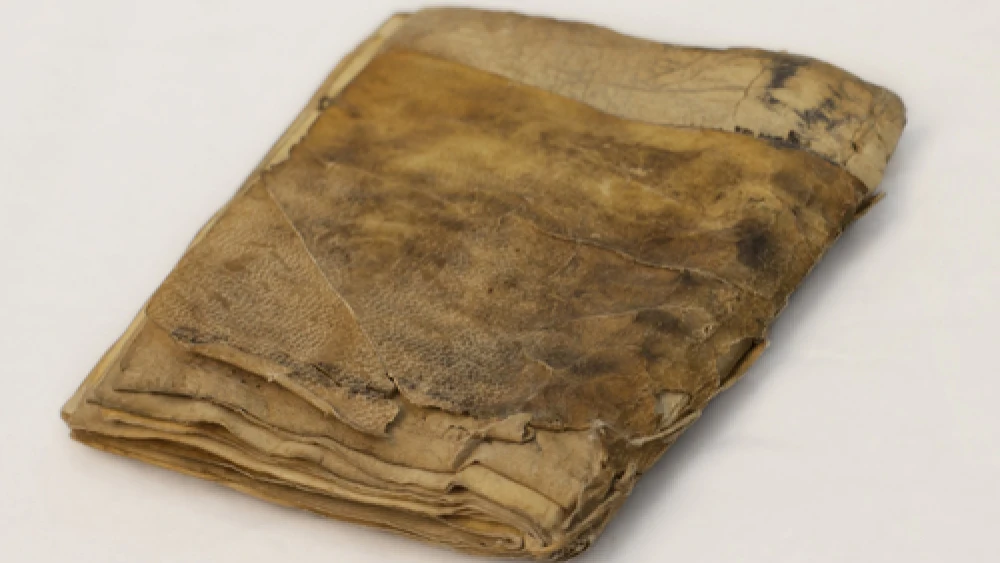
The oldest Jewish "siddur" ever found is part of the Green Collection, which will be donated to the future international Bible museum in Washington, D.C. Credit: The Green Collection.
The oldest Jewish “siddur” ever found is part of the Green Collection, which will be donated to the future international Bible museum in Washington, D.C. Credit: The Green Collection.

Artificial Intelligence is going biblical.

That’s the message emanating from Ben-Gurion University of the Negev, which is using state-of-the-art AI to decipher ancient Hebrew and Aramaic texts uncovered throughout the Near East.

Engineering students at BGU are now employing Mask Language Modeling to get to the bottom of these centuries-old inscriptions, which have been marred over time by earthquakes, fires, political conflicts and other natural and human-related causes, the university announced on Tuesday.

Previously, epigraphists encountered a major challenge in reconstructing the missing parts of such valuable writings and had to use time-consuming manual procedures to make out an approximation of the missing content.

Through the AI technique, the damaged content, whether single characters, partial words, single complete words, or multi-words, can be reconstructed more efficiently.

Students successfully tested the technology by taking hundreds of sentences from the Bible and applying them to corrupted inscriptions in Hebrew and Aramaic.

Their model, “Embible,” was highlighted last month at the latest meeting of the European Chapter of the Association for Computational Linguistics.

“We can help historians who have devoted their lives to recreating these ancient texts as accurately as possible,” said BGU professor Mark Last. “Furthermore, I believe the model can be extended to cover other ancient languages.”


Etgar Lefkovits is an award-winning international journalist who is an Israel correspondent and feature news writer at JNS. A native of Chicago, he has two decades of experience in journalism having served as Jerusalem correspondent in one of the world’s most demanding positions. He is now based in Tel Aviv.
There was never a question whether bar and bat mitzvahs were going to continue, says Rabbi Marla Hornsten at Temple Israel, despite the havoc that had teachers and children evacuate the building.
“We will not rest in the mission to stop the spread of radical Islam,” Texas Gov. Greg Abbott stated.
The panel conducts research on antisemitic activity and works with public and private entities on statewide initiatives on Holocaust and genocide education.
“If it’s something that families are attuned to, then I think it may be a good way to engage the kids on that level,” Rabbi Steven Burg, of Aish, told JNS.
“I was a little surprised at the U.K. to be honest with you,” U.S. President Donald Trump told reporters at the White House. “They should have acted a lot faster.”
“It is imperative that university administrators rise to the occasion to take a firm stand against antisemitism and racial violence,” Sen. Bill Cassidy wrote.