


After moving to a different house in his native Netherlands, Marco Schouwenaar was looking forward to lighting a large menorah on the windowsill, following the Chanukah custom of publicly advertising the miracle of the holiday. This year, however, that ritual will change.
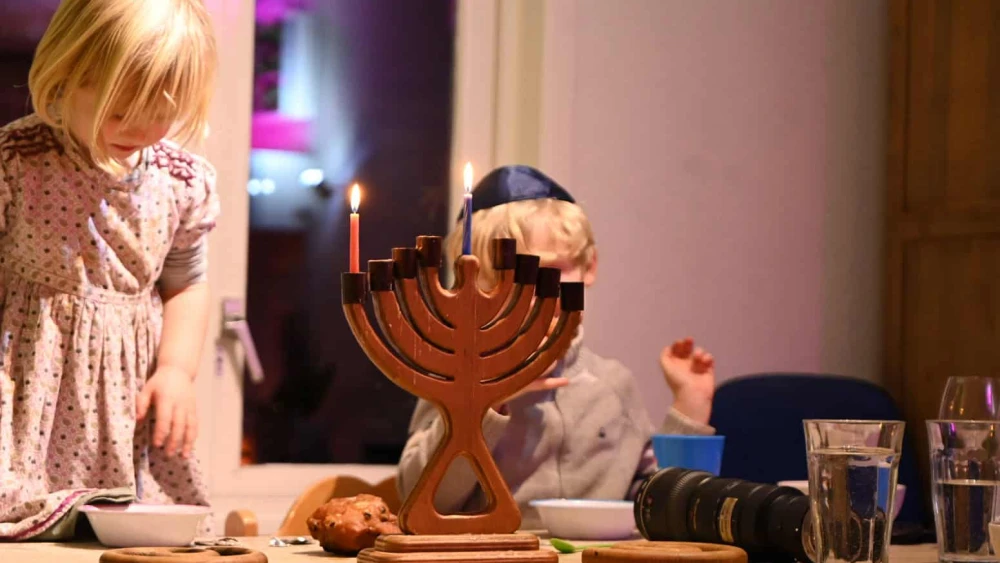
At his wife’s urging, Schouwenaar will instead place the menorah inside the living room of their home in Nijmegen, its light meant only for those inside.
The subtle shift reflects a broader response by European Jews to a sharp rise in antisemitism—an increase that has been building for roughly 25 years but intensified dramatically after Hamas-led terrorist attacks in southern Israel on Oct. 7, 2023.
While some have reacted by projecting their identity outward with defiance, others are pulling back, withdrawing public expressions of Judaism due to violence, intolerance, intimidation and growing doubts about the long-term viability of a robust Jewish presence in Europe.
Both reactions coexist in the household of the Schouwenaar, who are both Jewish and have four children. “I think we should celebrate visibly and publicly, without fear,” Schouwenaar, 57, told JNS. “But it’s making my wife uneasy, and I’m going to follow her lead here.”
Jews and Jewish community leaders in several countries told JNS of a growing reluctance to display a menorah at home this Chanukah.
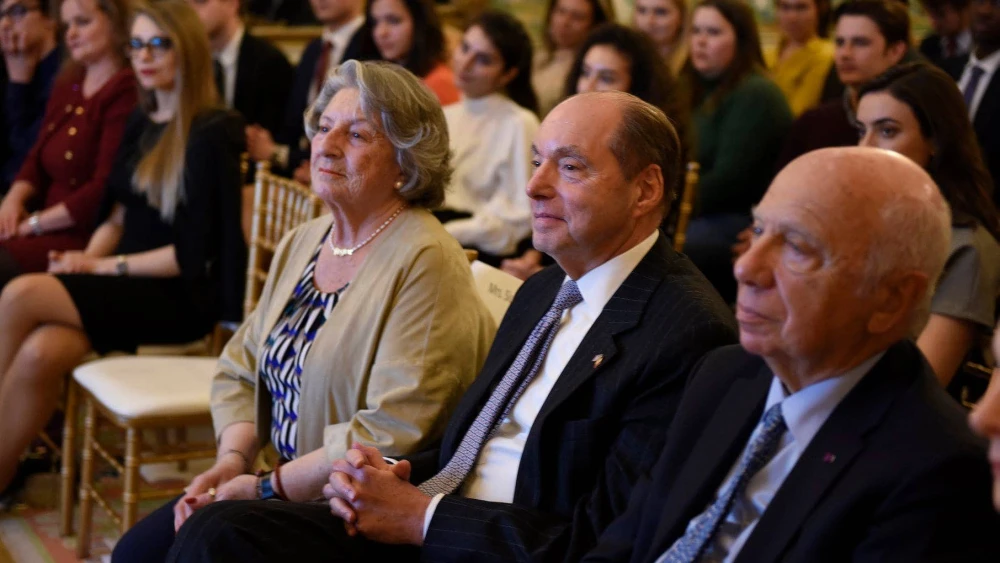
In Antwerp, Belgium, some Jews “asked not to do it now, because it’s so terrible, the antisemitism,” said Baroness Regine Sluszny, president of the Forum of Jewish Organizations of Belgium’s Flemish Region.
Sluszny, an 86-year-old Holocaust survivor, said the trend marks a return to pre-genocide norms. “Antwerp Jews didn’t generally display menorahs. It was part of living in a non-Jewish environment,” she said, noting that this began to change in the 1960s.
Back then, Belgium saw Jewish immigration from Eastern Europe and the United Kingdom. “Today, very few people who weren’t born here would start a Jewish family here. There’s too much hostility,” she said.
‘Don’t want to ‘stick out’ too much’
A 2024 European Union survey of nearly 8,000 Jews in 13 member states found that about 40% were “rarely” or “never” open about being Jewish at work or school, while 33% and 41% said they frequently hid their Jewish identity in those settings.
Italy, the Netherlands and Germany recorded their highest-ever numbers of antisemitic incidents in 2024, while the United Kingdom and France reported their second-highest tallies.
On Oct. 7, the terrorists killed 1,200 people and abducted another 251, triggering Israel’s two-year war against Hamas in Gaza and subsequent conflicts with Hezbollah, Iran and the Houthis in Yemen.
The attack prompted street celebrations by thousands of Muslims across Europe, alongside an initial wave of solidarity with Israel. But this later faded as Israel pursued its military campaign. Mass protests against Israel followed, accompanied by media coverage that Israel’s advocates say fueled antisemitism.
Yoni Wieder, Ireland’s chief rabbi, said that “even in the best of times, some Irish Jews prefer not to place a chanukiyah in the window—not out of fear, but because they don’t want to ‘stick out’ too much or simply don’t feel comfortable doing so.”
That said, he added, “I wouldn’t be surprised if this year some people here are more hesitant about displaying Chanukah lights visibly.”
‘Don’t think it’s wise to mark your home’
Others have moved in the opposite direction.
In Malmö, Sweden, Ilana Edner has increased her public displays since Oct. 7. She places menorahs in both her street-facing and rear-facing windows and flies Israeli flags on her balcony alongside the European-style date “7/10.”
More than merely a statement, these symbols carry risks in a city that has been a hotbed of antisemitism for the past 20 years and where about a third of the population is Muslim, including many thousands of Iraqis, Syrians and Palestinians.
“I find it important to demonstrate that I exist, unafraid,” she told JNS, despite harassment from students at a nearby, heavily Muslim high school. “After Oct. 7, I don’t care anymore what they think.”
Across Europe, public menorah-lightings—often organized by Chabad—will still take place, including in Nijmegen and across Amsterdam, such as the annual event on Dam Square.
Yet even these have grown harder to stage. In Amsterdam’s heavily Jewish Buitenveldert neighborhood, a public menorah-lighting at the Gelderland Square mall was canceled at shop owners’ request, said resident Marja Goldstoff, noting that Christmas decorations remain ubiquitous. The Goldstoffs, who in 2023 camouflaged their mezuzah for security reasons, have also since moved their menorah indoors. “It just doesn’t feel safe anymore,” she said.
Last month, the Royal Concert Hall in Amsterdam canceled a Jewish group’s Chanukah event because the cantor scheduled to perform in it was an Israeli who serves in the Israel Defense Forces. The concert was rescheduled amid legal action, a public outcry and allegations of open antisemitism.
While some Jewish leaders reported no concerns about menorah displays, including in places like Halle, Germany, where a neo-Nazi targeted a synagogue in 2019, others said they would refrain this year.

A Jewish woman in Bologna told JNS that she would not display a menorah anywhere in the city. An Israeli living in Paris said the decision is highly location-specific, with detached homes and street-facing windows posing greater risks.
“In an apartment building, there’s no problem. In a detached home, a rear-facing window’s better. It depends on the neighborhood and even traffic outside the relevant window,” he said, speaking anonymously. “But right now, I don’t think it’s wise to mark your home, self and family. It’s sad, but I think that’s how it is.”
One Israeli, Nimrod Hazan, plans to display a menorah publicly for the first time after moving with his wife from an urban setting to a small village in the Netherlands. “For the first time, the menorah’s going to be on the windowsill, and the mezuzah will be on the outside of the doorframe,” he said.

Rabbi Menachem Margolin, chair of the European Jewish Association, said authorities are making efforts to secure Chanukah celebrations, including high-profile events attended by European Commission leaders.
“At the same time,” he said, “Jews are afraid to show their Jewish identity in public, so much work remains to be done.”
Back in Nijmegen, Schouwenaar said the question of where to place a menorah pales beside larger uncertainties. Oct. 7, he stated, “let the genie of antisemitism out of the bottle.”
With one son in Israel and three in the Netherlands, he hears a question increasingly voiced by Jews around him: whether that genie can be put back or whether it is time to leave Europe altogether.



