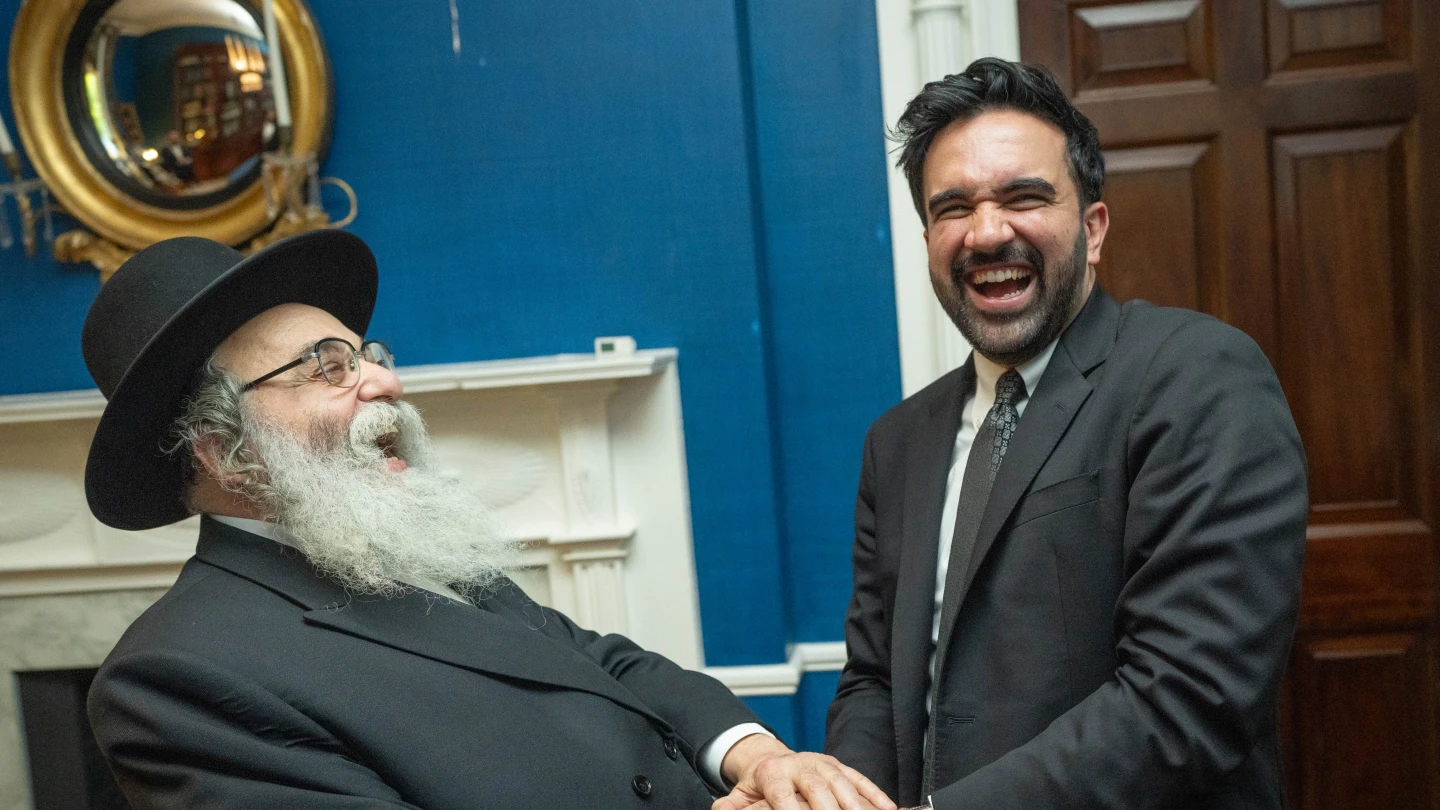
Likud lawmaker Eli Dallal spoke, in an interview with JNS at the Knesset in Jerusalem, about his vision on core issues concerning Israel’s security, including Gaza, Lebanon and Iran. He called on all Knesset members to unite for the good of the nation.
“I think the country needs less division. There are good people in the opposition and in the coalition. We need to work together in the interest of the country. The opposition voted in favor of my two pieces of legislation concerning youth,” Dallal said.
“We also vote with them on certain bills. Each side tries to pull things in its own direction—it’s part of the game,” he added.
A member of the Joint Committee for the Knesset Budget, Dallal said the 2026 state budget is highly complex and designed to address a wide range of challenges facing the country.
“Over the past two years, we have been dealing with a difficult war, which has required allocating significant resources to support the defense establishment. We are talking about more than 250 billion shekels [about $78.5 billion] allocated to the defense budget over the last two years,” he said.
Additional challenges include compensation funds for the rehabilitation of Israel’s north and south following the Oct. 7, 2023, Hamas-led onslaught on Israel, Dallal noted.
“Last year, we allocated close to 18 billion shekels [$5.65 billion] to rebuilding kibbutzim in the ‘Gaza Envelope.’ In the north, we need to address the impact of the war and provide compensation for damaged buildings and for people who were forced to leave their homes,” he said.
“There are also challenges in areas such as education, health and welfare. The country has found itself facing major challenges, and I believe the budget provides answers to almost all of them,” Dallal continued.
Israel’s Cabinet approved the 2026 state budget last month, totaling approximately 662 billion shekels (about $205 billion), with a deficit ceiling of 3.9% of GDP. The draft budget must still pass three readings in the Knesset.
The budget vote comes as Israel works to stabilize its economy following prolonged conflict since the Hamas-led attacks on Oct. 7, 2023. Failure to pass the budget by the March 31 deadline would automatically trigger snap elections to be held within 90 days.
Israeli Prime Minister Benjamin Netanyahu told Fox News on Tuesday that progress toward the next phase of the Gaza ceasefire depends on Hamas agreeing to disarm, calling the terrorist group’s refusal to give up its weapons the main obstacle to stabilizing the territory in 2026.
Netanyahu said the next stage of U.S. President Donald Trump’s peace plan—which calls for Gaza’s full demilitarization and the deployment of an International Stabilization Force—has stalled due to Hamas’s actions.
Addressing coalition agreements tied to the budget, he noted that Israel’s system of governance is coalition-based, with each Knesset faction seeking to advance its own priorities.
“Each faction wants to have a ministry of its own, but we can’t give ministries to everyone. Even if we close some ministries, it doesn’t mean there won’t be budgets. The minister and his staff won’t be there, so we might save half a million or a million shekels at most,” he said.
“I would also support closing ministries, but we don’t have much choice. We want to maintain a stable government. This coalition has been stable for three years. We have another year ahead, and I believe we will complete a full four-year term. That is part of the trade-off of a coalition-based system,” he added.
(A national election must be held by Oct. 27.)
The democratic world against Iran
Turning to the war with Iran—an issue that featured prominently in Netanyahu’s meeting with U.S. President Donald Trump in Florida on Monday, alongside discussions on advancing Trump’s 20-point peace plan for Gaza—Dallal said the conflict is not solely Israel’s war. Rather, he argued, Israel is fighting on behalf of the European Union and democratic countries worldwide.
“We are on the front line, and the proof is that President Trump joined us in this war,” Dallal said. “We were the tip of the spear for the democratic world against Iran. It is simply good versus evil.”
The IDF is accelerating preparations for a possible multi-front war with Iran amid growing internal unrest in the Islamic Republic, Hebrew media reported on Wednesday.
According to Israel’s Channel 12 News, the preparations are part of the IDF’s multi-year plan extending roughly to 2030 and anticipate conflict involving Iran, Lebanon, and Judea and Samaria.
The developing war plans reportedly take into account the possibility that Iran’s leadership could choose to attack Israel in an effort to prevent being overthrown by the Iranian people. A large-scale “surprise war” with Tehran and its regional terror proxies could, for the first time, include Israeli attacks conducted “in and from” outer space, the report said.
On Gaza, Dallal said Israel would like to move to Phase 2 of Trump’s peace plan, but not all the requirements of the first phase have been fulfilled.
“In the first stage, all the hostages needed to be returned, and we still have one hostage who has not been returned. I hope he will be returned quickly,” he said, referring to Israel Police Master Sgt. Ran Dvili.
“The next stage is the demilitarization of Gaza, which means removing all the weapons from Gaza and from Hamas. I hope it will happen. How will it be done? I don’t know, but this is what needs to be discussed—how to disarm Hamas and demilitarize Gaza. The moment it happens, both civilians in Gaza and we will be on track to eventually enjoy neighborly relations,” he continued.
Lebanon’s government claims it is close to disarming the Iranian proxy Hezbollah. Dallal said he hopes the claim is accurate but noted there have been several disappointments on the issue in the past.
“There cannot be another army that acts against the interests of the state, and this is what Hezbollah does. It brought chaos to Lebanon, and as such, I think this agreement, supported by President Trump, aims to create a situation in which Hezbollah is disarmed and peace and partnership can be created between both countries,” he said.
Hezbollah Secretary-General Naim Qassem on Sunday again rejected efforts to disarm Iran’s Lebanese terrorist proxy, claiming they amount to an “Israeli-American plan.”
Speaking at a ceremony marking the second anniversary of the death of senior Hezbollah official Mohammad Yaghi (Abu Salim), Qassem said that demands for exclusive arms control while Israel “is committing aggression” and the United States “is imposing its will on Lebanon” serve Israeli, rather than Lebanese, interests, AFP reported.
Under a U.S.-backed ceasefire agreement, the Lebanese military is working to complete Hezbollah’s disarmament south of the Litani River by the end of the year.
Dallal said that peace in the Middle East, as demonstrated by the Abraham Accords, has proven to be both the most viable outcome for the region and the most desired one for Israel.
“We see an expansion in tourism, industries and investments in the Emirates and other parties that signed the accords. This is how it should be. We need to end the wars, end the hatred and move on the road to peace, but it doesn’t depend only on us. Some of our neighbors teach and educate their children to hate Jews and Israel,” Dallal said. “We need to ensure that education promotes peace and not war.”
The right to be forgotten
As a former head of the Knesset Special Committee on the Rights of the Child, Dallal has promoted legislation related to youth, which he said would benefit not only Israelis but young people worldwide.
“If a young person makes a mistake at a certain point in their youth and it is published on social media, that mistake can follow them their entire life. My legislation states that, based on certain criteria, the justice minister can demand that social media platforms remove the publication,” Dallal said.
“It’s like having a criminal record removed. It’s an image issue. For example, if someone takes a picture of a young girl half-naked and publishes it on social media—someone else did it, but it can accompany her said entire life, even after she gets married and has children. It’s not fair,” he continued.
“It will now be possible to delete it. It’s called the right to be forgotten,” Dallal said.
The legislation has passed its preliminary reading and will now move to the Constitution, Law and Justice Committee, before returning to the Knesset for additional readings.
Another bill initiated by Dallal addresses providing minors with automatic representation by defense attorneys.
“My bill calls for minors to have a defense attorney automatically from the first hearing. These are two pieces of legislation that help children who find themselves in distress,” he said.
Dallal also told JNS that he initiated legislation calling for the separation of roles within the Attorney General’s Office.
“Today, the attorney general also serves as the general prosecutor—thus both a critic and an advocate for the government, and that role cannot exist. As such, it should be split. This is a major reason the government is not succeeding in implementing decisions,” he said.
Addressing legislation on ultra-Orthodox conscription, Dallal said, “I believe that everyone needs to serve the country. If you live in Israel, you need to give back to the country, whether you are Jewish, Arab, Muslim, Christian or Druze. If you can serve in the army and the army wants you, perfect. If you are Muslim and want to give back differently, you can serve in your community, in hospitals, community centers or schools, or be part of the firefighters or the municipal police,” he said.
As Israel is the Jewish state, Dallal said a framework must be created in which those who study Torah may continue to do so, while those who do not are required to enlist.
“There may be 1,000 or 2,000 ultra-Orthodox who study Torah out of 15,000 [men who reach draft age in each annual conscription cycle]. They cannot all be exempted. This is not right for equality in the country, and it also puts the country—which needs people to fight and protect it—in a difficult situation,” he said.
The draft legislation presented by fellow Likud lawmaker Boaz Bismuth requires revisions, Dallal said.
“It needs to be accompanied by a clear statement that every person who does not study Torah must enlist. At the moment, this is not the case,” he said.