


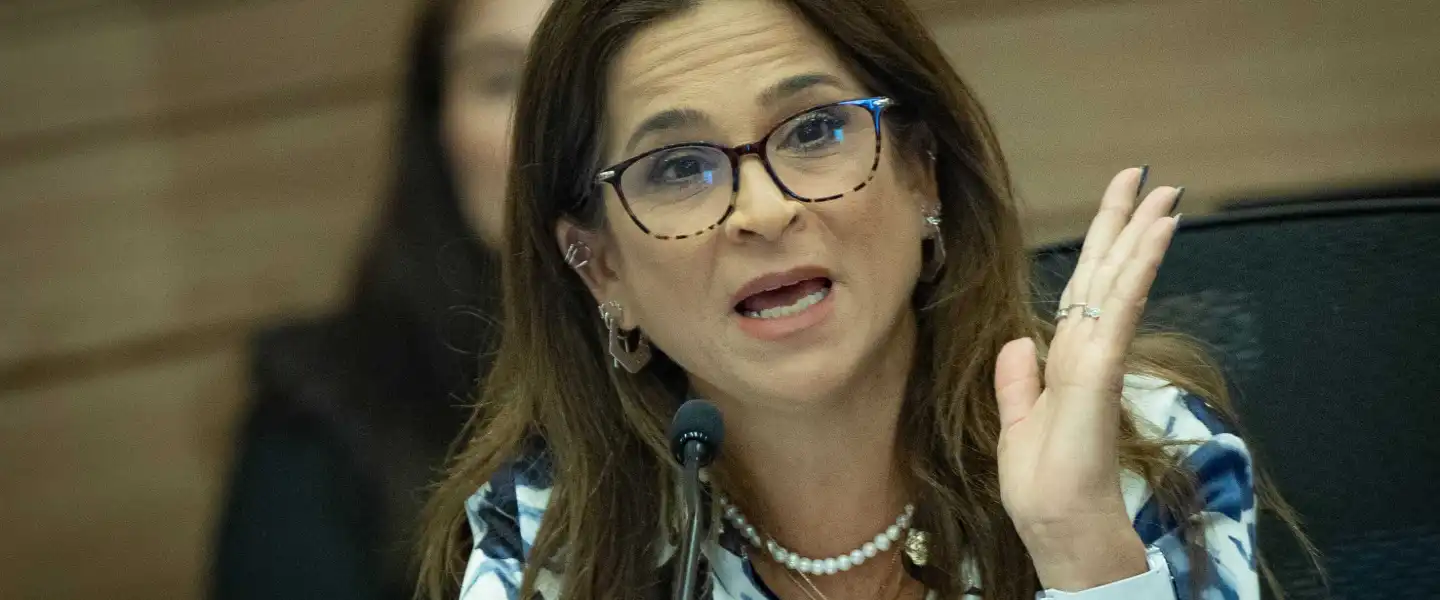
Yesh Atid legislator Meirav Ben-Ari, in a recent conversation with JNS, questioned the composition of U.S. President Donald Trump’s Board of Peace, saying it was unusual that countries with no apparent commitment to human rights were included in a forum intended to promote peace.
A longtime advocate for social issues, Ben-Ari was named the coalition’s most socially conscious lawmaker five consecutive times. As an opposition legislator in the 25th Knesset, she serves on several Knesset committees, including the National Security Committee and the Committee on the Status of Women and Gender Equality.
Speaking to JNS in her Knesset office in Jerusalem, Ben-Ari said she does not fault Prime Minister Benjamin Netanyahu for agreeing to participate in the Board of Peace, noting that the United Nations is a deeply problematic body biased against Israel.
“Our complaints relate mostly to the hypocrisy surrounding the crimes of Hamas on Oct. 7, 2023, and the latent antisemitism within the organization,” she said.
At the same time, Ben-Ari cautioned that the alternative may also be flawed, given that some participating countries have demonstrated an utter disregard for human rights.
Netanyahu’s office announced last month that the prime minister had accepted Trump’s invitation to join the Board of Peace. The Prime Minister’s Office had previously criticized the inclusion of Turkey, Qatar and Egypt in the Gaza Executive Board, a subordinate body tasked with advising the Board of Peace.
A lawyer by training, Ben-Ari holds a B.A. in law and government from the Interdisciplinary Center Herzliya, now Reichman University, and an MBA from the same school specializing in public leadership. She was the first woman to lead the institution’s student union.
She joined Asaf Zamir’s Rov Ha’ir party in 2008 and was elected to the Tel Aviv–Jaffa City Council in 2013. She entered the Knesset in 2015 as part of Moshe Kahlon’s Kulanu party.
Throughout her parliamentary career, Ben-Ari has been active in caucuses addressing issues such as higher education, LGBT rights, lone soldiers, celiac disease, and at-risk children and youth. She currently serves as opposition coordinator and faction chair for Yesh Atid, a role that includes refining legislation and budgets, submitting reservations (proposed amendments to bills ahead of their second and third (final) readings in the plenum) and overseeing the Knesset agenda.
Ben-Ari has advanced a range of legislative initiatives, including a bill regulating the use of water cannons for crowd control and limiting them to clean water only; a sexual harassment reporting bill requiring the Israel Defense Forces, Israel Police and Israel Prison Service to submit annual reports to the Knesset; legislation mandating the transfer of older rape kits to the Police Medical Records Office for safekeeping; the electronic monitoring law aimed at preventing domestic violence, which was passed by the Knesset after being promoted by the opposition; and the so-called Continuity Law, which would allow widows—and, under certain legal conditions, parents—to use the sperm of murdered victims for procreation.
What kind of country
Looking ahead, Ben-Ari said this year’s election—a vote must be held by Oct. 27—is unlikely to be framed as a traditional left-right contest, arguing that Israelis agree on roughly 80% of key issues.
“They agree on being against Iran, Hamas and Hezbollah. The election will be about what kind of country Israel will be, and whether it will be a liberal country centered around human rights, LGBT rights and women’s rights,” she said.
Ben-Ari voiced strong opposition to Likud MK Galit Distel-Atbaryan’s “Law for the Realization of Jewish Identity in the Public Sphere,” which seeks to anchor in law the right to lay tefillin in public spaces. She said the legislation is unnecessary, arguing there is no general problem with laying tefillin in public areas in Israel.
During Yom Kippur in 2023, prayers in Tel Aviv public spaces were disrupted and worshippers forced to disband their services after they erected a mechitza separating men and women. Mayor Ron Huldai had barred segregated prayer in public spaces, a decision later upheld by the Supreme Court.
Addressing her past remarks about Hadash-Ta’al MK Ayman Odeh, whom she said should not be in the Knesset, Ben-Ari noted that Odeh has since announced he would not seek reelection. She said her criticism reflected her view that he no longer represents the interests of Israeli Arabs, instead prioritizing the Palestinian issue over his constituents’ needs.
As Israel braces for another confrontation with Iran, Ben-Ari said the government is unlikely to act without U.S. involvement. “I don’t know what the Americans will do; the situation seems tense. Iran is an existential threat to the State of Israel, but Israel likely cannot and will not intervene until the Americans do,” she said.
Adm. Brad Cooper, commander of U.S. Central Command (CENTCOM), visited Israel over the weekend amid a U.S. military buildup in the region tied to rising tensions with the Islamic Republic. Cooper met with senior Israeli officials, including IDF Chief of Staff Lt. Gen. Eyal Zamir, in what the military described as an extended one-on-one meeting. Israeli security forces have since intensified preparations for a possible U.S. strike that could prompt an Iranian response.
In the north, Ben-Ari noted that the IDF strikes Hezbollah targets on a daily basis. “Hezbollah was severely damaged but not destroyed. It is too bad that we didn’t do so. It is one of many loose ends, including Iran and Hamas in Gaza. Hezbollah is a strong entity; unlike Hamas, it is embedded in the government, security services and banks in Lebanon—and the IDF has space to operate,” she said.
Turning to Trump’s 20-point plan and the idea of a reformed Palestinian Authority, Ben-Ari said Israel currently lacks a credible partner for peace.
“Even if one day we manage to have a partner there, it won’t be within the current Palestinian Authority constellation,” she said.


