In the world of academic Talmudic and Torah scholars, women authors are rarely read, and most Torah and books on Jewish law (halachah) are written by men. Between the challenges of balancing their robust lives as wives and mothers, female scholars often don’t have the financial backing or time to write serious books.
Enter Kitvuni, an initiative by the Matan Women’s Institute for Torah Studies in Jerusalem, a broad-based institute offering intensive Beit Midrash programs.
Kitvuni offers innovative and challenging learning opportunities for women of all ages and backgrounds, with a fellowship program offering women time, coaching and financial support to publish the serious Torah works they have always wanted to write.
The program, introduced three years ago, recently began to publish books researched and written by contemporary female Torah scholars, who are eager to break the glass ceiling of the Bet Midrash Study Halls.
“The books are being published by Matan and Maggid Books,” noted Yael Ziegler, head of the Matan Kitvuni Program and a Matan lecturer. “Although written on a high level and accessible to those well-versed in rabbinic sources, much of the material can also be integrated into high school and college curricula, and serve as valuable resources for community rabbis and educators,” she told JNS.
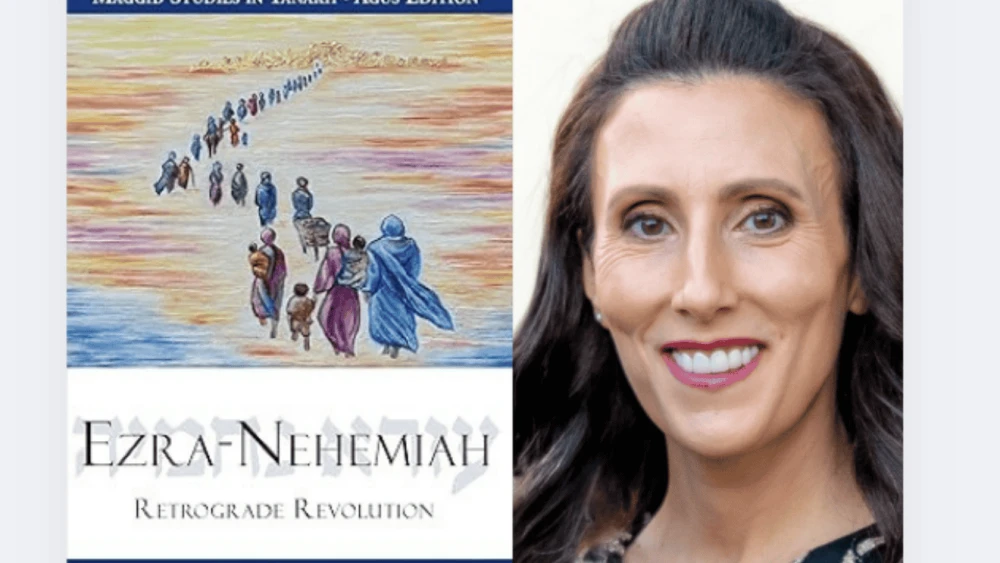
The first book in English to be published is Ezra-Nehemiah: Retrograde Revolution by Matan faculty member and Columbia University graduate, Yael Leibowitz, which explores revolutionary strategies employed by the Jewish leaders of the early Second Temple Period who were grappling with the challenges of reconstructing the Torah world.
“I chose to write about Ezra and Nehemiah because of all the biblical works of Tanach. It resonates most with the times we are living through,” Leibowitz said. “It talks about the Jews trying to rebuild a state after exile and all the challenges that entail. How to live alongside others, how to get back to our roots and understand what it means to be a Jew in the world, the agency we have in realizing that destiny.”
She continued, saying that “the awareness of the leaders rebuilding the land to maintain cohesion for the Jews living inside Israel and the Diaspora. It’s a book that talks about the ‘messiness’ of history and how decisions Jews have to make are never monolithic.”
Leibowitz said that according to Ezra and Nehemia, the ability to hear and synthesize the different voices of world Jewry is the root of Jewish resilience.
Also newly released is An Inner Look into Talmud, a book written in Hebrew by Merav Suissa. Head of Midreshet Siach Hasadeh, she holds a Ph.D. in Talmud. She began learning Talmud with her father, a rabbi in Shiloh, at age 8, even younger than most boys who learn Gemara.
“Forty years ago, girls didn’t really study Talmud,” she said. “But it was my father’s way of sharing something he really enjoyed with me. And it became a special way to spend time together.”
They started with the Tractate of Brachot and eventually expanded their learning to include other tractates pertinent to holidays or other things she was learning in school.
When asked what her favorite is, she laughed and said the question is like asking a parent which of her children she likes best. As a mother of six young kids, she says it is impossible to choose just one. She loves them all. Suissa doesn’t do the daily Talmud study (daf yomi) because she said that when she studied Talmud, she didn’t want to just read it.
“I prefer delving and absorbing it on a deep level,” she said.
She recalled discussing a passage from Sotah, about a woman who is sequestered alone with a man who is not her husband. “At first glance, it appears like a very not politically correct tractate, even chauvinistic,” she says. “When you read it, and capture the idea and understand the depth, you can really appreciate the relevance of the passages.”
Suissa is currently a lecturer in Talmud and a scholar at Bar-Ilan University in Ramat Gan. She wrote her book in six months, after being evacuated to a hotel from her home along the Israeli border with Gaza after the war began two years ago.
‘Done in a scholarly way’
Sharon Galper Grossman’s book, scheduled for release in mid-2026, focuses on Jewish law and preventive medicine. Based in Ra’anana, the Harvard-educated oncologist and graduate of Matan’s Morot L’Halakha program and other Matan Beit Midrash programs addresses halachic approaches to disease prevention, highlighting current topics such as using electronic cigarettes, cancer-screening tests and cutting-edge interventions.
By and large, many of the poskim (“scholars”) have come out in favor of screening tests, but she says there are still some people who are not aware of this, refuse to screen and choose to put their faith in God.
Genetic testing for the BRCA gene mutations, which are 10 times more common in Ashkenazi Jews compared to the general population and increase the risk of cancer, issues of confidentiality that arise when someone is found to carry the mutations, steps to take to reduce these risks such as surgery, recreational marijuana and vaccines, are all explored and run by rabbinical sources and authorities.
She devoted three chapters to obesity management and prevention, exploring the Jewish perspective on trans-fats, high-sugar foods and overeating, weight-loss surgery, medicine and alcohol use.
The book, which she started writing in September 2022, traces the development and evolution of the halachic perspective from its earliest sources to contemporary decisions.
In many cases, earlier poskim addressed these topics only indirectly, while more recent ones tackle them head-on. For those topics on which halachic authorities had not issued formal or in-depth rulings, she reached out to contemporary rabbis like Rabbi Eliezer Melamed to ask them to weigh in with their position.
One of her chapters, the one on trans-fats, required her to go back and forth between Melamed and Professor Walt Willett, former chairman of the Department of Nutrition for the Harvard School of Public Health, a world leader in the impact of nutrition and chronic disease, and Torah scholar. Even with her medical background, she said the book required numerous footnotes and clarifications and a lot of fact-checking.
“Because I’m writing a book on halachah and medicine,” she said, “I feel a lot of responsibility that the medicine is accurate and up-to-date, that the halachah is correct, and that everything be done in a scholarly way.”
Many of the books being written for Kitvuni center around the development of Jewish law in relation to highly significant topics for women, like the complicated Jewish laws pertaining to an agunah, a woman whose marriage status is uncertain or blocked, written by British legal scholar Chagit Blass.
The Kitvuni program offers a subsidy and writing support to high-caliber scholars who wish to dedicate time to serious Torah learning and writing. To date, 18 publications are planned—six slated for 2026, with more to come.