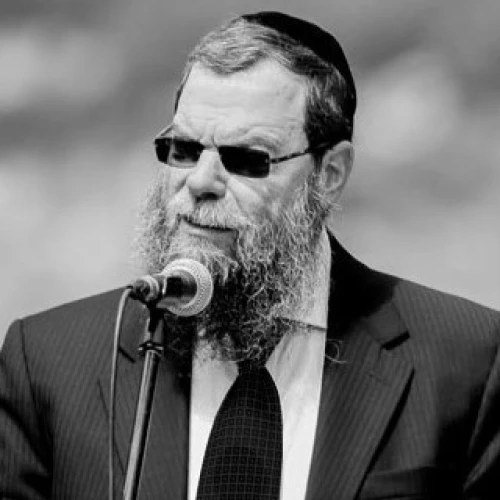
“We all do what we can. Some fight, others donate. We felt powerless, and we wanted to show the Israeli people that we haven’t forgotten them—or the 1,200 people murdered on Oct. 7. They are in our hearts,” said Charlie Taieb, creator of Minyan Everest, an initiative that brings Jewish prayer to the highest peaks on Earth.
His passion for mountain climbing began three years ago, when he turned 60, the French Jew told JNS on Thursday.
“I wanted to prove that it’s still possible to achieve great things,” he said. “In 2022, I decided to climb Mount Kilimanjaro, which is about 6,000 meters [19,341 feet] high. I had no previous experience in mountain climbing, but I set out with three friends, and we made it to the top.”
That first climb in Tanzania sparked a deeper pursuit.
“Mountain climbing is addictive,” Taieb said. “The following year, I wanted to add a spiritual element to the physical challenge. We traveled to Nepal to climb a 6,200-meter [20,340-foot] peak—and this time, we brought a Torah scroll.”
According to Jewish religious law, a quorum of 10 men, known as a minyan, is required for communal prayer. Taieb gathered a group of 10 and led what he calls the world’s highest minyan.
“We aimed to reach the highest possible altitude to perform our prayer together,” he said.

In 2024, Taieb returned to Nepal with a new group of 10 climbers on a mission to ascend Chulu East, which stands at 6,584 meters (21,610 feet). This time, the initiative included not only reading from a Torah scroll but delivering a humanitarian message calling for the release of hostages still being held by Hamas in Gaza.
The group received support from French organizations, including Le Collectif du 7 Octobre. Although the climbers’ goal was to reach the summit, they were forced to stop at 6,100 meters (20,000 feet) after encountering an impassable crevasse.
The latest expedition took place in late April and early May, with 12 climbers attempting to scale Mera Peak in northeastern Nepal. A banner bearing the names of the Oct. 7 victims was created as part of the tribute. Despite the thin air, extreme cold and physical exhaustion, five members of the team reached the summit—6,476 meters, 21,247 feet—on May 6.
At the top, they unfurled their banner, opened the Torah scroll and recited the Kaddish mourning prayer in memory of those murdered by Palestinian terrorists.
As the group ascended, Sherpas advised them to leave behind the 10-kilogram (22-pound) Torah scroll and banners to lighten their load. Taieb and his team explained that the purpose of the journey was to honor the victims of Oct. 7, 2023. It was then that the Sherpas informed them that 10 of their fellow Nepalese countrymen had also been killed in the attack.
Upon learning this, the team searched the banner and found the 10 names among the 1,200 victims.
“There was such overwhelming emotion among the Sherpas as they realized that a group of French people had come to their country to pray for Nepalese people they didn’t know but who had been massacred by Hamas,” Taieb said.
Taieb described the climb as a physically and mentally grueling experience, made bearable only by the mission.
“The only thing that kept us going was the promise we made to honor these people and the message we wanted to bring with us to the top,” he said. “It allowed us to go way beyond our physical and mental limits.”
That motivation came in part from families of hostages who had reached out to the group before the climb, asking them to pray for their loved ones. “We carried those prayers with us,” Taieb said.
Once they reached the summit, the group stayed significantly longer than climbers typically do—45 minutes instead of the usual five. “The goal is usually to descend as quickly as possible to get oxygen and avoid pulmonary edema,” Taieb noted. “But for us, the mission came first.”
As a result of staying longer than recommended, all five climbers who reached the top, including Taieb, developed fluid in their lungs, a condition caused by prolonged exposure to high altitudes with low oxygen levels.
After the descent, the group rested for a day in Kathmandu before flying back to Paris.
“I had blurred vision, I couldn’t eat, and I experienced psychological and respiratory distress,” Taieb recounted. “The brain needs oxygen, even just to sleep. You accumulate exhaustion over time. But with such a powerful message pushing us forward, we couldn’t give up.”