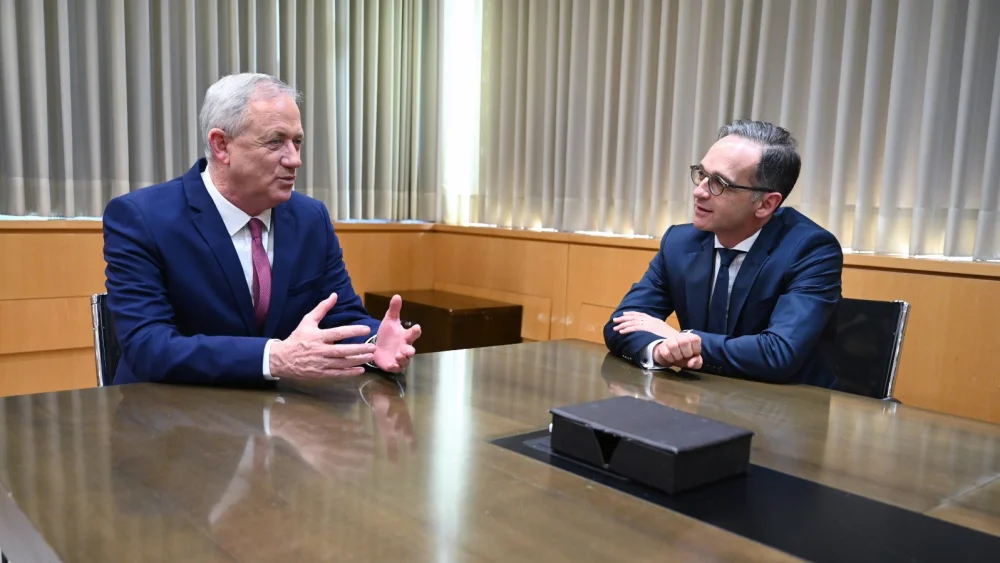
Israeli Defense Minister and Vice Premier Benny Gantz told visiting German Foreign Minister Heiko Maas on Wednesday that the Peace to Prosperity Middle East peace plan, rolled out by President Trump in January, is “an historic opportunity that should be promoted responsibly and constructively, in dialogue with the American government and with various regional and global players.”
Gantz met with Maas in Jerusalem, during the latter’s lightning trip to the region, where he had come, in large part, to discuss Germany’s and the European Union’s concerns over Israel’s stated plan to begin applying Israeli sovereignty to parts of Judea and Samaria on July 1.
Following the meeting, Gantz tweeted, “I thanked [Maas] for his personal involvement in outlawing Hezbollah’s activities on German soil and for his active efforts to battle anti-Semitism and anti-Zionism. I will do everything in my power to strengthen the cooperation with Germany, a true friend of Israel.”
Maas also met with Israeli Prime Minister Benjamin Netanyahu and Foreign Minister Gabi Ashkenazi. According to an official statement issued by the Prime Minister’s Office, Maas asked Netanyahu about the Israeli government’s intentions regarding Trump’s peace plan. Netanyahu responded that Israel’s vital interests, including complete security control west of the Jordan River, must be included in any future agreement with the Palestinians. He also said that any realistic plan has to recognize the reality of Israeli settlement on the ground, and not foster the illusion of uprooting people from their homes.
In May, the German-Palestinian Steering Committee, chaired by Maas and Palestinian Authority Prime Minister Mohammad Shtayyeh, released a joint statement that “noted with grave concern the agreement between coalition parties in Israel to advance plans for annexation of occupied Palestinian territories as stipulated in the Israeli coalition agreement signed on 20 April.”
After meeting with Israeli officials, Maas—whose country will assume the European Union Council presidency on July 1—stopped over in Jordan before returning to Germany.
At a joint press conference with Jordanian Foreign Minister Ayman Safadi in Amman on Wednesday, Maas said, “We are very worried about the repercussions of the annexation decision. We in the E.U. agree and are committed to the two-state solution and reject unilateral action and plans to annex.”