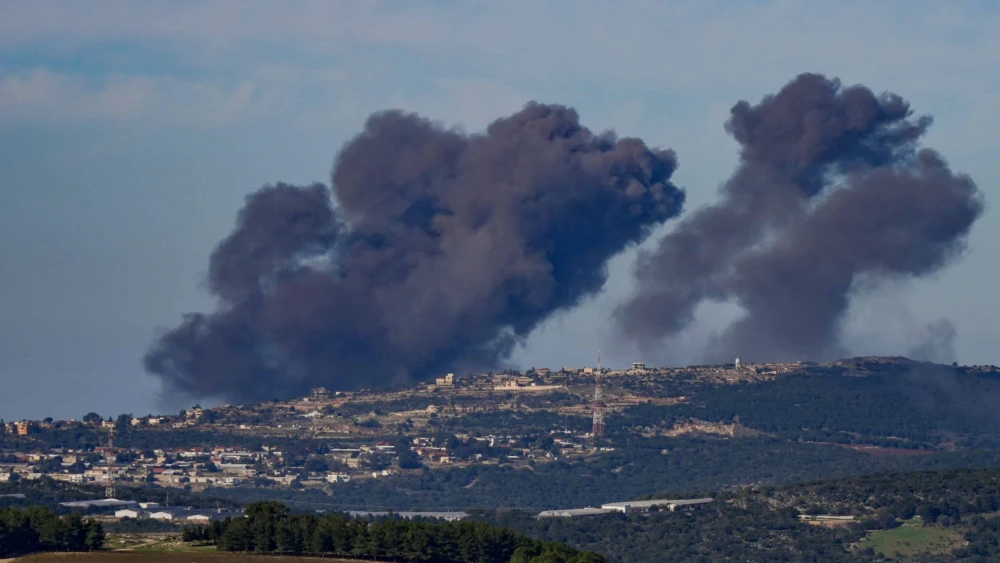
The Israel Defense Forces provided visual proof on Wednesday that Hezbollah operates from within residential areas, showing footage of an airstrike on a weapons depot “in the heart of a civilian neighborhood deep in Lebanon.”
As can be seen in the video, the recent Israeli Air Force attack set off lengthy secondary explosions that constitute “further proof of Hezbollah’s method of operation in which it stores explosives and dangerous chemical substances in civilian villages.”
The IDF accused the Iranian terrorist proxy of deliberately placing its weapons production infrastructure in the middle of civilian areas in Southern Lebanon, the Beqaa Valley and Beirut.
Using human shields is a war crime and is a tactic used by the Hamas terrorist group in Gaza and by other jihadist organizations.
According to the IDF, “under the law of armed conflict, the presence of the civilian population cannot be used to render certain points immune from military operations, or to shield one’s own military operations.”
Israel has been engaged in a low-intensity conflict with Hezbollah since the terrorist group joined the current war in support of Hamas following the Oct. 7 atrocities in the northwestern Negev. Tens of thousands of Israelis have been evacuated from areas close to the northern border that have seen near-daily rocket, mortar and drone attacks.
A majority of Israelis support attacking Hezbollah in Lebanon with full force either immediately or after the war in Gaza ends, according to the results of a monthly survey the Jewish People’s Policy Institute published on Sunday.
Sixty-three percent of respondents support attacking the Iranian terrorist proxy, with 29% favoring military action as soon as possible while 34% want to wait until Hamas is defeated in the Gaza Strip. Another 34% believe that a political settlement without expanding the current war is the best option and 9% are undecided.