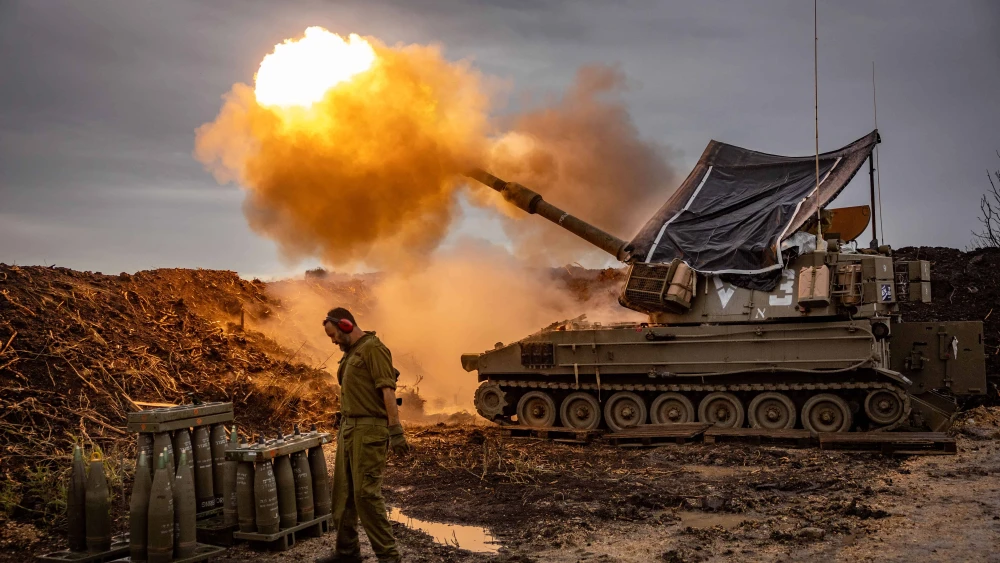
A majority of Israelis support attacking Hezbollah in Lebanon with full force either immediately or after the war in Gaza ends, according to the results of a monthly survey published by the Jewish People’s Policy Institute on Sunday.
Sixty-three percent of respondents support attacking the Iranian terrorist proxy, with 29% favoring military action as soon as possible while 34% want to wait until Hamas is defeated in the Gaza Strip. Another 34% believe that a political settlement without expanding the current war is the best option and 9% are undecided.
Israel has been engaged in a low-intensity conflict with Hezbollah since the terror group joined the war in support of Hamas following the Oct. 7 atrocities in the northwestern Negev. On Sunday afternoon, Israeli Air Force jets attacked four Hezbollah terror targets in Southern Lebanon simultaneously.
לפני זמן קצר מטוסי קרב תקפו יעדי טרור של ארגון הטרור חיזבאללה בשטח לבנון, התקיפה בוצעה בארבעה מרחבים במקביל.
— צבא ההגנה לישראל (@idfonline) March 17, 2024
בין המטרות שהותקפו, תשתית טרור ועמדת תצפית של ארגון הטרור חיזבאללה במרחב עיתרון לצד מבנה צבאי של הארגון במרחב עלמא א-שעב ועמדות תצפית במרחבים מרווחין ועייתא א-שעב pic.twitter.com/0L8dUpUN0d
Six hundred Jewish Israelis participated in the survey online, while there were 200 Arab Israeli respondents, half of whom were interviewed by phone and half of whom participated online.
החודשים שחלפו מאז תחילת המלחמה, וגילויים המתפרסמים על הימים והשעות שקדמו למתקפת חמאס בדרום הארץ, הביאו לשינוי בעמדת הציבור בנוגע לחלוקת האחריות ל״מחדל״ בין הדרג הפוליטי לבין הדרג הצבאי.
— המכון למדיניות העם היהודי - JPPI (@JewishPolicy) March 17, 2024
לקריאת מדד החברה הישראלית המלא לחצו כאן >> https://t.co/h1nd0NIHeF pic.twitter.com/rhYPJSv59A
Political differences are evident in the polling, with a large majority of voters for Prime Minister Benjamin Netanyahu’s right-wing and religious coalition favoring immediate (40%) or delayed (41%) military action against Hezbollah, while a 51% majority of opposition voters support the pursuit of a political settlement.
With regard to the Palestinians, a large majority of Jewish Israelis and a large minority of Arab Israelis agreed that “there is no chance of a peace agreement with the Palestinians in the foreseeable future.” Out of the 79% of Jews who agree with this statement, 65% “strongly agree.” Among the Arabs, 24% strongly agree and another 15% “somewhat agree” for a total of 39%.
Additionally, most Jewish Israelis believe that “Jewish settlements in Judea and Samaria create deterrence and contribute to the security of all the citizens of Israel” and do not agree that the settlements are a “burden.”
“One of the profound results of the Oct. 7 attack is a sharp drop in the confidence of the Israeli public in the possibility of a political solution to the conflict,” said Jewish People’s Policy Institute President Professor Yedidia Stern.
“The same goes for the conduct of the war in the north (therefore 63% believe that Israel must initiate an attack against Hezbollah) and the post-war era (79% believe that there is no chance of peace with the Palestinians in the foreseeable future). The Hamas terror convinced Israelis to strive for decisive victory and give up on a political agreement,” Stern said.