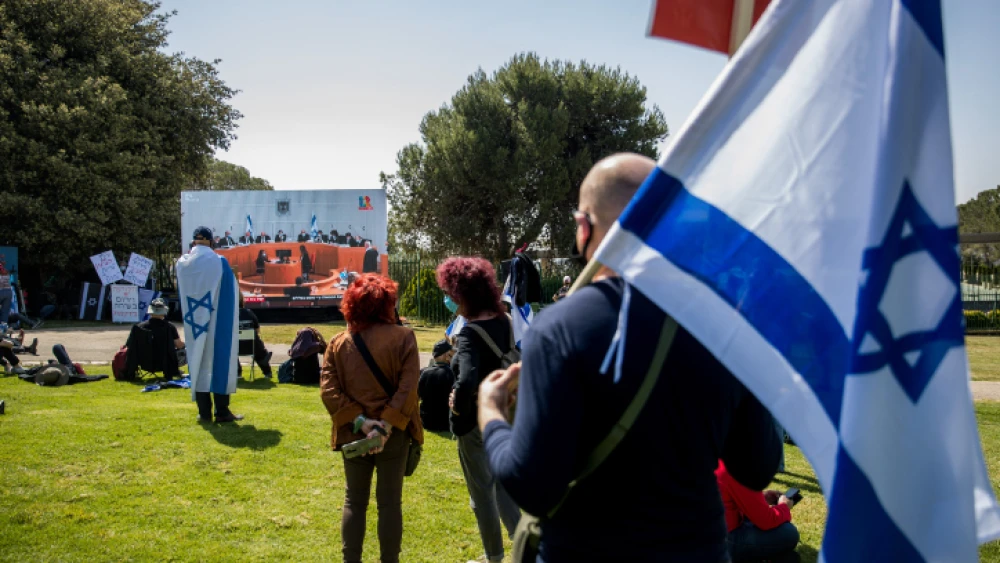
Israel’s High Court of Justice began hearing petitions on Sunday seeking to bar incumbent Israeli Prime Minister Benjamin Netanyahu from forming a government, including a national-unity coalition with Blue and White leader Benny Gantz, while facing criminal indictments.
The proceedings, which are expected to last through Monday, are being heard by an unusually large 11-judge panel and are being televised live. On Monday, the court is scheduled to hear petitions contesting the legality of the coalition agreement reached last month between Benny Gantz’s Blue and White Party and Netanyahu’s Likud.
Though Israeli law does not prohibit a prime minister under indictment from forming a government, it does require that ministers and mayors resign if indicted. In an opinion submitted to the High Court on Thursday, Attorney General Avichai Mandelblit said that there is no legal obstacle to Netanyahu’s forming of a government, despite “significant problems” raised by his indictments on fraud, bribery and breach of trust—charges that he denies—and by the Likud-Blue and White unity deal reached earlier this month.
In January, two months ahead of the third round of Knesset elections in under 12 months, the court refused to rule on the matter, calling it “theoretical.” The first two elections, both of which resulted in a political deadlock, were held on April 9 and Sept. 17.
Both Likud and Blue and White representatives argue that the judicial branch of government should not interfere in the decisions of the legislature, the Knesset, which reflects the will of the electorate. They also are warning against High Court intervention in a process that is “beyond its purview,” and expressing concern that if it rules in favor of the petitioners, the country will be forced to hold a fourth election—something that will waste billions of shekels at a time when the country’s economy is reeling from the coronavirus crisis.