Newsletter
Newsletter Support JNS

Iran mum after IAEA finds uranium traces at Tehran facility

The radioactive traces were found in samples taken from a site that Israeli Prime Minister Benjamin Netanyahu characterized in a speech last year as a “secret atomic warehouse.”

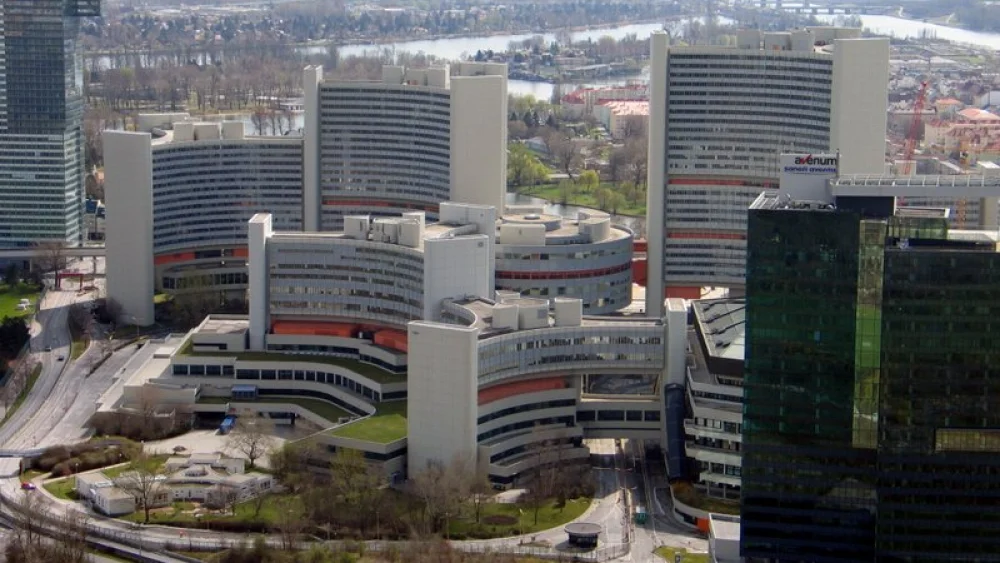
IAEA headquarters in Vienna, Austria. Credit: Wikimedia Commons.

The U.N. International Atomic Energy Agency (IAEA) has found traces of uranium at a facility in Tehran that Israeli Prime Minister Benjamin Netanyahu has called a “secret atomic warehouse,” Reuters reported on Sunday.

The IAEA has asked Iran to explain the traces, but so far Tehran has not done so, according to the report.

In a speech a year ago, Netanyahu called on the IAEA to inspect the site immediately, claiming that it had housed 33 pounds of unspecified radioactive material that had since been removed.

Meanwhile, IAEA acting director general Cornel Feruta met with officials in Tehran on Sunday to discuss verification and monitoring activities, according to a statement published by the agency on Monday.

“Regarding the implementation of Iran’s Safeguards Agreement and Additional Protocol, during my discussions in Tehran, I emphasized the importance of full and timely cooperation by Iran,” said Feruta.

“It is important to advance our interactions and, therefore, I also stressed the need for Iran to respond promptly to Agency questions related to the completeness of Iran’s safeguards declarations. The Agency will continue its efforts and will remain actively engaged. Time is of the essence,” he added.

Reuters first reported in April that the IAEA had inspected the site, taking samples for analysis.

Yechiel Leiter told JNS that he wrote in his introductory letter to the U.S. secretary of state that he represents “the people indigenous to the land of Israel. Period.”
JNS panel highlights the families, businesses and volunteers sustaining Israel’s war effort.
“It’s time to move forward and realize the potential of the Abraham Accords 2.0,” says Asher Fredman, director for Israel at the Abraham Accords Peace Institute.
“Despite their protestations and false statements to the contrary,” said the U.S. president, “Iran has fully and completely agreed to highest level nuclear inspections long into the future.”
Sixty-five percent of Victory’s 152 million shekel ($50 million) first-quarter year-over-year growth came from Gaza, according to a supplemental report released on June 14.
Benny Gantz, JNS editor-in-chief Jonathan S. Tobin, Gilad Erdan, Mosab Hassan Yousef, Nissim Black and leading voices in security, diplomacy, media, law and Jewish communal affairs headline the summit’s third day in Jerusalem.