An Israeli high school this year began using an AI-powered robot to help teachers in one of the country’s first classroom applications of the technology, the school has said.
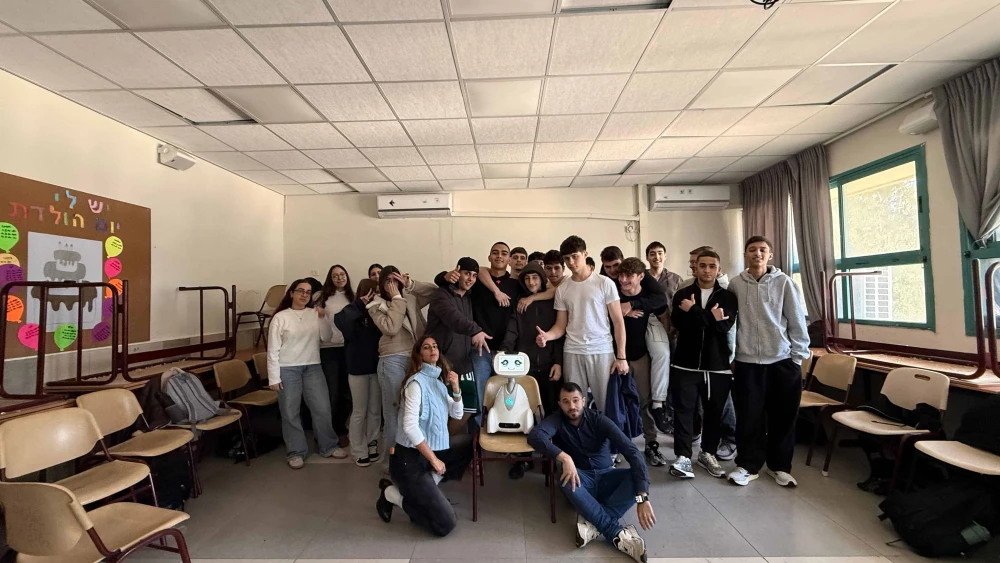
The robot, known as “Buddy,” is used at the ISTS Kiryat Bialik school near Haifa, where it supports technology classes and special needs students, the Israel Sci-Tech Schools network, to which the Kiryat Bialik institution belongs, announced last week.
The device is not meant to replace teachers but assist them, school administrators said.
“When we first set out to implement AI in Israel’s education system, we knew that its primary purpose must be to strengthen and enhance the work of teachers,” Meirav Zarbiv, deputy director general and head of the Innovation and Technology Administration at the Israeli Education Ministry, told JNS.
The robot comprises a computer housed inside a plastic chassis the size of a large housecat. The head is a rectangular screen displaying an animated face with cartoon eyes and a smiling mouth. A camera bar is mounted above the screen.
The robot’s rounded body has blue LED lights that glow in circular accents. A speaker grille is visible on the front panel.
The robot enables teachers “to dedicate more time to individualized student guidance, creative thinking and social-emotional learning, while preserving the central role of the teacher,” Zarbiv added.
Students can also communicate with the robot in brainstorming sessions, or it can guide them through assignments. It prompts short physical-activity breaks, said the ISTS school network, which was founded in 1949 and has some 100,000 students across 264 middle and high schools in 54 municipalities.
Students can also program the robot themselves as part of coursework.
School officials said the device helps teachers build lesson plans and pull examples from online resources, allowing educators to focus more on creativity, critical thinking and social-emotional development.
“Buddy is designed to enhance, not replace, the vital role of our teachers,” said Raya Tubul, director of the ISTS Kiryat Bialik campus. “It allows teachers to dedicate more time to meaningful student engagement while ensuring every child receives personalized attention.”
The robot is also expected to serve as a remote-learning assistant for students unable to attend school due to illness, transmitting live video and audio from the classroom through a dedicated app.