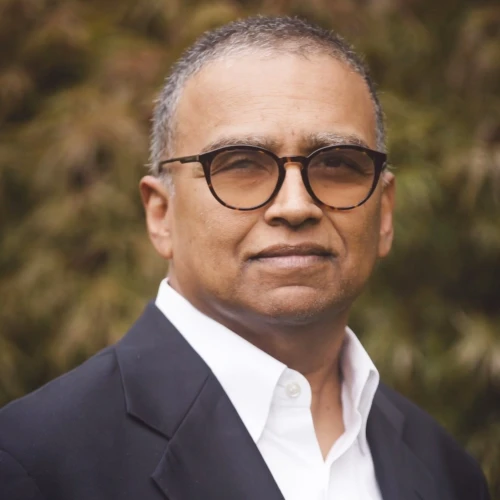
A founding member and co-chair of the Senate Abraham Accords Caucus, Sen. Joni Ernst (R-Iowa) has co-sponsored and shepherded several legislative initiatives to advance the accords.
Ernst announced that she won’t seek reelection next year, at a time of fragility for the U.S.-brokered pacts between Israel and Arab nations.
At a fifth anniversary celebration for the accords on Wednesday held by the American Jewish Committee, Ernst told JNS that the accords are built to last, with the backing of Capitol Hill.
“It will stand the test of time because it is about peace and stability,” she said. “That is the goal of the Abraham Accords: greater cooperation—economically, educationally, militarily.”
“So this is what we all want, and you will hear from Democrats and Republicans that the accords are very, very important,” she said.
At the gathering in a House banquet room, Ernst explained her approach to Israel’s strikes targeting Hamas leadership in Qatar on Tuesday, which have further strained Israel’s relationship with the Arab world, even as Ernst has been one of the most vocal critics of the Qataris.
“We understand that Israel is in a place where they have said Hamas will be destroyed, end of story. We support them in that effort,” Ernst said, echoing sentiments expressed earlier in the week by U.S. President Donald Trump.
“The problem is when you are striking a partner nation, who has been working so heavily on securing peace and stability in the Middle East, and that country on this particular strike happened to be Qatar,” Ernst said. (Qatar hosts a strategic U.S. air base.)
Ultimately, Ernst said, the accords provide an opportunity for the United States to remain engaged with the region.
“Presence is power,” she said. “If you don’t have a seat at the table, you are not able to shape and influence the outcome.”
“It is very important that the United States remain engaged around the globe,” she said.
The Trump administration has repeatedly suggested that other countries will soon join the accords. JNS asked Ernst what Washington has had to do to keep the pacts alive during the Israel-Hamas war.
“Honestly, behind the scenes, all of our partner nations have been extremely supportive of the accords,” Ernst said. “There has not been a day that we have questioned whether they would stay in the accords. They remain strong, and we hope to grow them and improve them even in the future.”
Rep. Sheila Cherfilus-McCormick (D-Fla.) serves as ranking member of the House Foreign Affairs Subcommittee on the Middle East and North Africa. JNS asked her on Wednesday when Congress can hope to add countries to the accords.
“I think we have to work simultaneously in finding solutions,” both to add countries and maintain participation in the accords, she said.
The focus for other House Democrats on Wednesday was on keeping a two-state solution viable as a means to secure a future for the accords.
Rep. Brad Schneider (D-Ill.), a House Abraham Accords Caucus co-chair, said that the United Arab Emirates’ concern about Israel applying sovereignty to parts of Judea and Samaria was one of the initial drivers of the accords.
As part of its normalization with the UAE, Jerusalem agreed to forego expanding Israel’s territory to the east for four years—a timeline that has expired.
Some Israeli officials have called in recent weeks for the application of sovereignty in light of hostile diplomatic moves in Europe and elsewhere, but those calls have grown quieter since a UAE official issued a veiled threat of the collapse of the accords should Israel move forward.
“The UAE has made clear that if Israel goes down that path, it has the likelihood—not the possibility, but the likelihood—of cleaving the Abraham Accords to such a point that they may not be recoverable,” Scheinder told those gathered on Wednesday.
Schneider said that doesn’t mean he agrees with the push this summer, underwritten by France and Saudi Arabia, for more countries to recognize a Palestinian state.
Taking that step “before the elements necessary to be successful as a state—the institutions, having elections, having responsive government, having control of all security under one authority—it’s not there yet,” and gives “the perception” of rewarding Hamas, he said.
Rep. Debbie Wasserman Schultz (D-Fla.), also a co-chair of the caucus, warned that “progress could be squandered by any steps that permanently foreclose a two-state future,” putting the accords at a “crossroads.”
Big moves related to the accords appear to be on hold during the Israel-Hamas war. Wasserman Schultz suggested Washington should pursue an “accords-plus framework” and bring countries like Mauritania and Azerbaijan that already have ties with Israel into the accords.
Wasserman Schultz said that “patient, serious tracks of engagement with Saudi Arabia, Indonesia and Oman” must also continue.
Many Arab and European nations say that Israel’s military operations throughout the region are hurting the chances of expanding the accords. Yechiel Leiter, Israel’s U.S. ambassador, said at Wednesday’s event that the opposite is true.
“We are empowering the moderate elements within Islam,” Leiter said.
The envoy compared Tuesday’s strikes in Doha to Israel’s pursuit of those responsible for the 1972 Munich massacre and America’s reaction to the Sept. 11 attacks.
“Israel acted in the context of what any normal country does. It pursues terrorists and eliminates them,” Leiter said.
“Now what is Qatar doing if not financing and supporting terrorism by playing host to Hamas?” Leiter said. He noted Monday’s terror attack in Jerusalem, in which six Israelis were murdered and for which Hamas claimed responsibility.
“Who sent them? The terrorists we targeted in Doha,” Leiter said. “They celebrated the murder of these six innocents the same way they celebrated on camera the slaughter of 1,200 innocents on Oct. 7.”
Dana Stroul, who served as deputy assistant secretary of defense for the Middle East in the Biden administration, told JNS at Wednesday’s event that Israel’s strikes would require some cleanup duty from Washington.
“It appears to me that President Trump is both trying to reassure our allies in the Gulf, who host forces and air bases and military capabilities, that the United States is committed to their security, and at the same time, wants to be very clear that nobody should be supporting Hamas,” Stroul said.