


Estonia, the northernmost Baltic state, is not on the radar of many Israelis, but that might change after Israel opened an embassy there last week. Estonia has had an embassy in Israel since 2009.
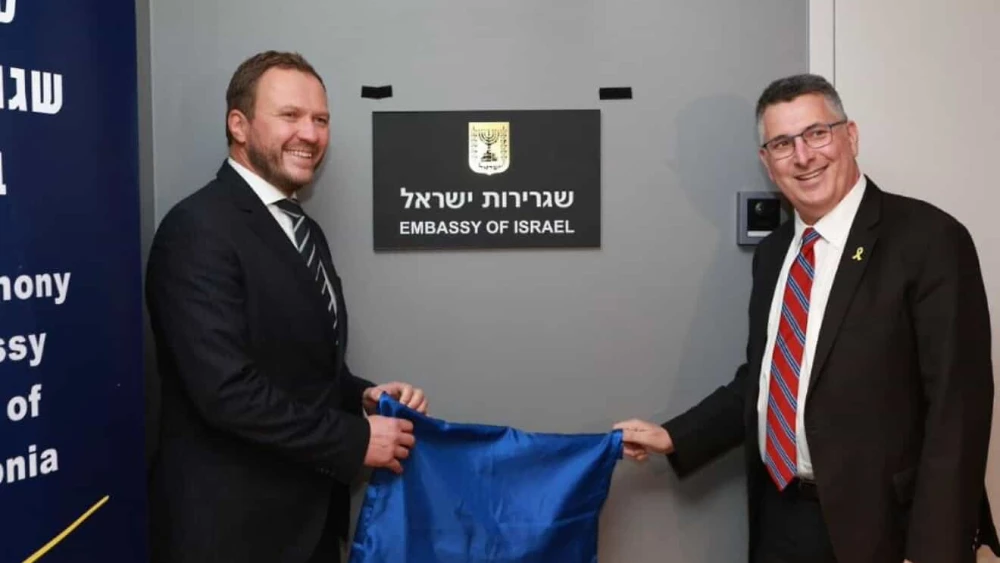
Israeli Foreign Minister Gideon Sa’ar, who attended the Nov. 11 opening in Estonia’s capital of Tallinn, called it a “historic milestone.” He admitted that it should have been opened sooner.
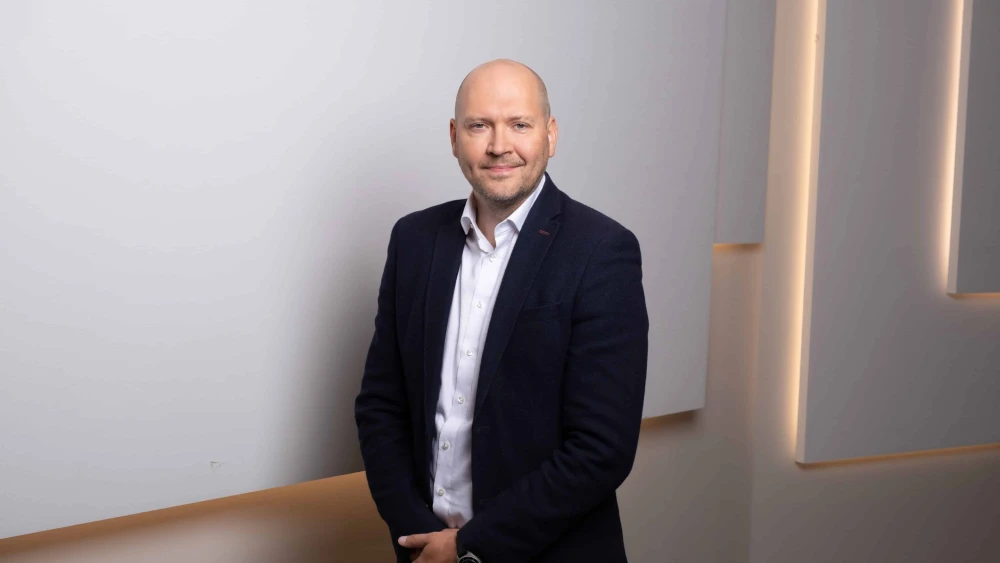
Estonian Ambassador to Israel Andres Vosman expressed enthusiasm about the new Israeli embassy, telling JNS he was happy to have a counterpart for his work in Tel Aviv.
He hopes the two embassies together will act as a “force multiplier.”
“Since we established an embassy here in 2009, we’ve been a small team. We didn’t have the manpower to explore all the possibilities. Now we have a partner in Tallinn,” he said.
The ambassador, at his post for three months, sat down with JNS on Nov. 18 to talk about the promise of Estonia-Israel relations.

JNS: How would you characterize Israeli-Estonian ties since Estonia regained independence in 1991?
Vosman: Positive. Diplomatic relations were established soon after we regained our independence from Soviet occupation in August 1991. Most Estonians remember Israel as the first country willing to sell weapons to Estonia.
In 1926, Estonia was the only country in the world that gave its Jewish community cultural autonomy. Jews managed their own school system and religious affairs. Rights for the Jewish minority were already called for in our Declaration of Independence when we founded our country in 1918. It says Jews, among other ethnicities, “shall be guaranteed their rights to cultural autonomy.” We will celebrate 100 years of that decision next year.
[The decision was formalized by the Cultural Autonomy Law of 1925, under which the Jewish community established self-government in 1926—D.I.]
Soviet occupation in 1940 immediately ended the Jewish autonomy. The synagogue was burned down. Learning Hebrew was outlawed and the repressions against the Jewish intelligentsia started. In the summer of 1941, before the Nazi occupation, most Jews escaped to the Soviet Union. Around 1,000 Jews stayed and were soon after killed by the German occupation forces and local collaborators.
Q: How do you account for Estonia’s early tolerance at its founding?
A: Estonia didn’t have deeply rooted antisemitism as had other European countries. Maybe because the Jewish community was smaller. It numbered only 5,000 to 6000 at that time.
Q: If an average Estonian were to be asked about Israel, what would he say?
A: The average Estonian would probably remember that Israel was very much aligned with the West during the Cold War. Secondly, Estonians see Israel as an underdog in a tough neighborhood—a small country facing a situation similar to our own, although obviously with differences. We view Israel as having traits that we find appealing: serious on defense, really a role model in military affairs, an intelligence giant, a tech superpower.
Q: Are there any political parties that are hostile to Israel in Estonia?
A: We currently have five parties in our parliament of 101 members, and you have pretty much a positive consensus view on Israel. And currently we don’t debate Palestinian statehood recognition.
Q: According to UN Watch, Estonia’s voting record from 2015 to the present is 76% against Israel and 3% for Israel. Is Estonia planning to change the U.N. voting pattern to be more favorable to Israel?
A: I’m not sure if we would define the U.N. resolutions we voted for as anti-Israel. All European countries believe in the two-state solution. When it comes to the Palestine issue, we follow the same line as all of Europe.
Q: Has Russia’s war on Ukraine impacted ties with Israel?
A: For us, the war of Russia’s aggression against Ukraine is the existential foreign policy issue. It’s the issue through which we look at other countries.
I understand that Israel has a lot on its own plate and perhaps Ukraine is not among the top three issues. Certainly, you can feel the support of Ukraine here in the streets when you talk to the Ukrainian community, even the Russian community, here.
That said, I wouldn’t say it has impacted ties. The ties between our countries are solid, including the security cooperation we have on defense.
Q: Estonian Foreign Minister Margus Tsahkna, during the press conference last week with Foreign Minister Gideon Sa’ar, also referred to the Ukraine war as “existential.” Does that mean Estonia thinks the Baltic countries are next?
A: No, but there is an understanding in Estonia and in the Baltics that should Russia achieve its maximalist goals in Ukraine, which for them mainly means getting control over Kyiv, then it’s a totally new security situation for all of Europe.
We are part of NATO and the E.U. We have no reason to believe that Russia doesn’t know what Article Five of NATO is [Article 5, a collective defense clause, states that an attack on one member is an attack on all]. In that sense, we don’t believe we are next.
Q: Israeli exports to Estonia are overwhelmingly defense related, some 70% of total exports. Has that always been the case?
A: It’s partly true that because of the ongoing war in Ukraine, defense spending has increased everywhere in Europe. Many countries, including mine, are buying cutting edge military weapons from Israel. So the amounts and the volumes have increased, but we bought defense equipment before.
Q: Are there other drivers of relations with Israel?
A: The main driver is technology. Estonia is also a startup nation—perhaps not to the same degree as Israel, but we come close. Per capita, we have the highest number of unicorns, [startup] companies with a valuation of more than $1 billion, in the world. [Estonia has a population of 1.37 million.]
We have a thriving tech scene, and we have many similarities with Israel in terms of innovation, in terms of not being complacent, and of always pushing forward. Technology, I would say, is a big common denominator.
I hope that we, here in the embassy, and also now the Israeli embassy in Tallinn, can act as force multipliers in making connections happen. When Mr. Sa’ar visited Estonia last week, he also had with him a sizable business delegation, mostly on the tech side.
Q: What is the source of the tech mindset in Estonia?
A: In the early ’90s, when we took our country back from the Russian-Soviet occupation, we were dirt poor. We thought, “What do we have to do to make up for the last five decades after being cut off from the rest of the world?” Luckily, this was at the birth of the internet. Our government at that time made a conscious decision that this is how we’ll leap forward. It embarked on a very deliberate strategy of digitalizing the whole country.
In our hearts, we always wanted to be part of Western Europe. In 1939, we were at the same level of per capita wealth as Sweden. The backwardness brought on by the Soviet occupation reduced us to poverty.
Second, we have a strong work ethic and good education levels.
I would also say that in Estonia, we trust our government, making it much easier to digitize all public services. Currently, 100% of public services, including marriage and divorce, notarization, buying property, are available online. The backbone of the system is a highly encrypted ID card given to every citizen and a digital signature, which has the same power as a handwritten signature.
Q: Western European countries have been far more anti-Israel than Eastern European ones. Is this solely due to Muslim immigration?
A: I doubt it’s solely, or mainly, to do with the Muslim immigration. But that’s a question you would have to direct to the Western European countries.
Q: Is Estonia, like Hungary, under pressure from the E.U. to admit more immigrants from Muslim countries?
A: We have never felt any such pressure.
Q: Is Estonia concerned about the rise of radical Islam in the West?
A: Speaking personally, I think there is a basis for worry. But because we don’t have the issue domestically, I would say it’s not high on our agenda.



