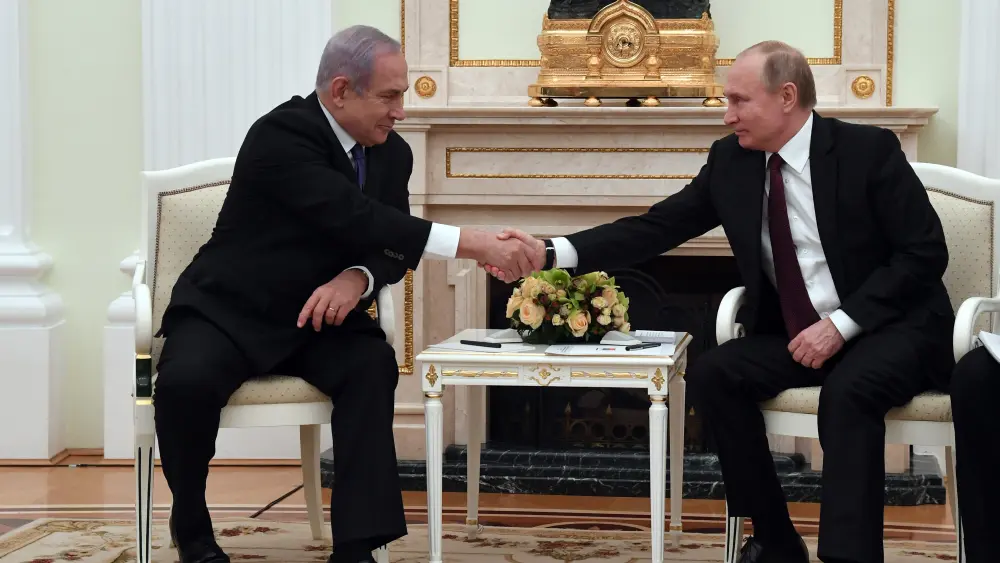
The carefully choreographed ceremony in Moscow, in which Russia handed over to Israel the remains of Sgt. First Class Zachary Baumel, missing in action since Israel’s 1982 Lebanon War, was meant to send a clear message that it was Russia—and President Vladimir Putin himself—that helped Israel accomplish this difficult operation. And it wasn’t for free.
In a joint press briefing, Israeli Prime Minister Benjamin Netanyahu and Putin exchanged greetings, each expressing appreciation for their warm friendship and close relations between their countries.
“I am always glad to visit you Mr. President,” Netanyahu said to Putin. “Two years ago, I asked you to help us find the bodies of missing Israeli soldiers and you responded in the affirmative. I want to thank you, my friend, for what you have done.”
Micky Aharonson, former head of the foreign-relations directorate of the National Security Council in the Prime Minister’s Office and an expert on Russia, told JNS that this event can be understood on a number of levels. “First,” she said, “this is, of course, another demonstration of the good relations between the prime minister and Putin.”
However, “it is not to be taken for granted,” she added.
She noted that the Russians “demanded credit for bringing back Baumel’s body” with Putin emphasizing Russia’s central role in making it possible.
“We will be requested to pay,” she said. “The Russians believe there are no free lunches.”
Anna Borshchevskaya, an expert on Russia’s Middle East policies with the Washington Institute for Near East Policy, agreed with Aharonson. She told JNS, “Putin always expects something in return, though it’s not always tangible. I think in this case, it’s about political capital for Putin. To that end, the World War II theme is a long-standing one between Putin’s Russia and Israel. Putin is going to Israel in May for the unveiling of a Red Army memorial.”
Borshchevskaya said that Putin “never wanted poor relations with Israel, but what matters to him is asserting great power status.”
Aharonson explained that Putin wants to strengthen Assad’s regime in Syria. He doesn’t want Israel to spoil his plans, but also wants something more active in return. And that return favor won’t necessarily be in the Syrian arena.
At least one analyst has made the case that Putin observed U.S. President Donald Trump recognizing Israeli sovereignty over the Golan Heights and now the Russian president wants to achieve international recognition of Russian sovereignty over Crimea. Putin feels that Israel has the leverage he needs to advance that interest.
Nevertheless, Netanyahu has positioned himself to leverage his relationship with Russia not only achieve his own personal political goals, such as scoring the return of a missing Israeli soldier just days before a general election, but also to assert Israel’s position on containing Iranian forces in Syria.
Borshchevskaya also pointed out that it is important for Putin “to have good relations with everyone in the region and for everyone to view Putin as the ultimate arbiter, a neutral powerbroker. Putin views everything through power dynamics, and having good relations with Israel is not the same thing as being equal.”
While a previous understanding between Israel and Russia saw Russia keeping the Iranians away from the Syrian border with Israel, that hasn’t necessarily happened. “The Russians can pressure Iran and convince them since they have leverage, but they just need the motivation to do it,” said Aharonson.
At the same time, Israel has been allowed to operate in Syria without any Russian comment or condemnation.
Aharonson said she is convinced that when the relationship between Israel and Russia “went sour” last year after Syrian forces shot down a Russian fighter plane either mistakenly or intentionally in response to an Israeli attack on Iranian forces on Syrian soil, “it was not only about the airplane, but about the Russians not getting what they wanted. I am confident they have expectations, and this is not a free gift.”