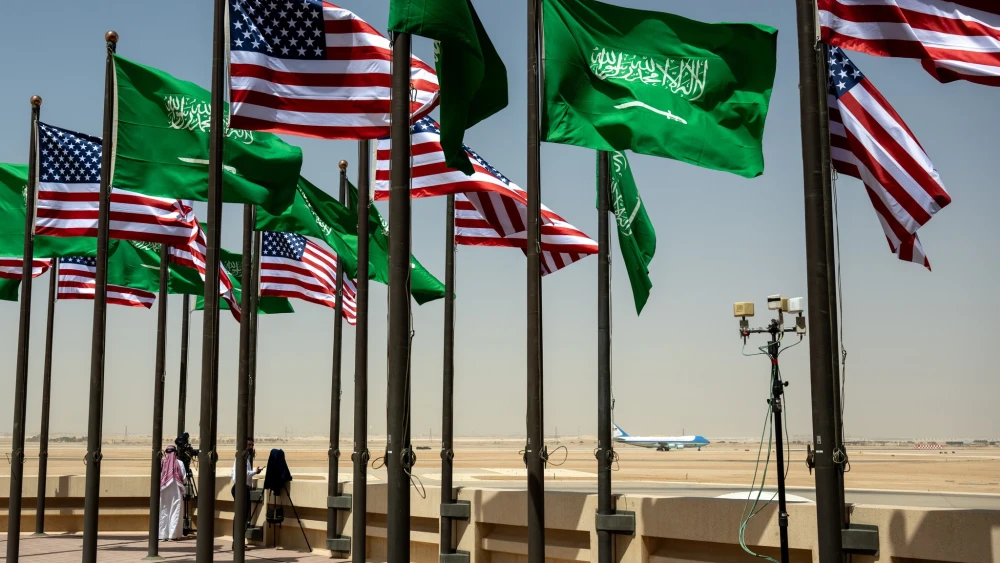

For three years, the foreign-policy consensus has treated Saudi-Israeli normalization as the capstone of a new regional architecture—the deal that would finally close the chapter opened by the 2020 Abraham Accords.
That framing is not merely premature but strategically backwards. Before Israel allows itself to be seduced by the recent boldness of the United Arab Emirates, it must reckon honestly with what Abu Dhabi can and cannot provide, because a bilateral axis built on enthusiasm without capacity is not a security architecture. It is a liability dressed as an alliance.
Saudi Arabia is not the engine of a new Middle East order. It is its anchor, and anchors do not move.
On May 7, Riyadh formally refused to grant the United States and Israel access to its bases or airspace for “Project Freedom,” the U.S.-led tanker escort initiative designed to counter Iranian harassment in the Strait of Hormuz. A kingdom that vetoes American operational freedom while Iran harasses international shipping is not a coalition partner. It is a veto player that extracts legitimacy from Washington while denying it the one thing that matters: room to act.
One day later, reporting emerged that the UAE had responded to the same Iranian threat in an entirely different register. Abu Dhabi has been sailing tankers through the Strait with their location trackers switched off, a quiet act of maritime defiance requiring no American permission and no Arab League consensus. The UAE recently withdrew from OPEC and is reportedly weighing departure from the Arab League itself, an institution whose primary achievement in recent decades has been to formalize the collective inability of Arab states to agree on anything consequential.
The UAE fields a professional military with real procurement sophistication, but it is a force of roughly 65,000 personnel defending a coastal city-state with no strategic depth and no capacity to project power across contested airspace. Abu Dhabi cannot replace the $3.8 billion in annual American military assistance that Israeli Prime Minister Benjamin Netanyahu’s 10-year autonomy plan envisions phasing out. It cannot provide Israel with the forward basing, prepositioned munitions or intelligence-sharing architecture that the U.S. relationship has historically guaranteed. Iran understands this.
Tehran’s calculus has always rested on the assumption that the Abraham Accords states are economically integrated but militarily shallow. A UAE that sails tankers in the dark is defiant. It is not yet dangerous to Iran in the way that a genuinely integrated military architecture would be.
What Israel actually requires is not a bilateral axis but a networked security architecture that uses the UAE as its Gulf node while extending in multiple directions simultaneously. To the west, Greece and Cyprus represent an underappreciated anchor. Both have signed defense agreements with Israel; both sit astride critical eastern Mediterranean energy corridors; and both have threat perceptions regarding Turkish revisionism that align naturally with Israeli strategic interests.
The EastMed corridor linking Israeli and Cypriot offshore gas fields to European markets is not merely an energy project. It is the skeleton of a strategic relationship that already involves joint exercises and extends Israeli deterrence into NATO’s southeastern flank without requiring a formal NATO commitment that will never come.
To the east, the I2U2 framework linking India, Israel, the UAE and the United States remains the most underbuilt diplomatic structure in the region. India is the piece that transforms the Israel-UAE bilateral relationship from a regional arrangement into a genuine counterweight to Iranian influence across the Indian Ocean littoral.
New Delhi has its own reasons to resist Iranian pressure in the Gulf and its own appetite for Israeli defense technology that has grown steadily for two decades. An I2U2 that acquires even an informal security dimension through technology transfer and intelligence coordination would give the Israel-UAE axis the strategic mass it currently lacks.
And Saudi Arabia, despite itself, remains structurally important—not as a partner but as a variable. Riyadh’s refusal to join “Project Freedom” is a signal, not a permanent condition. The correct Israeli approach is not to chase Saudi normalization as a diplomatic trophy or to write Riyadh off as irretrievably passive. It is to build the alternative architecture aggressively enough that Saudi Arabia eventually faces a binary choice between relevance inside the new order and irrelevance outside it.
Strategic autonomy is not a slogan. It is a procurement policy, a basing doctrine, a technology export framework and a set of bilateral commitments that must be negotiated and operationalized before American guarantees are reduced rather than after.
The UAE has signaled—through its OPEC exit, its tanker defiance and its reported reconsideration of the Arab League—that it has made a strategic choice. Israel’s task is to meet that choice with architecture rather than rhetoric, dense enough to deter Iran and broad enough that no single partner’s limitations define the whole.