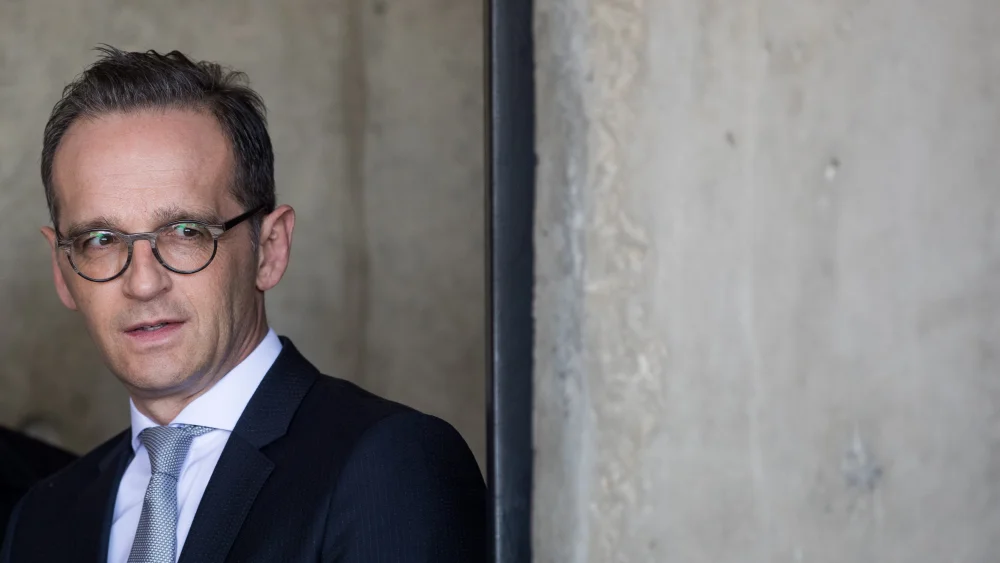
German Foreign Minister Heiko Maas is set to arrive in Israel on Wednesday morning for meetings with Israeli Prime Minister Benjamin Netanyahu, Defense Minister Benny Gantz and Foreign Minister Gabi Ashkenazi.
“The fact that [his] will be the first European visit since the coronavirus pandemic broke out reflects the close and varied bilateral relations,” the German Embassy in Tel Aviv said in a statement on Tuesday. “Therefore, Foreign Minister Maas’s conversations will deal with the full spectrum of bilateral and regional issues, including the future of the Middle East peace process.”
It is U.S. President Donald Trump’s “Peace to Prosperity” plan that is expected to be the focus of discussions, as Jerusalem has announced the intention to begin implementing the part of the plan that involves extending Israeli sovereignty to Jewish communities in Judea and Samaria on July 1.
Germany and other European nations have expressed fierce opposition to the move.
In May, the German-Palestinian Steering Committee, chaired by Maas and Palestinian Authority Prime Minister Mohammad Shtayyeh, released a joint statement that “noted with grave concern the agreement between coalition parties in Israel to advance plans for annexation of occupied Palestinian territories as stipulated in the Israeli coalition agreement signed on 20 April.”
The coalition agreement signed between Netanyahu and Gantz, the basis of the new Israeli government, stipulates that Israel will move forward with the application of Israeli sovereignty to parts of Judea and Samaria, in line with the U.S. peace plan.
Following his meetings in Jerusalem, Maas—whose country will assume the European Union Council presidency on July 1—is slated to stop in Jordan before returning to Germany on the same day.