


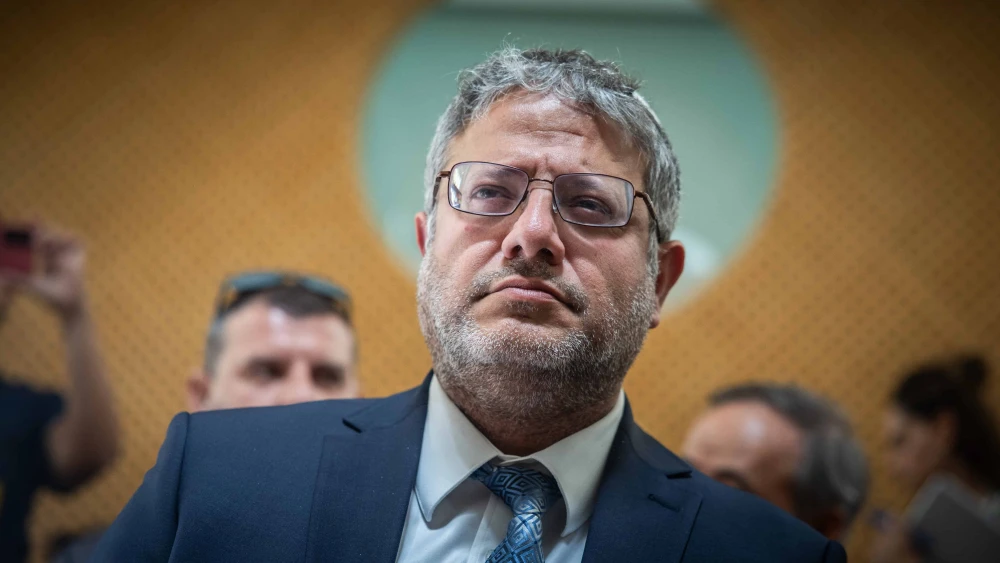
Israel’s High Court of Justice on Wednesday cancelled a hearing scheduled for Jan. 15 to weigh petitions calling for the ouster of Israeli National Security Minister Itamar Ben-Gvir.
It based its decision on its dissatisfaction with what it called the government’s failure to address the merits of the charges in the petitions against the minister.
An alternative hearing date will be set no later than the end of March, the court said, and the panel to sit on the hearing will be expanded to five judges.
The expanded panel may issue an order requiring Israeli Prime Minister Benjamin Netanyahu himself to attend the hearing to explain why he has not fired Ben-Gvir, the court said.
Israeli Attorney General Gali Baharav-Miara on Jan. 1 requested that the High Court demand Netanyahu justify his failure to remove Ben Gvir from office, whom she has accused of abusing his powers.
Other petitioners to the court include radical left-wing organizations, among them Ima Era and Tag Meir, an umbrella group.
The attorney general’s main argument against Ben-Gvir is based on her assertion that a minister’s role is limited to setting general policy and that he may not interfere in police operations, investigations and enforcement.
She accused Ben-Gvir of crossing this line through statements and actions.
Specifically, the attorney general accused Ben-Gvir of changing policy on the Temple Mount regarding Jewish prayer, asserting that this was done without the input of the government and the prime minister.
“The Israel Police is tasked with implementing the government’s policy,” her statement said. “The minister cannot change it in a public statement, without an orderly process in the government, on a sensitive issue that involves a security risk.”
She also accused Ben-Gvir of interfering in police appointments, specifically mentioning a case involving Police Supt. Rinat Saban, whose promotion the minister opposed.
On Tuesday, Ben-Gvir submitted his response, totaling 55 pages, to the High Court, rejecting the attorney general’s accusations. He said he does not interfere in police activities and he carries out his ministerial duties according to the law.
Regarding the Temple Mount, Ben-Gvir said he operated in full coordination with the prime minister. According to this week’s Cabinet meeting, Netanyahu told Deputy Attorney General Gil Limon that Ben-Gvir’s policy on the Temple Mount was his idea.
Ben-Gvir said the attorney general’s appeal failed to provide a single concrete example of interference in police investigations, unlawful directives or corruption in appointments.
He accused Baharav-Miara of political persecution, based entirely on her political disagreement with his policies.
Ben-Gvir also said that there was no conviction, indictment, criminal investigation, review or public report that could justify the petition, writing: “Had any of the minister’s actions warranted a criminal investigation, the attorney general would have opened one immediately.”
Baharav-Miara’s opposition was due to the fact that he supported her ouster as attorney general, he said.
The attorney general is deeply unpopular with the government, which unanimously voted to sack her on Aug. 4. The High Court canceled that decision on Dec. 14.
On Tuesday, coalition members sent a letter to the prime minister in support of Ben-Gvir, calling the attempt by the attorney general “a coup against democracy.”
“We will stand as a wall against the baseless dismissal of a government minister,” said the signatories, who included Religious Zionism Party Chairman Bezalel Smotrich, New Hope Party Chairman Gideon Sa’ar and Likud MK Ofir Katz, the parliamentary whip, and Ben-Gvir himself.
“No legal body, including the High Court, has the authority in law to force the dismissal of a government minister, especially when no indictment has even been filed against him,” they wrote.
“We will not lend a hand to this. Only the people will choose the government, and only the people will decide at the ballot box who their elected representatives are,” they wrote.
According to news site Ynet last week, Netanyahu backs Ben-Gvir and says his firing “will not happen.”
On Nov. 10, 2024, after earlier petitions were filed against Ben-Gvir with the High Court, Netanyahu told a Cabinet meeting that he would refuse to dismiss the minister, saying that it paved the way for a “constitutional crisis.”
“Today it’s me; tomorrow it’s you,” Ben-Gvir reportedly told the premier during the meeting. “They want to take over the government.”
Netanyahu was said to have told Ben-Gvir that he didn’t know “a faster way to bring about a constitutional crisis than trying to fire a minister without an indictment.”
Both sides of the political aisle have identified the power struggle between the judicial branch and the legislative as a threat to democracy, though they disagree on who is at fault.
Former IDF Chief of Staff Lt. Gen. (ret.) Gadi Eisenkot, chairman of the newly formed opposition party, Yashar, said the coalition’s threat to disobey the High Court was the “real danger to Israeli democracy.”
“A government that places itself above the law and nullifies the principles of the democratic system loses the moral authority to lead,” he said.
The coalition sees the justice system as having gone off the rails. On Jan. 12, speaking at a meeting of his Otzma Yehudit Party, Ben-Gvir expressed the view of most government members, saying, “We find ourselves in a critical period and facing an existential threat to the existence of the State of Israel as a democracy.”
He said Israel was engaged in a struggle over “a basic principle of democracy"—who is sovereign?
“Do the people elect their representatives? Or are those elected at the ballot box, in fact, subjects of a group of officials, who decide for them what to legislate, whom to appoint?”
The actions of unelected officials amount to a “coup.” They are unlawfully undermining the authority of the Knesset, the government, and the voters, using criminal investigations and legal pressure as tools to persecute and intimidate elected officials in order to override the public’s will, Ben-Gvir alleged.


