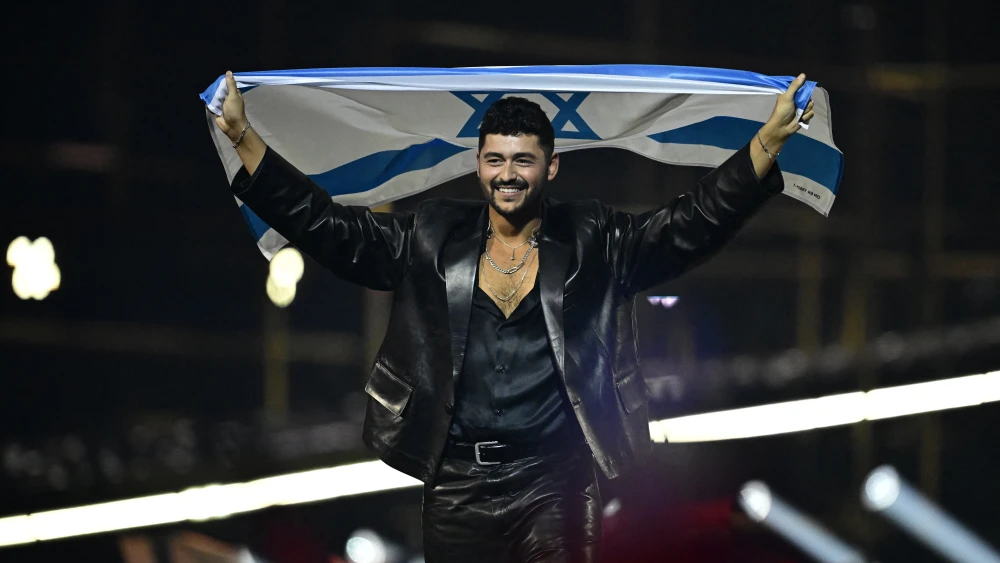
Israeli singer Noam Bettan finished in second place at the 2026 Eurovision Song Contest in Vienna on Saturday night, earning praise from Israeli leaders after a performance that drew strong public support, despite anti-Israel protests and boycott campaigns.
Bulgaria’s DARA won the contest with the song “Bangaranga,” while Australia’s Delta Goodrem came in third with “Eclipse.”
Israeli President Isaac Herzog personally congratulated Bettan after the results were announced.
“You have incredible composure on stage. Thank you so much. You brought honor to the people of Israel,” Herzog told the singer in a call.
Israeli Prime Minister Benjamin Netanyahu praised Bettan in a call on Sunday morning, noting that he had earned Israel second place for the second year in a row.
“Noam, what an amazing victory; what an achievement! How much pride, strength, confidence, and artistry,” Netanyahu said. “You are on a path to greatness. In any case, you have the gratitude of the entire nation. Everyone is very, very proud of you. And you stood tall against those hollow verbal potshots. You did it exactly as it should be done. You did a wonderful job. And I saw that the audience, as usual, was more supportive than the judges. Well done to you!”
In response, the 28-year-old thanked Netanyahu, saying, “I am happy to represent our country. It was a great privilege to bring honor, to represent us in a positive light, and to bring some light and goodness into this world. I have a certain hope, because I felt there was a very great unity last night, and I hope so much that it stays with us and continues in two days, in a year, and in 50 years. I want unity so much, and I truly hope it continues.”
The prime minister also conveyed “a special thanks to Kan—the Israeli Public Broadcasting Corporation—for the production and coverage” of the 70th Eurovision Song Contest from Austria, which aired live for Israeli audiences on television and radio.
Bettan performed “Michelle,” a trilingual ballad in English, French and Hebrew, to an estimated global audience of more than 160 million viewers. He concluded the performance with the phrase “Am Yisrael Chai” (“The People of Israel Live”), despite scattered boos and “Free Palestine” heckling.
Israel surged from eighth place to second after receiving a massive public vote tally, prompting audible boos inside the arena when the results were announced. Five countries—Spain, Ireland, Iceland, Slovenia and the Netherlands—boycotted this year’s competition over Israel’s participation.
The contest was also marked by controversy surrounding Israel’s promotional campaign. The European Broadcasting Union issued a formal warning to the Kan broadcaster over social media posts encouraging voting for Bettan after critics claimed Israel’s campaigning violated Eurovision guidelines.
In response, Kan said it complied with all contest rules and removed the posts immediately. Kan reported that Eurovision organizers declined to use anti-booing audio technology during Bettan’s performance, despite its use in previous years. Bettan reportedly rehearsed in advance with simulated crowd boos to prepare for possible disruptions.
His polished performance ultimately received strong support from viewers across Europe and beyond. Israel received 123 points from the professional juries, placing eighth in that category, and 220 points from viewers worldwide, giving the Israeli singer the second-highest public vote total of the night and 343 points overall.
In a significant shift from previous years, 22 of the 34 national juries awarded points to Israel, including Poland’s top “douze points.” Other countries awarding jury points to Bettan included France, Germany, Switzerland, Austria, Ukraine and Azerbaijan.
The stronger jury showing marked a significant improvement over Israel’s recent Eurovision performances. In 2025, Yuval Raphael received only 60 jury points despite finishing second overall, while Eden Golan received just 52 jury points in 2024.
“Wow! ... It was crazy. It was fun,” Bettan told Kan after leaving the stage. “I love you all. Am Yisrael Chai!”
Before going on stage, Bettan received a video message of support from Israeli actress Gal Gadot, who urged him to ignore the anti-Israel boos and protests. “They don’t have any power over you,” she said. “You’re amazing, and you’re talented, and we’re all behind you.”
The son of French immigrants to Israel, Bettan who was raised in Ra’anana, has spent almost a decade as a professional performer. Alongside his polished pop image, he also embraces a more traditional Jewish lifestyle and was photographed in Vienna praying and laying tefillin before the Eurovision final.
It marked the second time Israel has finished as runner-up in consecutive years, following back-to-back second-place finishes in 1982 and 1983. The Jewish state first joined Eurovision in 1973 and has won the competition four times—in 1978, 1979, 1998 and 2018.