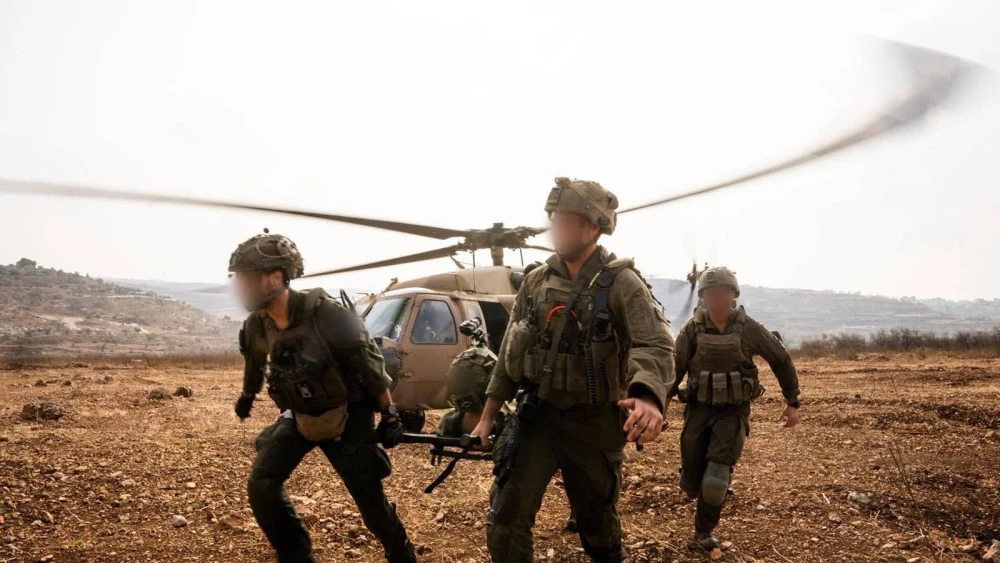
A recent large-scale exercise held by the Israel Defense Forces in Judea, Samaria and the Jordan Valley showed that the military is unprepared for an attack by unmanned aerial vehicles, Makor Rishon reported.
The Nov. 10-12 “Lion’s Roar” drill included 40 operational scenarios, 11 of which involved gliders and attack drones. Participating forces failed to effectively neutralize the UAVs, senior officers told the newspaper.
Although soldiers struggled with the UAV threat early in the drill, troops adapted by increasing aerial vigilance and avoiding movement in large groups to reduce potential casualties, according to the Nov. 13 report.
The drill—which was based on scenarios more extreme than the Oct. 7, 2023, Hamas assault, as well as attacks observed in the Russia-Ukraine war—used drones with water balloons, simulating explosive warheads.
Small drones were used to simulate attempts to lure IDF soldiers and the destruction of critical infrastructure, as well as airstrikes on rear command posts, armored vehicles, casualty collection points and special-forces teams traveling in open vehicles, the report stated.
The senior officers acknowledged that the IDF’s existing drone defenses are not sufficient and said the threat must be addressed in the military’s upcoming multi-year plan. They added that developing offensive drone units could give Israeli forces similar advantages against enemy forces.
IDF Chief of Staff Lt. Gen. Eyal Zamir, who participated in the exercise, instructed commanders to investigate and present him with solutions.
The exercise’s planners came up with “an escalating reality that is nearly impossible to cope with, and therefore the drill did not end with a 100% success,” one officer said. “The scenario was far more extreme than Oct. 7, so the units would face real problems rather than achieve a tactical ‘victory.’ We presented them with dilemmas and pressure points.”
“We will not be surprised,” he said. “There is no threat we didn’t address—everything imaginable and everything unimaginable. For matters too sensitive to carry out in the field, we used war-games,” the officer added.
The three-day exercise drilled surprise raids from the Jordanian border and inside Judea and Samaria, a scenario the IDF believes would leave local communities defending themselves until backup forces arrive.
The drill began with multiple extreme, simultaneous incidents designed to test the divisions’ limits, including hostage situations in a yeshivah and the Beit She’an municipal building, according to Makor Rishon.
As part of the exercise, Air Force pilots drilled scenarios based on Oct. 7, including difficulty telling terrorists and Israeli civilians apart, it added.
The exercise involved forces of the IDF’s Central Command, as well as “special units,” the Israeli Air Force, the IDF Technology and Logistics Directorate and other military branches and security forces, an IDF statement said on Nov. 10, adding that it was a “pre-planned” drill.
On Oct. 21, Zamir warned senior officers that terrorist elements could try to disturb the “stabilization processes” in the Middle East, particularly in Israel’s Judea and Samaria region.
The region is “in a period of significant change, which could bring new developments, and we must be prepared for all scenarios,” Zamir said during a visit to Central Command headquarters in Jerusalem.
Palestinian terrorists targeted Israeli Jews in Judea and Samaria at least 6,343 times last year, according to figures published by the Rescuers Without Borders (Hatzalah Judea and Samaria) NGO on Feb. 17.
Twenty-seven Israelis were murdered in Judea and Samaria in 2024, and more than 300 others were wounded, the group said in its annual report.
According to a July poll, two-thirds of Israelis (66%) fear another Oct. 7-style massacre, this time from Judea and Samaria. Among Jews, 77% express concern, compared to just 22% of Arab Israeli citizens.