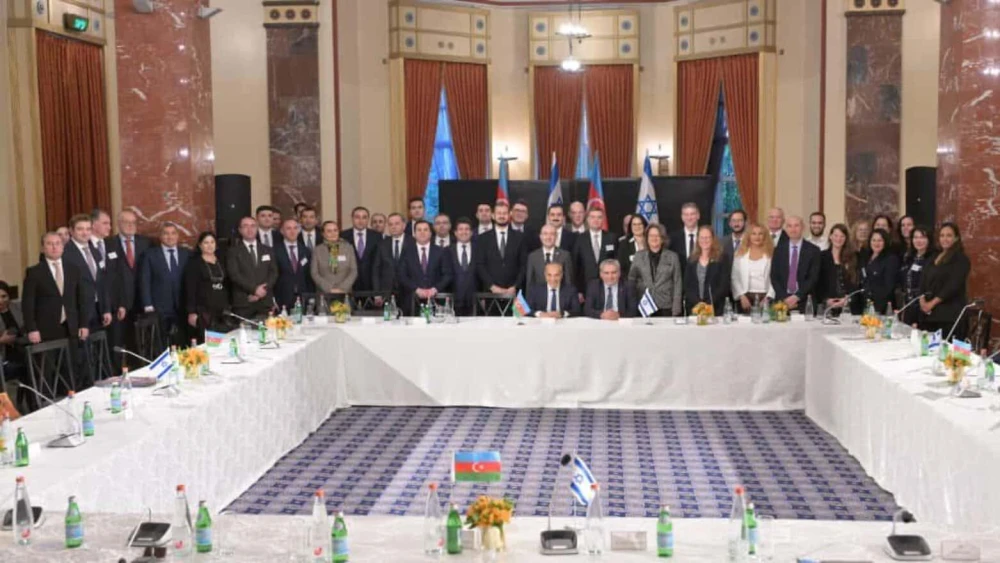
An Azerbaijani delegation led by Minister of Economy Mikayil Jabbarov took part in a joint government meeting in Jerusalem on Thursday, further strengthening diplomatic relations between the two countries.
The high-level visit, which follows the ceasefire in Gaza last month and the subsequent expansion of the 2020 Abraham Accords to the Central Asian country of Kazakhstan, comes amid burgeoning ties between the Jewish state and the predominantly Shi’ite Muslim Azerbaijan.
Jabbarov co-chaired the fourth meeting of the Azerbaijan–Israel Joint Commission with Ze’ev Elkin, a minister in the Israeli Ministry of Finance. More than 70 officials from 15 ministries and government agencies attended the meeting.
The session covered bilateral relations, cooperation in energy, trade, investment, agriculture, transport, digitalization and other fields of mutual concern.
“We exchanged views on the activities of the Joint Commission, the prospects for advancing bilateral #economic relations, and the effective realization of the existing #business partnership potential,” Jabbarov posted on X about his 36-hour visit.
The Israeli Foreign Ministry lauded the “display of friendship,” noting that the large-scale government meeting “reflected the close relations between our countries.
“A key part of our relations are economic ties, which have grown significantly in recent years,” the ministry’s Economic Division posted on X. “We welcome the strengthening of our cooperation and diversification in different sectors for the benefits of our people.”
The next meeting of the joint government commission will be held in Baku.
Israeli Foreign Minister Gideon Sa’ar, who also met with Jabbarov during his visit to Jerusalem, highlighted the increase in Israeli tourism to Azerbaijan over the last year and said he looks forward to visiting soon. The South Caucasus country has been notably free of the antisemitism that surged around the globe following the Oct. 7, 2023 Hamas-led attack on southern Israel.
Ties that bind
For Israel, ties with Azerbaijan—which shares a 428-mile border with Iran, a country that is home to tens of millions of ethnic Azeris—are of strategic importance, both as a conduit for reconnaissance and because Azerbaijan supplies nearly half of the Jewish state’s oil.
At the same time, Azerbaijan is a leading purchaser of Israeli military hardware, which helped Baku in the Second Nagorno-Karabakh War with archrival Armenia in 2020. The victory greatly strengthened Baku regionally in a time of geopolitical change.
Two years ago, Azerbaijan made history by becoming the first Shi’ite Muslim country to open an embassy in Israel, defying threats from Iran and putting its longstanding ties with Israel out in the open.