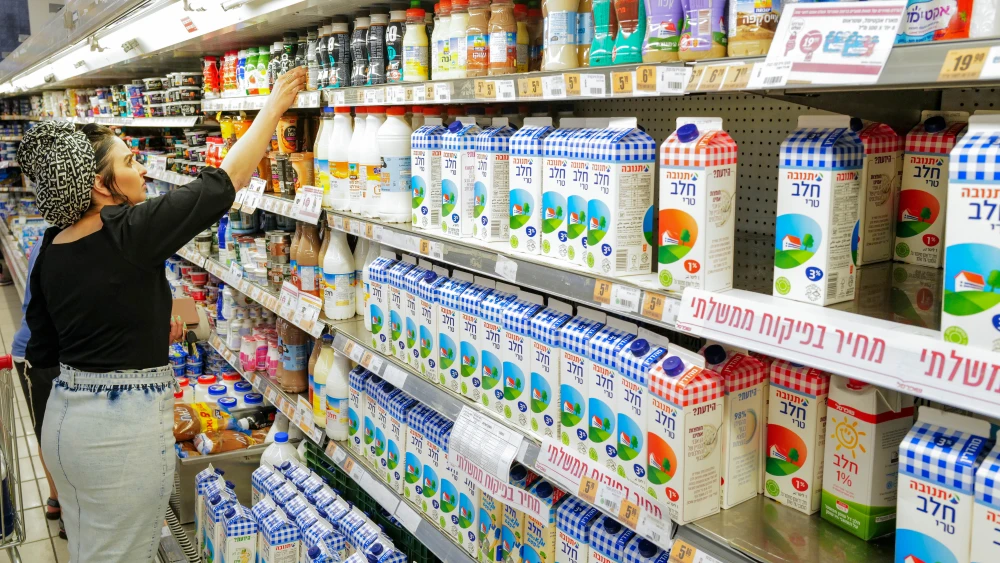
Following an announcement by Israel’s largest dairy producer, Tnuva, that it would raise prices on some products ahead of the Jewish holiday of Shavuot, supermarket chain Shufersal said it would remove certain items from its shelves.
Products set to increase in price include butter, which will rise by 4.8%, as well as unregulated long-life milk and two types of white cheese, which will increase by 1%.
Shufersal had requested that the price hike be postponed until after Shavuot, which marks the giving of the Torah and during which many observant Jews traditionally increase their consumption of dairy products.
“I congratulate every chain that tries to deal with price increases by monopolies. Unfortunately, customers still demand these products because they are part of their daily needs,” Yesh Atid lawmaker Simon Davidson told JNS on Sunday.
“The problem is not the chains, but the ministries that need to do their job, such as the Ministry of Economy and the Ministry of Finance. They are not addressing the monopolies or preventing them from raising prices in the first place,” he added.
Milk and dairy prices have been the subject of controversy for months, particularly after Israeli Finance Minister Bezalel Smotrich’s proposed reform to open the market to greater competition—aimed at lowering prices and reducing the dominance of major producers—was shelved in March.
At the time, Smotrich noted that three companies—Tnuva, Tara and Strauss—control 85% of the market and charge prices more than 50% higher than those abroad. Opening the market to imports and reducing domestic production, he argued, would have provided meaningful relief to consumers.
While Tnuva plans to implement its price increases in May, Strauss is expected to follow with hikes beginning June 1.
“There have been several price increases over the past two years, and unfortunately, each time companies sought to raise prices, they succeeded and the public paid,” said Davidson.
“If the same thing had happened in France or any modern European country, the public would have taken to the streets to protest and stop the increases. In Israel, this does not happen,” he added.
Davidson also criticized the timing of the increase, noting that Tnuva reportedly distributed a 200 million shekel ($68 million) dividend to shareholders in early 2026.
“On one hand, they are putting hundreds of millions into their pockets, and on the other, they raise prices whenever it suits them, especially when Shavuot is approaching and consumers will buy these products out of necessity,” he said.
“In my opinion, the public should boycott these companies, but the problem is the lack of competition. When there is no competition, every monopoly does as it pleases,” he added.
Davidson called for measures to increase competition as a way to curb rising dairy prices in Israel.
“We see it in banking, dairy products and meat. When there is no competition, prices keep rising, and the public pays. We have become one of the most expensive countries in the world because there is no competition,” he said.
“We need to create fair and effective competition for these large players,” he added.