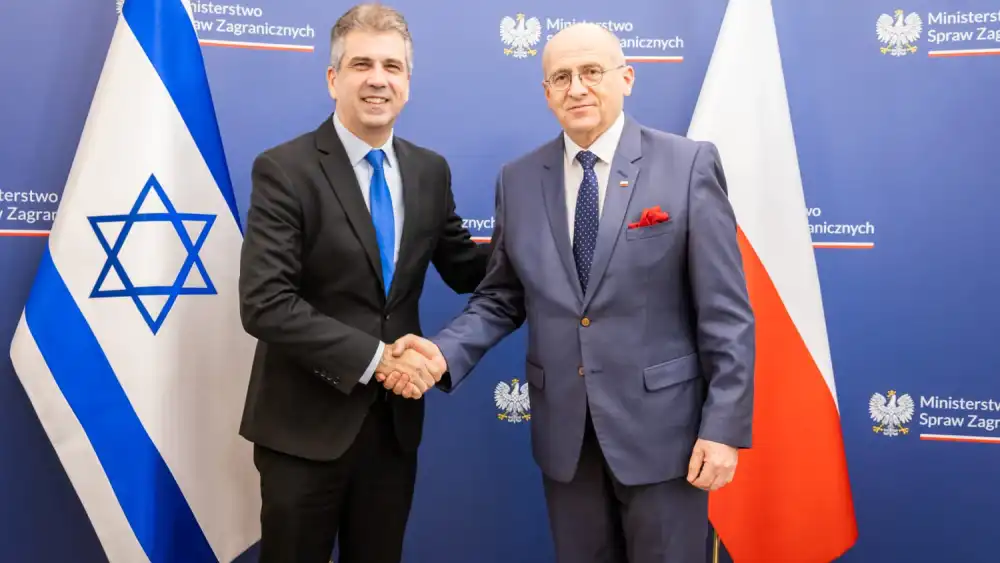
Israel and Poland announced on Wednesday that the two countries were mending ties, ending a years-long crisis that severely strained relations between the erstwhile allies.
The agreement, signed during an official visit by Israeli Foreign Minister Eli Cohen to Warsaw, will see Poland restore its ambassador to Israel, and the resumption of Israeli youth visits to Poland for Holocaust education.
After meeting with his Polish counterpart, Zbigniew Rau, Israel’s top diplomat hailed “a new chapter” in the relations between the two counties.
“We agreed on the Polish Ambassador’s return to Israel and on ending the tensions between our countries,” Cohen tweeted. “We also signed an agreement about the return of Israeli youth delegations to Poland.”
“Poland is a significant actor in Europe today, and together we will continue to promote issues such as the determined fight against Iran’s nuclear plan,” he added.
It was not immediately clear when a new Polish ambassador to Israel would be appointed. The Polish embassy in Tel Aviv has been led over the last year by the charge d’affaires.
Israel had previously restored its ambassador to Warsaw.
Israeli Prime Minister Benjamin Netanyahu on Wednesday welcomed the breakthrough.
“This decision marks a positive step forward in our diplomatic relations, and I am sure that it will lead to even closer cooperation between our two countries,” he said in a statement. “I look forward to the continuation of the dialogue and the strengthening of our relations.”
Ties between the two countries had nosedived after Poland’s government enacted laws that were seen by Israel as whitewashing Poland’s role in the Holocaust, and then banned claims for restitution of seized property by Holocaust victims and their relatives.
The overarching dispute over the Holocaust-related issues over the last several years only served to heighten a years-old difference between the two countries over the content of the educational trips, and who would handle security for the youth groups.
Until the dispute broke out, tens of thousands of Israeli teens routinely traveled to Poland on such educational trips each year, touring former Nazi camps in order to learn about the Holocaust and memorialize those murdered. The trip has long been considered a rite of passage in Israeli education and the best way to study the Holocaust.
In a further sign of the warming of relations, Israeli President Isaac Herzog is expected to visit Warsaw next month for the 80th anniversary of the Warsaw Ghetto Uprising, the armed 1943 revolt by Jews in Nazi-occupied Poland.