Newsletter
Newsletter Support JNS

Israel delivers Iron Dome defense systems to US Army

Defense Minister Benny Gantz: “I am proud that this advanced system will also protect U.S. Army troops.”

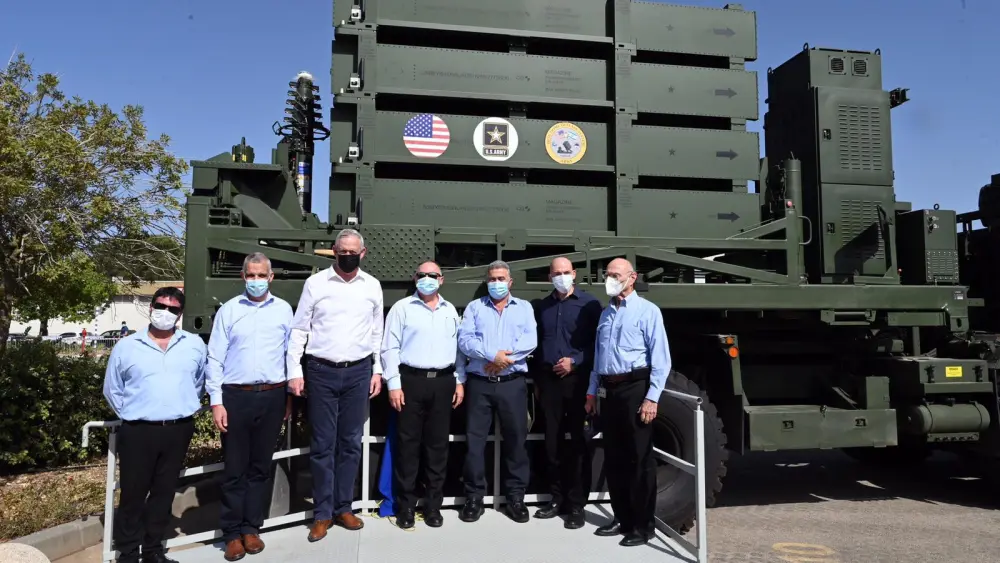
Israeli officials at the ceremony held in honor of the delivery of an Iron Dome battery to the U.S. Army, September 2020. Photo by Ariel Hermoni/Israel Ministry of Defense.

The Israeli Ministry of Defense delivered the first of two Rafael-made Iron Dome air-defense systems to the U.S. Army, the Defense Ministry announced on Wednesday.

“As a result of the effectiveness of this system, many deaths were prevented on the home front of southern Israel, and it has a significant impact on the battlefield. I am proud that this advanced system will also protect U.S. Army troops,” said Defense Minister Benny Gantz, according to a statement from Israel’s Defense Ministry.

Gantz mentioned that on his visit last week to the United States, and during his meetings with senior officials from the U.S. Department of Defense and the military, “we discussed procurement and information sharing in the field of technology.”

The United States and Israel signed an agreement in August 2019 for the procurement of two Iron Dome systems. The first battery was delivered in record time; the second battery will be delivered in the near future within the framework of the agreement.

Iron Dome has been operational in Israel since 2011 and has intercepted more than 2,400 incoming threats, stated the ministry.

With Lt. Gov. Sara Rodriguez suspending her campaign, state Rep. Francesca Hong, a Democratic Socialists of America member with a record of anti-Israel activism, and former Lt. Gov. Mandela Barnes have emerged as the Democratic Party’s leading candidates ahead of the Aug. 11 primary.
Rep. Jake Auchincloss accused President Trump and Prime Minister Netanyahu of breaking the compact underlying U.S. military assistance to Israel by launching the war against Iran.
“I want to maintain the dialogue and the conversation, because I think they need to work harder to try to figure out how to get more friends instead of creating more enemies,” the Washington Democrat said.
“The rules that they’ve been using to build these data centers were not intended for these kinds of data centers,” David Greenfield, of Met Council, told JNS. “Now they’re happening very frequently, and they’re having unintended consequences.”
She helped turn JINSA into the “very significant face of the American Jewish community to the US military,” the JNS publisher said.
The 15 still appear on the AIPAC website in a section about candidates it supports, but users are no longer offered links with which to donate to the candidates.