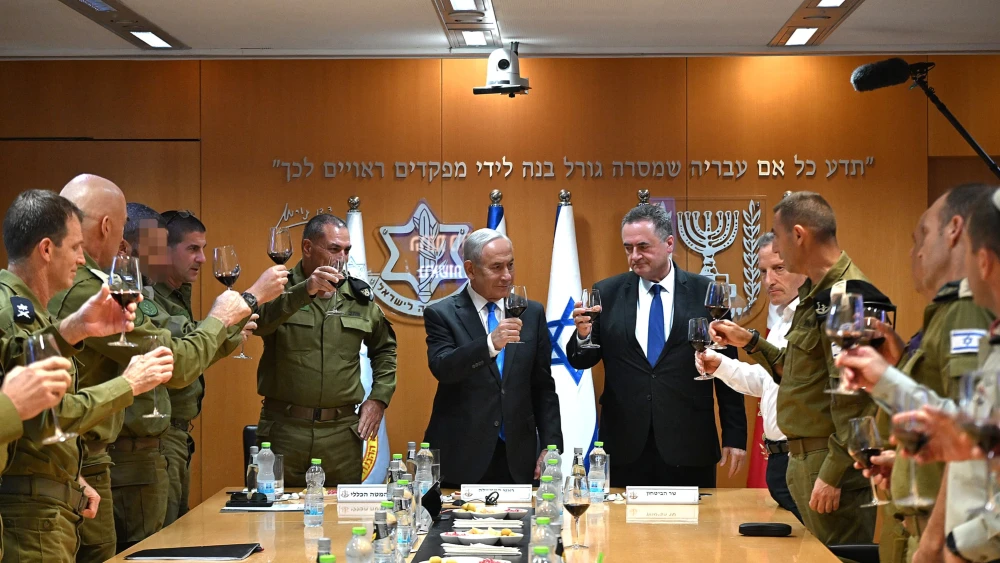
Israel is capable of toppling the Iranian regime, Prime Minister Benjamin Netanyahu said on Thursday, describing the goal as “within reach.”
“I am convinced of our ability to remove this threat once and for all; meaning, to topple this regime,” Netanyahu said at a Rosh Hashanah toast with the IDF General Staff Forum at the Kirya military headquarters in Tel Aviv. “This is the central mission still before us, but it is close. It is not impossible. It is within reach.”
Netanyahu was joined by Defense Minister Israel Katz, IDF Chief of Staff Lt. Gen. Eyal Zamir and members of the General Staff.
The prime minister said that Israel had achieved historic gains during three years of war, including in its operations against Iran.
“We faced the threat of annihilation by a regime that aspires to eradicate us and wants to arm itself with nuclear bombs to destroy us. We have pushed back this threat and other threats as well,” Netanyahu said.
Netanyahu noted that while Iran continues to attack other countries, it has refrained from attacking Israel.
“They are not just failing to attack us. They attack everyone, except us. They know our power, the force of our arm and our determination,” he said. “This regime is currently faltering. It is weaker than ever before. It is fighting for its life.”
Israeli Ambassador to the United States Yechiel Leiter said in an interview aired on Monday that although Iran has been defeated, “there’s just a little bit of a time lapse until it actually collapses.”
Leiter said U.S. President Donald Trump “has led an incredible effort to bring this regime down; I think it’s going to happen soon.”
The ambassador likened Iran’s situation to that of the Soviet Union in the ’80s. While nobody could predict the exact date of its fall, U.S. President Ronald Reagan “saw it coming,” said Leiter. “He knew that it was the end of that evil empire. It was just a matter of time.”
Israel sends stark warning amid U.S.-Iran clashes
On Thursday, Netanyahu issued a general warning.
“I say to our enemies: Do not mess with us. If you have learned anything, do not mess with us,” he said. “We have the power, the determination and the internal unity to overcome you, and that is what I wish for the people of Israel in the coming year.”
Defense Minister Israel Katz warned earlier on Thursday that an Iranian attack on the Jewish state would remove “every existing constraint” on an Israeli response, including strikes on Tehran’s civilian and energy infrastructure.
Speaking at a Rosh Hashanah toast at the Defense Ministry in Tel Aviv, Katz said Israel would, if attacked, hit Iran’s “national, military and civilian infrastructure,” and send the Islamic Republic “back deep into the Stone Age and darkness.
“The ayatollah regime in Iran knows very well why it is not attacking Israel: After we struck them powerfully twice [in June 2025 and February 2026], dealt a blow to the nuclear program, eliminated [Supreme Leader Ali] Khamenei, and severely damaged their strategic capabilities,” Katz said.
He said Israel had identified indications that severe economic pressure and concern over internal unrest and a possible collapse of the regime could drive Iran toward “desperate steps.”
“Israel is very well prepared, defensively and offensively, for every possibility, and the IDF is ready to carry out the mission,” Katz said.
On Wednesday, Trump suggested renaming the Strait of Hormuz the “Trump Strait,” asserting that the strategic waterway was now under American control. Separately, he said that U.S. forces had destroyed Iranian equipment installed along the Strait of Hormuz during overnight strikes.
“We took out all of the new equipment that they tried to build along the Strait of Hormuz, some defensive, some offensive,” Trump said. “We’re prepared to do another one [such operation] anytime we want.”
His comments came after U.S. Central Command on Tuesday completed a wave of strikes targeting facilities operated by the Islamic Revolutionary Guard Corps across Iran.
American forces attacked IRGC air-defense sites, radar installations, maritime assets, communications centers and mine-laying capabilities.
CENTCOM said the operation was carried out in response to recent Iranian attacks on commercial shipping in the Strait of Hormuz and U.S. service members deployed in the region.
Meanwhile, Iran’s attacks in the region continue, with Kuwait’s military saying on Thursday that its air defenses were “confronting hostile missile and drone attacks” following “sinful Iranian aggression.”
The army said any explosions heard were the result of interceptions.
“Everyone is requested to adhere to the security and safety instructions issued by the competent authorities,” it added.
The renewal of direct hostilities between the U.S. and Iran began on Sunday when the U.S. military attacked Iranian rocket launchers at the Strait of Hormuz in its first military action in a month, breaking a lull in fighting during a six-month intermittent conflict. In response, the IRGC fired ballistic missiles at U.S. bases in Jordan.