


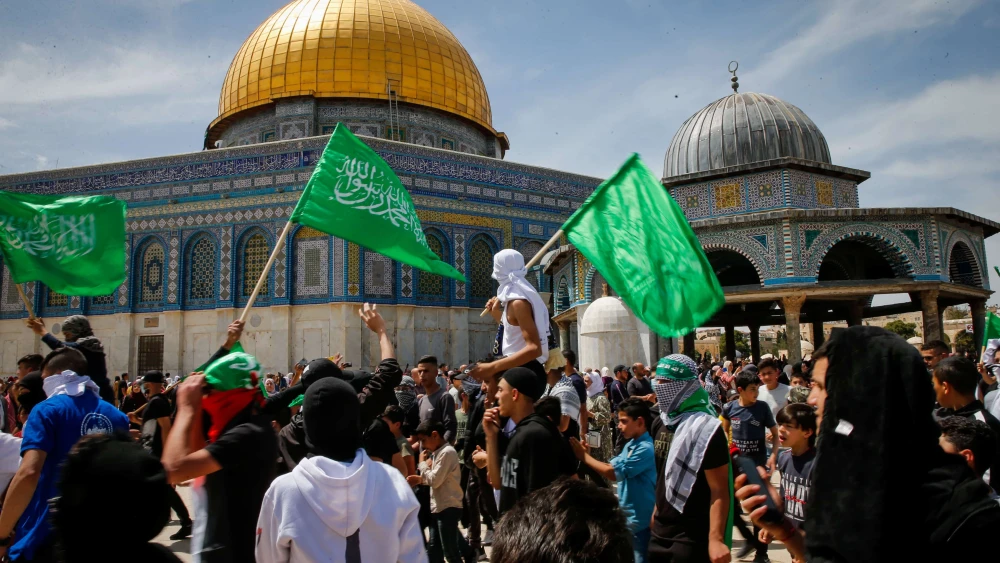
The Israel Police said Monday they would prevent attempts by Hamas to stage a triumphal display on Jerusalem’s Temple Mount during the first Ramadan since the Gaza truce, expected to begin in mid-February.
“The goal is to maintain security and public order” during the Islamic month of fasting, Chief Supt. Ido Katzir told members of the Knesset National Security Committee. He added: “For us, Ramadan is taking place against the backdrop of war—that is our working assumption.”
“We want to allow observance of the holiday and prayers on the Temple Mount, while at the same time preventing celebrations or the creation of some ‘victory’ picture, which has no place. We won’t allow this,” he said.
The police representative told lawmakers that the force was carrying out preventative operations ahead of Ramadan, including detaining terrorists and those inciting violence.
As in past years, Israeli police have recommended limiting the number of Palestinian worshippers from Judea and Samaria allowed to enter Jerusalem, with access restricted to older individuals, Katzir stated.
“This is one of the most significant cornerstones in balancing religious observance with maintaining security,” the superintendent declared.
Meanwhile, Israel Defense Forces Lt. Col. Shimon Orkabi told the panel that the army was working to prevent a possible escalation by terrorists along the Jewish state’s pre-1967 boundaries with Judea and Samaria.
“Preparations are inter-organizational and arena-based and provide a response. We are carrying out preemptive counter-terrorism actions to reduce threats while reinforcing the Seam Line ahead of Ramadan,” he said, referencing areas along the Judea and Samaria security barrier.
Israel’s National Security Committee chairman Tzvika Foghel (Otzma Yehudit Party) noted that the Islamic holy month over the past two years took place against the backdrop of war, and that this year, security forces would need to manage the fallout of the “War of Redemption.”
The committee chair said several factors could affect security, including unemployment in Judea and Samaria, rising crime in the Negev, Galilee and mixed Jewish-Arab cities, the threat posed by lone-wolf attackers and the potential for incitement by Iranian-backed terror organizations.
“Religious events can be used to incite the masses,” continued Foghel, a former senior military officer who served as chief of staff of the IDF’s Southern Command. He stressed the importance of cooperation between security agencies, calling this “the formula for success.”
Ahead of last year’s Ramadan celebrations, Hamas terrorists aimed to incite a wave of attacks in Jerusalem, including on the Temple Mount.
In 2025, the Israel Police recommended that 10,000 Muslims at a time from Judea and Samaria be allowed to pray atop the Temple Mount—Judaism’s holiest site—which is also home to the Al-Aqsa Mosque.
The government subsequently approved the entry of a limited number of Muslim worshippers from Judea and Samaria on the Fridays during Ramadan, as part of the tens of thousands praying there each week.
According to the framework approved by the government, Palestinian men aged 55 and over, women aged 50 and over, and children up to the age of 12 were able to enter the capital after undergoing security checks.
Hamas at the time said that it viewed restrictions on the number of Palestinian worshippers as “a dangerous escalation and precedent aimed at undermining freedom of worship at Al-Aqsa Mosque.”
Ramadan, the Muslim month marked by fasting from dawn to dusk, is expected to begin in mid-February, subject to the sighting of the new moon.



