Newsletter
Newsletter Support JNS

Israeli fourth-graders show dramatic drop in reading ability

The Jewish state still places above the global average.

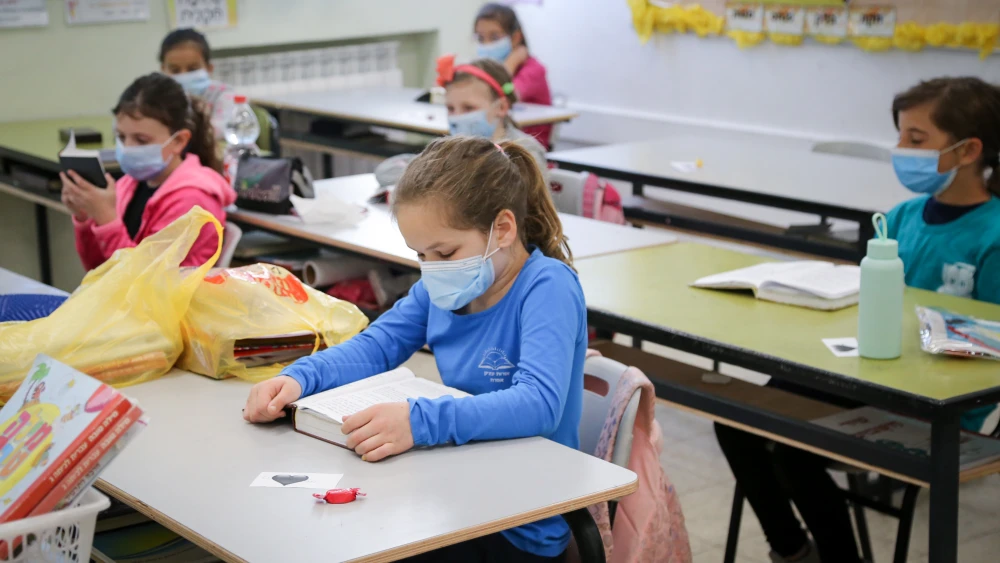
A class at the Orot Etzion middle school in Efrat, Judea, May 3, 2020. Photo by Gershon Elinon/Flash90.

Israeli fourth-graders displayed a dramatic drop in reading proficiency in the latest Progress in International Reading Literacy Study (PIRLS) published on Tuesday.

The study was conducted over two years during the COVID-19 pandemic in 57 countries and eight benchmarking entities. PIRLS 2021 was the fifth assessment performed every five years since 2001.

According to the data made available by the Israeli Education Ministry, students in the Jewish state had the worst performance in more than 20 years with high reading skills decreasing by 11% and low reading skills increasing by 8%.

Some 5,000 Israeli students in approximately 200 schools participated in the study.

“The data shows the crisis in which the education system is [experiencing]. Our mission is to get the system back on track, with an emphasis on the outstanding students and to help the age groups that were particularly affected by the [pandemic]. We have a great challenge, and a great responsibility,” Education Minister Yoav Kisch said.

The Education Ministry said that following the PIRLS results they were crafting a plan to strengthen language studies, and that “the program will be introduced soon and will start already in the coming academic year.”

Despite the decline, Israel still places above the global average—ranking 30th among OECD countries. Most countries experienced a decline with a global average of eight points lost. Only Egypt, Oman, Singapore, Hong Kong and France saw improvement.

In a draft report delivered to the U.S. president, the commission also called for improved religious accommodations for U.S. service members.
Salah Salem Sarsour, accused of concealing Israeli military court convictions on immigration forms, argued his detention was part of a Trump admin effort to target the pro-Palestinian movement.
CENTCOM stated that the strikes targeted missile, drone and radar facilities after the Islamic Republic attacked a cargo ship in the Strait of Hormuz, calling the assault a violation of the ceasefire.
Now that the primaries are over, “we hope that everyone will come together and be united,” Christine Quinn, chair of the executive committee of the New York State Democratic Party, told JNS.
An Iranian official warned on Friday that the safety of ships passing through the Strait of Hormuz without Iran’s permission “cannot be guaranteed.”
“We have put the train back on the tracks and going in the right direction,” said Yechiel Leiter, Israeli ambassador in Washington. “Final destination? Peace between our two countries.”
Benny Gantz, JNS editor-in-chief Jonathan S. Tobin, Gilad Erdan, Mosab Hassan Yousef, Nissim Black and leading voices in security, diplomacy, media, law and Jewish communal affairs headline the summit’s third day in Jerusalem.