


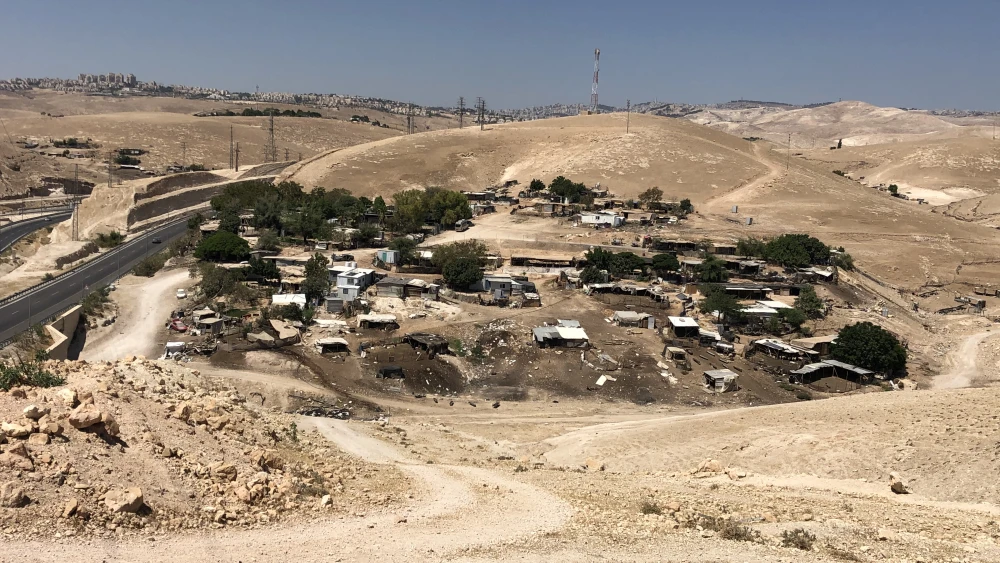
Israel’s High Court of Justice on Sunday rejected a petition to immediately demolish the illegal Bedouin Arab outpost of Khan al-Ahmar.
In dismissing the 2019 petition, the judges sided with the government’s position that current security concerns and foreign policy considerations trump the dismantling of the settlement, which is located in a sensitive area in Judea adjacent to a major highway.
Regavim, an NGO that pursues legal action against illegal Arab construction in Judea and Samaria and other regions of Israel, slammed the decision as a capitulation to international pressure that sets a dangerous precedent for the Israeli government, leading the state “to the brink of anarchy.”
The High Court of Justice rejected Regavim's sixth petition in the Khan al Ahmar saga yesterday.
— Regavim (@RegavimEng) May 8, 2023
Read our response here: https://t.co/IM9lD95guZ pic.twitter.com/xL9sFPgszF
“This decision’s impact goes far beyond this particular illegal Palestinian outpost. This most recent High Court decision illustrates that in today’s judicial system, some are more equal than others,” Regavim said in a statement.
It was the sixth petition against Khan al-Ahmar, with the NGO questioning why the High Court went against the state’s arguments of political considerations when it came to the evacuation of Jewish outposts such as Amona, Netiv Ha’Avot and Ramat Migron.
“The ground rules for Israeli retreat have been laid, and foreign concerns now have official confirmation that the Israeli government will back down from its own stated policies and national interests when pressure is applied,” stated Regavim.
“The current terminology for today’s decision is, ‘Shame!’—shame on the government of Israel and shame on the High Court of Justice.”
The legal battle over Khan al-Ahmar began in 2009, when Regavim filed its first petition against what it called “the Palestinian Authority’s flagship outpost in the systematic takeover of Area C” of Judea and Samaria. The encampment, inhabited by fewer than 200 members of the Jahalin tribe, is built on state land located within the city limits of Ma’ale Adumim, east of Jerusalem.
In May 2018, the High Court of Justice determined that Khan al-Ahmar residents could be evicted, but the government has repeatedly requested and received delays on a decision on the demolition—the most recent request being the ninth. The United Nations, European Parliament, Amnesty International and other foreign bodies have weighed in, saying that the eviction would violate international law and could constitute a war crime.
Israel has readied a relocation site for the Khan al-Ahmar residents some nine miles west of the current site with infrastructure in place including a sewage system, water and electricity.



