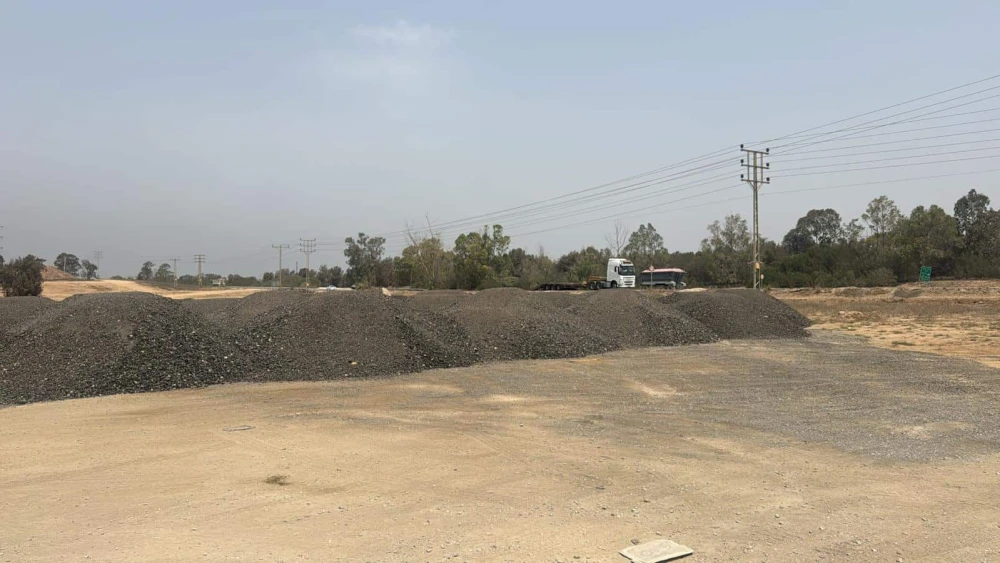
The concrete barriers that separate Kibbutz Nahal Oz from north and central Gaza are being taken down, after Israel’s defense establishment assessed that the threat of anti-tank and mortar fire from the Strip has been eliminated, Hebrew media reported on Sunday.
Nahal Oz, located just southeast of Gaza, sits opposite to the so-called “Ridge 70,” a natural mound that grants terrorists in the Gaza Strip an elevated point from which they can fire at the community.
However, the present deployment of the Israel Defense Forces in the security buffer zone along the Strip’s border with Israel, coupled with the destruction of the terrorist infrastructure on Ridge 70 during the War, have led the defense establishment to conclude that this threat has been eliminated, according to Israel’s Channel 12 News.
The walls, including an especially large one at the Nahal Oz Junction, were erected in May 2023 with the launch of the IDF’s “Operation Shield and Arrow” against the Palestinian Islamic Jihad terrorist organization.
The IDF is expected to continue dismantling concrete walls in other areas throughout the Gaza Envelope, the report added.
Meanwhile, the country’s Tkuma Directorate announced on Sunday that a route of Highway 25 from Sa’ad Junction to Kibbutz Nahal Oz will reopen by the end of September, after five years of closure.
The directorate is a government agency established in 2023 to manage the extensive rehabilitation efforts in the region, that suffered heavy damage during the Hamas-led Oct. 7, 2023 massacre.
Highway 25 is Israel’s longest transverse road, running 113 kilometers (~70 miles) from the Gaza border near Nahal Oz to Ha’Arava Junction near the southern Dead Sea.
Before its closure due to security concerns, it served as the main entrance to the kibbutz.
Nahal Oz chairman Ilan Morag said he was “pleased about the reopening of Route 25 at the end of the month. Restoring traffic to the main entrance to the kibbutz symbolizes for us the beginning of a return to normal life. We are back on the right track—and this reopening is not only physical, but also emotional. It serves as a symbol of the kibbutz’s recovery and renewed growth.”
According to Tkuma Director General Aviad Friedman, “The reopening of Route 25 after five years is not just a transportation project—it is an important step in Nahal Oz’s journey of recovery. We are working tirelessly, in cooperation with government ministries, the IDF and local authorities, to restore infrastructure, security and hope for a full life here in the Gaza border region. The renewed road symbolizes for us the true beginning of coming home.”
Despite the preparations for the residents’ return, 45 families—among them bereaved families, children of those kidnapped into Gaza and families with small children—requested an extension of the evacuation period due to renewed fighting in the Palestinian enclave, according to Ynet.
Israel’s High Court of Justice last month rejected a petition submitted by 120 Nahal Oz residents, out of about 450 in total, against the government’s decision to end their evacuation period.
Ynet cited one of the families as saying in a letter that “the renewal of fighting requires us to face reality. Our children should not live in a war zone.”
Also on Sunday, Kibbutz Nir Oz marked its first house demolition as part of reconstruction efforts of the town, adjacent to Gaza’s southern border. Many homes in the kibbutz were heavily damaged during the Oct. 7 attack and have since stood untouched.
Renovation efforts in nine homes in the kibbutz have concluded in recent days, where families and individuals will stay temporarily during the reconstruction and rehabilitation efforts, according to Channel 12.