Newsletter
Newsletter Support JNS

Liberman: US aid plan for Gaza ‘very, very negative’

“Humanitarian aid should not have been allowed to enter since the start of the war, as long as our hostages are rotting in Hamas’s tunnels,” he told JNS.

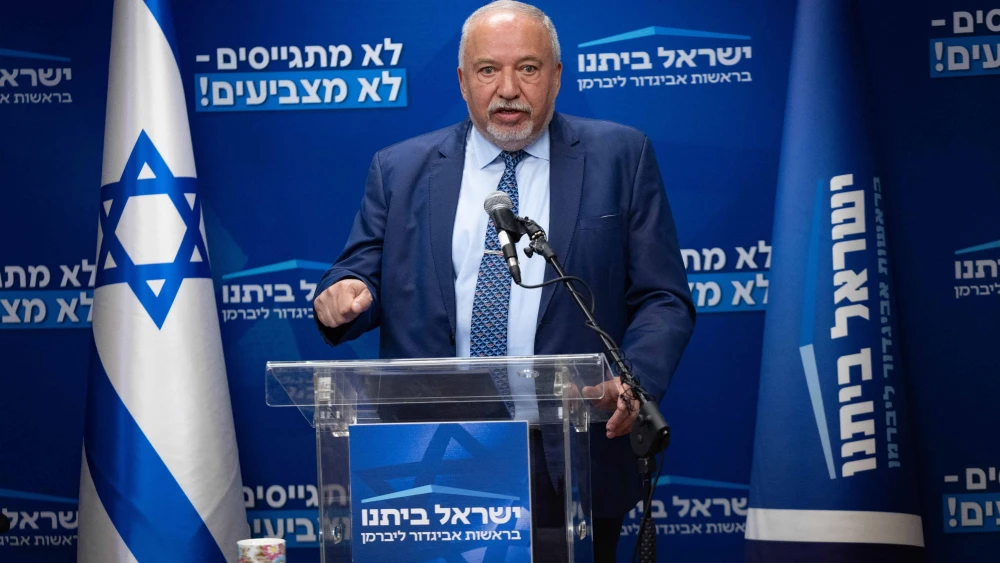
Yisrael Beiteinu Party leader Avigdor Liberman leads a faction meeting at the Knesset in Jerusalem, May 5, 2025. Photo by Yonatan Sindel/Flash90.

Avigdor Liberman, leader of Israel’s opposition Yisrael Beiteinu Party, on Monday denounced the Trump administration’s plan to let aid supplies into the Gaza Strip as a “very, very negative development.”

“In my opinion, humanitarian aid—of any kind—should not have been allowed to enter since the start of the war, as long as our hostages are rotting in Hamas’s tunnels,” Liberman stated in response to a question from JNS at his party’s faction meeting at the Knesset in Jerusalem.

“We just need to say it out loud to everyone and stand by it,” Liberman said. “You want humanitarian aid? First, return the hostages, then we’ll talk. And therefore, for me, this is a very, very negative development.”

Fifty-nine abductees remain captive in Gaza, according to official Israel Defense Forces figures. It is believed that up to 24 of them are still alive, with heavy question marks over one Israeli and two foreign nationals.

Israeli Foreign Minister Gideon Sa’ar on Sunday stressed the government’s full backing of the American-led humanitarian plan for the Strip, which was announced on Friday by U.S. Ambassador to Israel Mike Huckabee.

“Humanitarian aid will be facilitated by a private fund—based on the principles laid out by the U.S. administration,” Sa’ar said, adding that the plan will enable aid “directly to the people” and not to Hamas terrorists.

Washington’s plan is “based on international humanitarian law and its principles, which we are committed to. And we would like to cooperate with as many countries and NGOs as possible on the matter,” he added.

Akiva Van Koningsveld is a news desk editor for JNS.org. Originally from The Hague, he made the big move from the Netherlands to Israel in 2020. Before joining JNS, he worked as a policy officer at the Center for Information and Documentation Israel, a Dutch organization dedicated to fighting antisemitism and spreading awareness about the Arab-Israel conflict. With a passion for storytelling and justice, he studied journalism at the University of Applied Sciences Utrecht and later earned a law degree from Utrecht University, focusing on human rights and civil liability.
Originally from Casablanca, Morocco, Amelie made aliyah in 2014. She specializes in diplomatic affairs and geopolitical analysis and serves as a war correspondent for JNS. She has covered major international developments, including extensive reporting on the hostage crisis in Israel.
“Public pressure, spirit and resolve have won,” Tzav 9 chairwoman Reut Ben-Haim said.
This week’s meetings will test a U.S.-brokered plan for IDF pullbacks and Lebanese army “pilot zones” tied to removing the threat from the Iranian proxy.
The French president commemorated the Jewish officer who was falsely charged and convicted 120 years ago in a case that tore French society apart.
“There have been a lot of asks and requests from the member states,” the bloc’s top diplomat said.
“As long as the other side violates its commitments, Iran will also refrain from implementing its obligations,” a spokesman said.
“Haredim for Medicine” was established with the aim of enabling the Haredi community to integrate into medical studies.